
- PRICING
- LIVE QUOTES
- LEARN
- HELP


EN
The trillion-dollar computing power Hong Feng supported the semiconductor bull market! 800 billion US dollars is an “American illusion” global AI capital spending has entered the trillion-dollar era
Zhitong Finance App learned that as AI application leader Anthropic plans to sign a six-year AI computing power lease agreement with Nscale for 45 billion US dollars to lock in about 460 megawatts of computing power resources based on the Nvidia Vera Rubin system, and Nvidia's latest quarterly revenue increased 106% year over year to 96.2 billion US dollars, data center business revenue increased 117% to 89 billion US dollars. What is even more shocking is the heavy forecast given by Nvidia's management led by Huang Renxun — expected revenue for the 2028 fiscal year ending January 2028 A significant increase of about 70%. In addition, South Korea's exports in July increased 62.8% year on year to 98.89 billion US dollars, of which semiconductor exports increased 178.8% to 41.01 billion US dollars. These latest data at the AI computing power industry chain level can be said to have jointly highlighted that global demand for artificial intelligence computing power is still far from peaking.
Precisely based on the AI computing power industry chain and Nvidia's performance, and the positive signals of AI computing power demand released at the latest Hot Chips conference, the research department from Wall Street financial giant Goldman Sachs recently restored the “capital expenditure of American hyperscale cloud service providers (i.e. hyperscalers)” well-known in the market into a true “global AI investment.” Goldman Sachs's previous compilation of $794 billion not only omits private AI companies, Asian companies, and non-US projects, but also incorporates traditional capital expenditure that is not entirely used for AI; Goldman Sachs's latest forecast for 2026 will be about 1 trillion US dollars of global AI investment, of which about 581 billion US dollars will actually occur in the US.
Goldman Sachs's latest estimates also show that the cumulative global AI investment since 2022 is expected to reach a record $1.8 trillion by the end of 2026, and the leading indicators are still at the high end of the range since 2022, which means that no recent capital expenditure inflection point has occurred.
Recently, the Philadelphia Semiconductor Index, which has the title of “AI computing power weather vane,” and Korea's benchmark stock index, the Korea Composite Stock Price Index (the Korea KOSPI Index), have all shown a strong rebound driven by positive news in the industry chain. Based on the closing calculation on August 28, the PHLX Semiconductor Index (SOX) reported 11,469.66 points, rising 61.93% during the year; the index once retraced more than 20% from the June high in July, then rebounded about 21% from the low in late July, and re-entered a technical bull market in mid-August. KOSPI reported 6,788.88 points, up about 61.1% from 4,214.17 points at the end of 2025; it once plummeted by about 39% from a high in June to a low on July 30, but it rebounded nearly 22% in just ten trading days, once again meeting the technical definition of a bull market.
These two major stock market benchmark indices together prove that the main profit line of the AI computing power infrastructure investment theme was not broken by the AI deleveraging storm and the extreme congestion position clearance storm during July, but there is still clear room until the previous high. A return to a “technical bull market” does not mean that the risk of excessive concentration of positions has disappeared in terms of volatility and valuation.
Goldman Sachs: AI capital spending officially enters the trillion-dollar era
The most commonly cited artificial intelligence (AI) investment estimate is a prediction of AI capital expenditure for US hyperscale cloud service providers (i.e. hyperscalers). According to Wall Street analysts' consensus, these US tech giants are expected to spend around $800 billion this year.
However, Goldman Sachs Research notes that these estimates have several flaws. They don't include investments in AI computing power infrastructure by well-known private companies or companies outside the US — including large Asian tech companies. Not all capital expenses of hyperscale cloud service providers are necessarily related to AI. Furthermore, large US tech companies generally do a lot of business around the world, which means that some of their investments take place outside the US.
Goldman Sachs Research adjusted the capital expenditure channels of widely quoted US hyperscale cloud service providers to arrive at a more comprehensive estimate. Joseph Briggs, co-head of the Global Economy Team, wrote in a report that the forecast shows that global AI-related investment will reach $1 trillion in 2026, of which the US is 581 billion US dollars.
These extended caliber estimates show that the $794 billion hyperscale cloud service provider capital expenditure forecast commonly quoted by the market may have underestimated the total global AI capital expenditure of about 200 billion US dollars. At the same time, the $794 billion figure may also overestimate the US investment in AI by about $200 billion.
After incorporating private enterprises, Asian industrial chains, and overseas projects, the scale of AI investment clearly surpassed the caliber of traditional US hyperscale cloud service providers. Global AI investment is expected to exceed $1 trillion, providing real capital expenditure and profit support for the Philadelphia Semiconductor Index and KOSPI to return to a technical bull market. Goldman Sachs's new approach reveals that the scale of AI investment is being systematically underestimated, which means that there is still room for improvement in semiconductor, data center power chains, and AI factory token resource requirements.
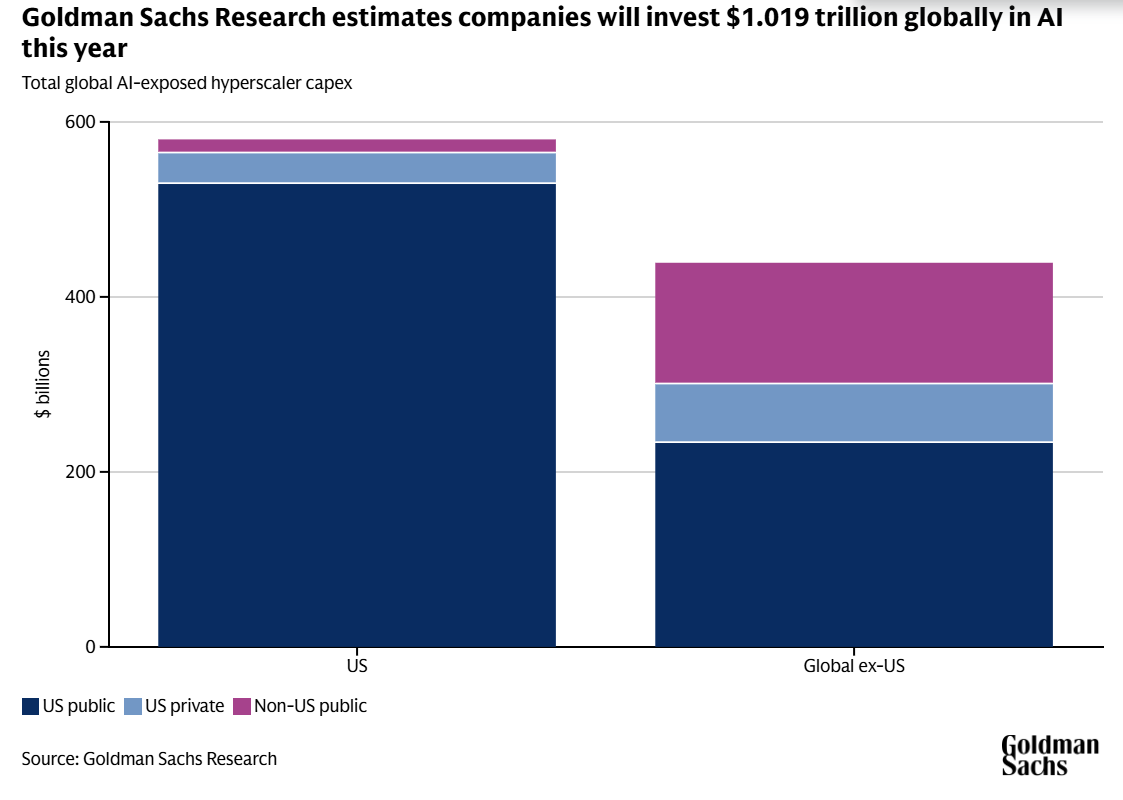
Goldman Sachs Research has expanded the capital expenditure indicators for hyperscale cloud service providers frequently cited in the market through the following key aspects:
Our economists included capital expenditure forecasts for listed companies in the US other than hyperscale cloud service providers and included in Goldman Sachs's AI-related stock basket. They also collected media coverage on key private corporate capital expenditures in the AI ecosystem.
Goldman Sachs Research also included capital expenditure forecasts for companies with AI business exposure outside the US.
Our economists adjusted the total capital expenditure by deducting the 2022 capital expenditure level from the total capital expenditure of US hyperscale cloud service providers. (This adjustment is based on our stock analysts' judgment that almost all additional capital expenditure since 2022 has been invested in AI projects.) For the private companies included in the statistics, they also attributed all of their capital expenditure to AI. For companies with low direct exposure to AI and non-US companies, Goldman Sachs Research also assumes that their capital expenditure above the 2022 level is all related to AI.
As long as conditions permit, Goldman Sachs Research will eliminate financial leases to prevent these projects from double calculating AI computing power and hardware capital expenses of other companies.
To estimate where the investment actually occurred, Goldman Sachs Research used data on the locations of announced investment projects, mainly from US hyperscale cloud service providers. Our economists also assume that AI investments by most other non-hyperscale cloud service providers — including private companies and global enterprises — follow a similar geographical distribution pattern, but that major AI-related companies in China and South Korea invest outside of the US.
The team of analysts led by Briggs added that these estimates rely on assumptions that are difficult to verify. For some companies that do not disclose property, plant and equipment investments separately from financial leases in capital expenditure statements, there is also a certain risk of double calculation of AI capital expenses. Therefore, Goldman Sachs Research used two other methods to cross-check the estimated results.
In order to obtain an alternative indicator of overall AI investment, our economists observed the actual implementation of gross profit and forecast revisions of listed companies participating in AI construction compared to the 2022 forecast. They also use official government data to track the increase in nominal AI investment, and use global trade data and the observed relationship between US imports and total AI investment to estimate the total investment scale of other economies.
The speed of investment shown by these two cross-checks is very close to the capital expenditure path of the extended hyperscale cloud service provider preferred by Goldman Sachs Research. Both cross-checks show that the total global investment in AI will reach about 1 trillion US dollars in 2026, while the US will be slightly less than 600 billion US dollars.
Analysts such as Briggs wrote that although there are slight differences in estimating the cumulative investment scale of the various methods over the years since 2022, the average results show that by the end of this year, the total cumulative investment in AI starting in 2022 will reach 1.8 trillion US dollars.
Briggs wrote, “The outlook for AI capital expenditure growth — including how high the share of AI investment in GDP will eventually rise and when capital expenditure growth will slow — is a key source of uncertainty in the current macro market.”
Goldman Sachs Research has extended its preferred AI investment estimates forward to forecast total AI investment as a share of US GDP by 2028. According to these estimates, AI capital expenditure will rise from 1.8% of US GDP in 2026, global AI investment accounting for 0.9% of global GDP during the same period, then to 2.5% of US GDP in 2027 — a similar global indicator of 1.3%, and further rise to 2.8% of US GDP in 2028 — a similar global indicator of about 1.4%.
The Briggs team wrote, “These levels are consistent with the peak investment pulse of 2% to 5% of GDP observed in previous general-purpose technology construction cycles. Although our US portfolio strategy team has indicated that the market's consensus forecast for capital expenditure in 2027 may be too conservative, even if the forecast is drastically raised, AI investment as a share of GDP will remain stable within the historical range observed in previous technology cycles.”
To estimate when the growth rate of AI-related capital expenditure will slow down, Goldman Sachs Research said that it is most appropriate to use a “dashboard approach”. Our economists have compiled a wide range of leading indicators — including imports of semiconductor manufacturing equipment from Taiwan and South Korea, relevant purchasing managers' index indicators and their segments, import prices, and memory purchase prices and graphics processor rental prices — to determine whether an economic slowdown is imminent. Our economists have found that the selected indicators can provide leading information on the growth rate of AI capital expenditure in the US.
The Briggs team wrote: “As far as the capital expenditure outlook is concerned, the good news is that all leading indicators are near the upper end of the fluctuation range since 2022. This pattern shows that growth prospects remain strong in the near future.”
The bull market trajectory of the AI chip superleader and the global HBM storage leader is far from over
Wall Street's target share price for the Earth's most important stock — that is, Nvidia, which has the title of “AI chip supersupremacy,” and the target share price of SK Hynix, the global leader in HBM storage, means that analysts believe that the rise in the stock price of these two major AI computing power industry chain leaders and even the AI computing power investment theme as a whole is far from over.
Wall Street analysts' unanimous bullish judgment on Nvidia and SK Hynix is that AI computing power demand, HBM shortage, and global capital expenditure will still support industry profits, while differences focus on valuation multiples, gross margin pressure, and return on capital expenditure. Wall Street's overall views on the direction of the Korean stock market are more positive and more bullish, but KOSPI is highly concentrated on Samsung and SK Hynix, which means that profit elasticity and index fluctuations will be amplified simultaneously.
Citigroup's target share price for Nvidia rose from 300 US dollars to 315 US dollars after the financial report, and for SK Hynix's target price of 3.1 million won, it is particularly advocating the deployment of AI storage terminals every time there is a pullback. Citi also maintained its 10,000 point target for the KOSPI index. The core basis is memory chip profit growth and South Korea's financial support. Goldman Sachs maintains a “purchase” and target price of 3.5 million won for SK Hynix. The core bullish logic focuses on HBM's long-term shortage, long-term supply agreements, and shareholder returns. More importantly, Goldman Sachs maintained the “increase” in the Korean stock market and the 12,000-point KOSPI index target point, believing that the sharp decline in July was an excessive correction other than fundamentals.
Wall Street is generally optimistic about the AI storage supercycle, but the ranking of stock price elasticity is closer to “SK Hynix's HBM leadership - Micron's pure storage attributes for US stocks - Samsung's catch-up and repair elasticity.” Goldman Sachs gave SK Hynix a target price of up to 3.5 million won, Citi gave 3.1 million won, and Morgan Stanley offered a target price of 2.6 million won. By the close of the Korean market on Monday, SK Hynix's Korean stock market trading price had turned up 1.27%, closing at around 1.67 million won per share. During the night trading session of US stocks on Monday, SK Hynix's US stock ADR (SKHY.US) hovered around $161.
TrendForce, a well-known research and market research agency, predicts that in 2026, server DRAM contract prices will increase by about 270%, enterprise solid-state drive prices will increase by about 235%, and HBM contract prices may still rise 70% to 140% in 2027; the combined share of DRAM and NAND in the capital expenditure of major cloud service providers will rise from 47% in 2026 to 68% in 2027.
Wall Street financial giants Goldman Sachs, Morgan Stanley, and Bank of America, which are optimistic about the long-term investment prospects of the AI computing power industry chain, have recently generally stated that the AI super bull market is far from over, but will move from the “AI chip purchase frenzy” to the second stage of “large-scale construction of AI factories” — that is, the next round of excess alpha earnings will no longer only belong to the list of the strongest leaders in the AI GPU/AI ASIC field, and will spread systematically to data centers with high-performance CPUs, DRAM/NAND/HBM storage, AI PCBs, and liquid cooling An “AI factory” level full-stack AI computing power infrastructure layer such as systems, data center optical interconnection/optical communication systems, ABF carrier/glass substrates, MLCC, data center grade electronic distribution, and extensive wafer foundry other than advanced manufacturing processes.
As Nvidia once again announces strong performance that has surpassed expectations and an unusually explosive performance outlook, the AI computing power-themed trading hotspot is likely to not only revolve around Nvidia's GPU computing power clusters, but also further accelerate its spread to the entire AI computing power industry chain, such as HBM/DRAM/NAND, COWS/3D advanced packaging, data center CPUs, high-performance network infrastructure, optical interconnection, and data center power chain infrastructure, forming a new round of “main rise” super market at the industrial chain level.