
- PRICING
- LIVE QUOTES
- LEARN
- HELP


EN
AI energy storage demand detonates lithium prices, lithium mining giant profits ushered in a “second growth engine”
The Zhitong Finance App learned that, driven by the dual demand for AI data centers and renewable energy, the global lithium market is undergoing a price revaluation triggered by the energy storage revolution. From China to Australia, lithium producers are turning this structural transformation into real money at an unprecedented rate — the net profit of Tianqi Lithium (002466.SZ) surged nearly 49 times in the first half of the year, Ganfeng Lithium (002460.SZ) reversed a loss of 500 million yuan to a profit of 4.257 billion yuan, and Australia's PLS Group turned losses into profits to achieve net profit of 526 million Australian dollars. Energy storage is growing from “marginal demand” to the core engine of lithium consumption, and the ripples of this change are reshaping the valuation logic of the entire lithium resources industry.
The collective “explosion ground” of lithium companies' semi-annual reports: Tianqi's net profit skyrocketed 49 times, and Ganfeng turned a loss into a profit
China's lithium industry's “two champions” handed over the most impressive report card in recent years. In the first half of 2026, Tianqi Lithium achieved operating income of 12.242 billion yuan, an increase of 153.32%; net profit to mother reached 4.242 billion yuan, a sharp increase of 4925.46% (about 49 times) over the previous year. The company's core asset, Greenbush Mine CGP3, has resumed production, and the sharp rise in the volume and price of lithium products has become the main reason for the performance explosion.
Ganfeng Lithium also achieved an astonishing reversal. Revenue for the first half of the year was 23.097 billion yuan, up 175.75% year on year; net profit to mother was 4.257 billion yuan, compared with a loss of 531 million yuan in the same period last year, turning a loss into a profit. The company's gross margin increased 20 percentage points to 32% year over year, and net profit margin to mother increased 25 percentage points year over year to 18%.
Australia's Pilbara Minerals turned a loss into a profit in the 2026 fiscal year ending June 30, shifting from a net loss of 196 million Australian dollars to a net profit of 526 million Australian dollars in fiscal year 2025. Annual revenue reached $1.93 billion. The company benefited from a strong rebound in spodumene concentrate prices — in March 2026, it rebounded from around $700 per ton in mid-2025 to more than $2,150 per ton.
Other lithium mining companies are also flourishing across the board. The net profit of Salt Lake Co., Ltd. reached 6.169 billion yuan in the first half of the year, an increase of more than 131%; the net profit of Shengxin Lithium Energy was 1,012 billion yuan, turning a year-on-year loss into a profit; and the net profit of Rongjie Co., Ltd. and Tibet Mining increased 1076% and 492%, respectively.
AI energy storage—the “second engine” of lithium demand is fully launched
The biggest difference between this rebound in lithium prices and previous cycles is a fundamental shift in the demand structure. Demand for lithium is shifting from “electric vehicle single engine drive” to “electric vehicle+energy storage dual engine drive”.
According to industry insiders, energy storage is expected to surpass new energy vehicles in 2026 and become the number one support for lithium demand. Globally, demand for energy storage is growing steadily: US data center development is driving up large storage procurement, rising European gas prices are driving household storage demand, and energy storage policies are frequent in emerging markets. Global energy storage installed demand is expected to reach 455 GWh in 2026, an increase of 40% over the previous year.
The explosive growth of AI data centers is becoming the strongest incremental variable in demand for energy storage. From January to May 2026, global AI data center energy storage battery shipments have exceeded 10 GWh, surpassing the total volume of 2025; the agency predicts that it will rise to 30 GWh throughout 2026. According to estimates, the computing power energy storage scenario favors the lithium iron phosphate route, so lithium demand is strongly linearly correlated with the amount of energy storage installed.
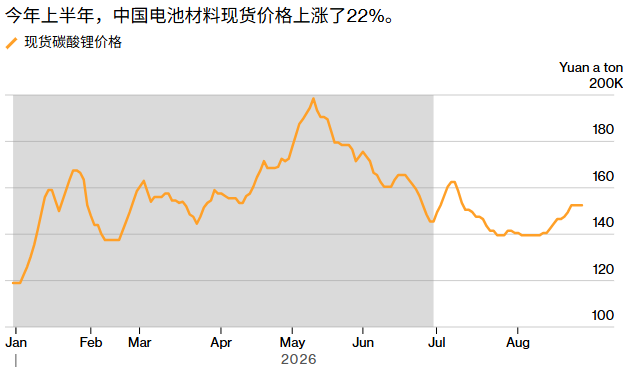
Data from the world's largest lithium producer, ALB.US (ALB.US), confirm this trend. The company said that as of May this year, global demand for lithium increased 45% year over year, supply growth lagged behind demand, and inventories continued to be tight. Albemarle's total sales for the second quarter rose 31% year on year, adjusted EBITDA surged 155% year on year, and revenue from the energy storage chemical sector increased nearly 80% year on year. Abbott CEO Kent Masters pointed out during the Q2 earnings call that strong demand for energy storage is the main driving force, and the company raised the 2026 fixed energy storage battery production forecast to 900 to 1,100 GWh.
UBS predicts that in 2026, global demand for lithium will increase 16% year on year to 1.97 million tons of lithium carbonate equivalent (LCE), with energy storage system battery demand accounting for 17%, up 60% year on year. The UBS Global Commodity Team raised the average spot price forecast for lithium carbonate in China by 18% to 200,000 yuan per ton in 2026.
Miners' judgment: from “surplus” to “tight balance”, the balance between supply and demand is tilting
Tianqi Lithium executives said during the earnings call that market supply will tighten for the rest of 2026 due to increased demand and supply “disruptors”. Overseas supply may be affected by policies and logistics, and actual supply will take some time to return to market level after some production is restarted. The stocks of battery materials held by Chinese industry companies are declining, further confirming the tight supply situation in the market.
Notably, battery material inventories of Chinese industry companies are declining, indicating tight market supply. Zijin Mining said in its financial report that there is still room for lithium prices to rise in the short term.
PLS Group achieved net profit of 526 million Australian dollars (approximately US$377 million) in the 2026 fiscal year ending June 30, reversing the previous year's loss situation. The company's actual average sales price soared 121% year over year to 1,488 US dollars per ton. We are also optimistic about the trend of lithium prices in the next few months.
Chile Mining & Chemical (SQM.US) has raised production expectations for this year, and Shengxin Lithium Energy announced plans to invest more than 476 million US dollars to build lithium sulfate plants in Zimbabwe and Nigeria.
Demand for energy storage is fundamentally changing the supply and demand structure of the lithium industry. The desire for electricity in AI data centers, the acceleration of global energy transformation, and the intensive introduction of energy storage policies in various countries have jointly upgraded lithium from an “electric vehicle metal” to a “strategic resource in the AI era.”
Abbott raised the low end of the 2030 fixed energy storage demand forecast to 1500-2000 GWh; UBS predicted a 60% annual increase in demand for energy storage batteries; and the continued decline in Chinese lithium companies' inventories — all of these signals point to a conclusion that the tight balance pattern of lithium will be difficult to reverse at least in 2026.
Institutions debate prospects
But how long can the lithium price spree last? Wall Street investment banks are giving a different answer.
UBS's “gap theory”: UBS predicts global lithium demand of 1.97 million tons of LCE in 2026, risk-weighted supply of 1.91 million tons of LCE, and there is still a shortage of 65,000 tons of LCE. UBS believes that factors such as the ban on the export of Zimbabwean lithium concentrate will continue to disrupt supply. However, UBS analysts pointed out, “Fundamentals are still strong, and we think prices are expected to rise in the second half of the year. But looking ahead, we expect supply to grow faster than demand from 2027.”
Goldman Sachs's “surplus theory”: Goldman Sachs gave a completely different judgment — the price of lithium carbonate will peak at 164,000 yuan/ton in the first half of 2026, and then revised to the LCE range of $101-16,000 per ton from the second half of 2026 to 2028. Goldman Sachs believes that in 2026-2027, the industry will add about 1 million tons of LCE supply, which is equivalent to a nearly 50% increase in demand, and that more than 60% will be released in the second half of 2026. Its high-frequency model shows that the global lithium market will experience an oversupply of 20-22% from the second half of 2026 to 2027.
Jefferies, on the other hand, believes that the month-on-month increase in current battery production plans indicates strong market demand. Analyst Shuhang Jiang said, “The supply expansion/restart is ongoing, but we are less concerned about the second half of 2026 than 2027 because it will take some time to enter the market. However, market expectations may exceed the spot market”.