
- PRICING
- LIVE QUOTES
- LEARN
- HELP


EN
The yen once again fell below the 160 mark, and the market kept a close eye on the 161 intervention line
The Zhitong Finance App learned that the exchange rate of the yen fell below the 160 mark against the US dollar, highlighting its vulnerability to further weakening, and the risk of the Japanese authorities interfering again in the market. Although the specific intervention threshold is unclear, strategists warned on Monday that the price that would trigger a new round of intervention could be around 161, followed by the 162-163 range. They still believe that, apart from buying time, such actions are unlikely to actually reverse the decline, as the yen has already taken back most of the gains made by the record intervention at the end of July.
The latest round of decline in the yen stemmed from the sharp strengthening of the US dollar last Friday because the market expected US interest rates to rise, which further confirms the view that the trend of the yen is largely uncontrolled by Japan. Since the US and Japan implemented the first joint purchase of yen since 1998 in July, the exchange rate of the yen against the US dollar failed to break through the 155 mark. Since then, the yen has been under pressure again.
The exchange rate of the yen against the US dollar once again fell below the 160 mark
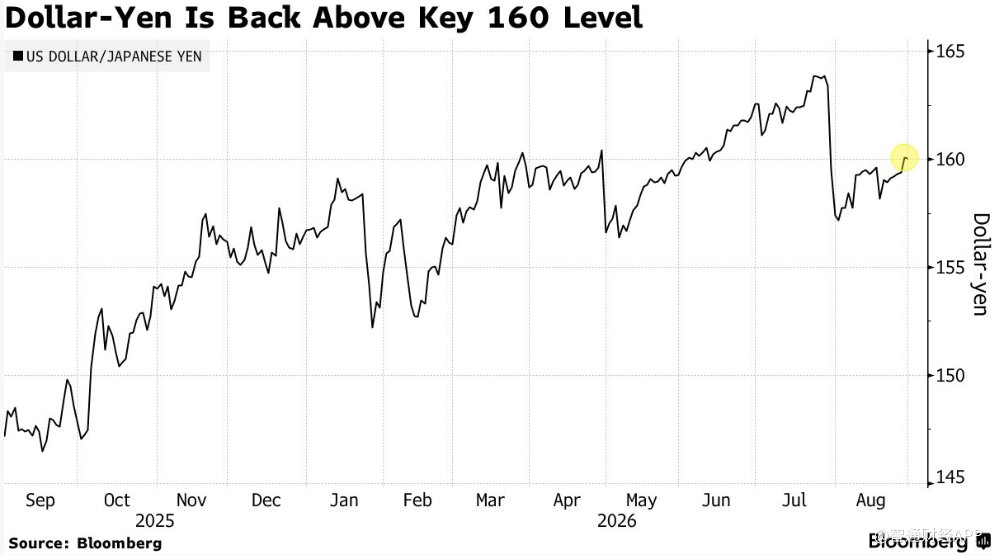
Rinto Maruyama, senior interest rate and foreign exchange strategist at SMBC Nikko Securities, said, “In terms of key prices, we must first focus on 161, followed by the 162.9-163.3 range. This is the range where the authorities last intervened.” But at the same time, he pointed out that during the last round of intervention, the government “paid considerable attention to maintaining its surprise”, so the authorities could take action at any time.
On Monday, the exchange rate of yen to the US dollar was reported at 159.77, and last Friday it was about 160.09.
Expectations of interest rate hikes were met, and the effects of the intervention were discounted, and the Bank of Japan was “forced into a dead end”
According to data from Japan's Ministry of Finance, in the past month, Japan invested a record 96.4 billion US dollars to support the yen, which fell to a 40-year low. Japan's Finance Minister Katayama Satsuki and US Treasury Secretary Scott Bessent both said they are willing to act again if necessary.
Japanese officials have stated many times that the key to evaluating whether intervention is needed is the speed and degree of disorder of currency fluctuations, not any specific exchange rate level. Bessent also said that he expects Bank of Japan Governor Ueda Kazuo to “make the right choice” on monetary policy, while describing the recent trend of yen as “quite manageable.”
According to swap market pricing, the probability that the Bank of Japan will raise interest rates at the September 18 policy meeting is 90%, and the possibility of raising interest rates by October 30 has been fully digested. Former Bank of Japan review committee member Seiji Adachi warned earlier: “The Bank of Japan has basically been driven into a dead end. The market has almost completely absorbed expectations of interest rate hikes. If the Bank of Japan does not raise interest rates, the yen may weaken sharply again.”
National Australia Bank strategist Rodrigo Carterill said, “We believe that once the dollar rises above 162 against the yen, intervention risk is only of substantial significance. In the context of the overall strengthening of the US dollar and hawkish signals from the Federal Reserve, it is difficult to implement intervention.”
Speculative positions have also once again turned bearish on the yen. Hedge funds drastically cut short positions in yen after the joint intervention of the US and Japan, and have now re-established short positions. They have maintained a bearish stance on the yen as a whole since July 2025.
Commonwealth Bank of Australia strategist Carol Kong said, “If the yen weakens rapidly, the Japanese authorities may not have to wait until the Bank of Japan meeting to intervene again. However, since the market generally expects interest rate hikes in September, the authorities may be more inclined to first observe whether monetary policy can provide some support for the yen.”
Market observers believe that at the end of the day, with Japan's real interest rate still in a negative range, intervention alone may be difficult to reverse the trend of the yen.
OCBC strategist Mo Xiong said, “Given that the Bank of Japan has an upper limit on raising interest rates beyond market expectations, it faces even greater difficulties. In order to reverse the weakening yen, other measures such as encouraging capital flows back must work.”