
- PRICING
- LIVE QUOTES
- LEARN
- HELP


EN
The gold bull market logic is getting stronger! From hedging US dollar credit to “1 basis point allocation leveraging 1.4%,” the price of gold is no longer just about the face of the Federal Reserve
The Zhitong Finance App learned that with the recent significant cooling of international oil prices and the US Treasury's unexpected action to curb the rise in the long-term US Treasury yield curve, the spot price of gold rose to 4,696.18 US dollars per ounce last week, the highest point in more than three months since May 14; however, Federal Reserve Chairman Kevin Wash emphasized at the Jackson Hole Global Central Bank Annual Meeting that the PCE inflation index for the past 12 months has still reached 3.7%, and the annual PCE inflation target for the past 12 months has reached 4.1%, and the 2% inflation target is “firm and fixed” if the basis for inflation is not fast enough The speed is clear When it falls, the Federal Reserve “still has work to do.” Walsh's speech can be described as a statement that clearly favors interest rate hikes but has not directly predicted interest rate hikes, driving the probability of interest rate hikes in September from 35.4% to around 60%, and precious metals such as gold weaken accordingly.
On the day of Walsh's speech on Friday, local time, global risk assets, including stocks and commodity markets, were collectively weakening. Spot gold fell rapidly by 2.9% to $4,567.23, silver fell 3.5% to $66.81, platinum fell 0.6%, and palladium rose 5.3%; two-year, ten-year, and 30-year US Treasury yields rose 12.79, 5.6, and 2.19 basis points to 4.36%, 4.728%, and 5.22%, respectively, while the US dollar index rose 0.61%.
However, the latest statistics show that gold bulls have not retreated to any extent recently, even in the face of escalating interest rate hikes. Instead, after US Treasury Secretary Bessent expanded long-term US bond repurchases to reactivate the “currency depreciation transaction” trend, capital bet that the price of gold will continue to rise with more restraint and lower costs — such as bullish option spreads, dual-asset digital options, and cross-asset singular options replaced aggressive one-sided gold bullish options at the beginning of the year to hedge against dollar currency credit.
Gold's implied volatility and bullish bias indicators were lower than in the first quarter, indicating that market capital is still bullish, but it favors an orderly upward or range-breaking run of $4,900-5,300 rather than replicating the “end of volatility” fanaticism at the beginning of the year. Bitcoin, on the other hand, has both depreciation hedging and bearish squeezing properties. Whether it can continue to break through in the future will depend on whether additional spot capital can take over leverage and be forced to buy.
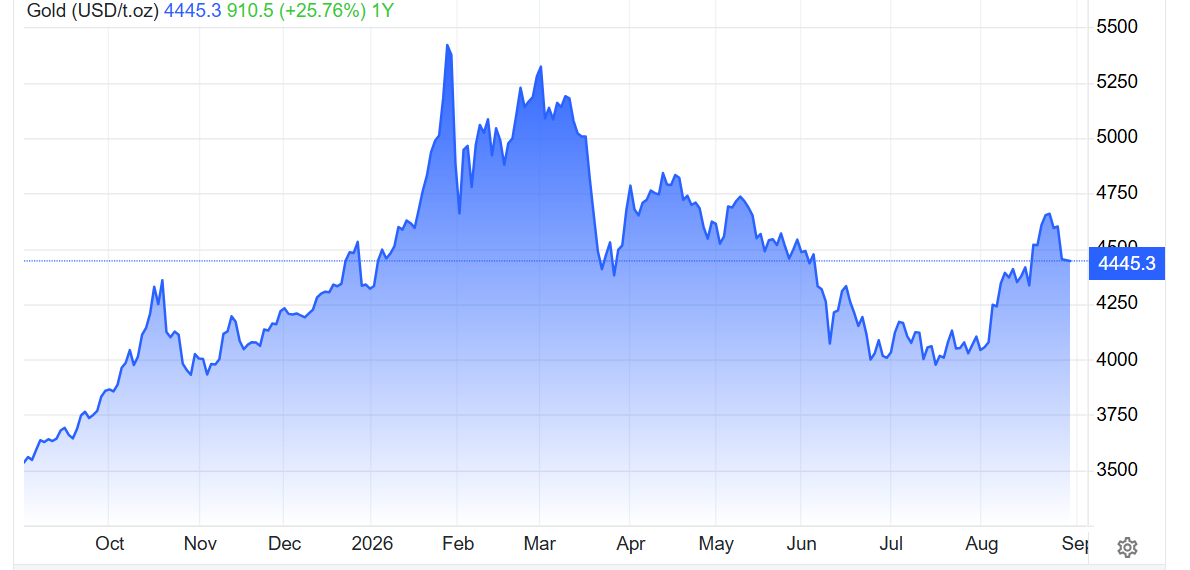
According to Wall Street financial giants such as Citibank, Bank of America, and Deutsche Bank, gold is likely entering a new upward wave in a long-term structural bull market. Citi raised its target for the next zero to three months from $4,500 to $4,800 and maintained a target of $5,000 for six to twelve months; Deutsche Bank's fair value forecast based on a quantitative model is about $4,700, and believes that the “explosive phase” of gold allocation that began in 2024 is not over, and the year-end benchmark target is $4,700—5,100; Goldman Sachs lowered its target for the end of 2026 from $5,400 to $4,900 due to backward expectations of interest rate cuts from the Federal Reserve; Morgan Stanley admits Gold has reached its fourth-quarter forecast of $4,450 ahead of schedule and is expected to have a path above $5,000 in 2027.
Can't the “hawkish” Fed hold back gold? In an orderly bull market, bulls switched to exotic options, and Wall Street is looking forward to another 5,000 US dollar mark
Boosted by the US Treasury's efforts to control US borrowing costs, revitalized gold bullish representatives are collectively shifting to “exotic options” (exotic options) and options market spread strategies to bet on further increases in gold prices.
Compared to ordinary bullish or put options (Vanilla Options), exotic options are derivatives with a customized yield structure. The final payout depends not only on the rise or fall of gold, but also on whether the price hits a barrier, whether it falls within a specific range at maturity, and whether the second or third assets such as USD/JPY and crude oil meet the requirements.
“Dual-Digital Options (Dual-Digital Options)” and “Triple Binaries (Triple Binaries)” are typical examples: fixed income is paid only if gold and foreign exchange or crude oil meet the pre-set conditions at the same time, so the premium is usually lower, and the potential return leverage can reach 10-20 times or more; the cost is that failure to meet any of these conditions may cause returns to zero, and is accompanied by high pricing complexity, liquidity, and counterparty risk.
US Treasury Secretary Scott Bessent plans to “at least double” the repurchase scale of 10-30 year treasury bonds. Expectations of huge dollar investment brought about by this move depress the dollar index, while boosting gold and its digital alternative, Bitcoin. Faced with the continuous erosion of the dollar's purchasing power, investors hungry for hard assets have driven the price of spot gold to rise by 10% since August; even if gold falls on Friday due to Federal Reserve Chairman Kevin Walsh's promise to fight inflation, it is still expected to record the biggest monthly increase since January this year.
Meanwhile, Bitcoin's short positions have been squeezed, driving it up 12% since August 19, finally allowing this cryptocurrency asset to finally break out of months of sluggishness and once surpass $80,000.
Akash Doshi, head of gold and metals strategy at State Street Investment Management, said, “Investors are focusing on re-bulging gold, whether through direct demand linked to exchange-traded funds (ETFs) or through the derivatives market. In my opinion, currency depreciation transactions have only temporarily stopped and never died out; as the market enters September, this deal will become popular again.”
Investors' confidence in gold has recently been more restrained than at the beginning of the year. At the time, US President Donald Trump said he was not worried about the dollar falling, which ignited a rise in gold. Traders have been buying large numbers of SPDR Gold Trust exchange-traded fund (SPDR gold ETF) bullish option spreads rather than simply buying call options; exotic options are also popular — both methods can bet on the depreciation of the US dollar and the sharp rise in gold prices in the future at a lower cost.
Doshi of State Street Investment Management said in an interview: “Compared with the 'end of volatility' in the precious metals market in January, the price performance and derivatives trading activities of the August round are clearly much more orderly and healthy.”
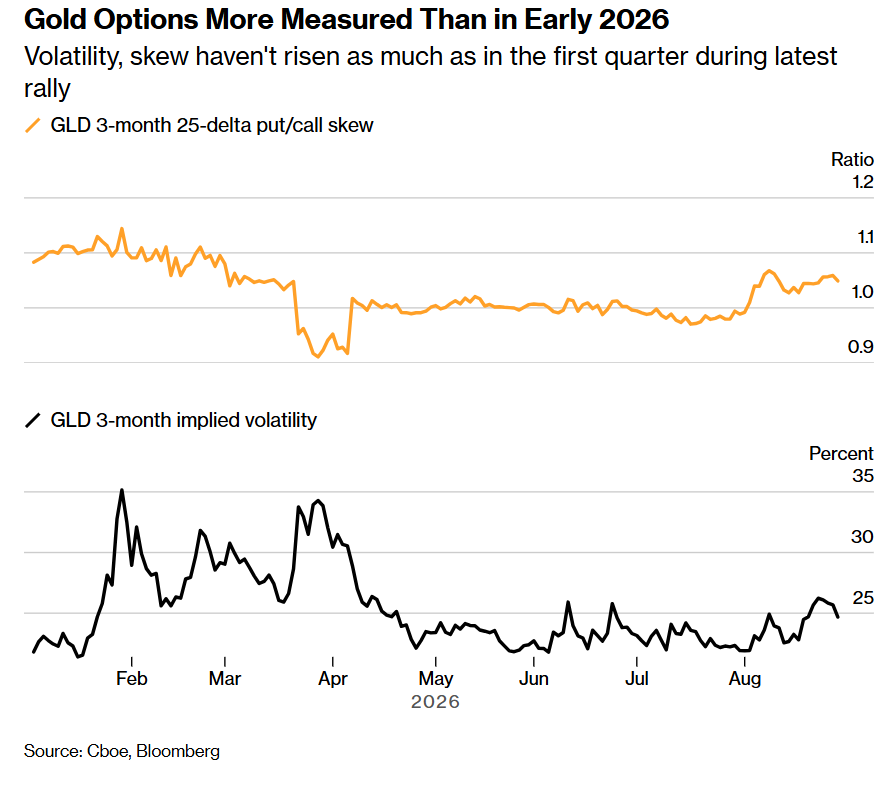
As shown in the chart above, the performance of gold options was more restrained compared to the beginning of 2026 — during the latest round of growth, both volatility and bias did not increase as much as in the first quarter.
The implied volatility of gold options has increased, but has not reached the level of the first quarter; at the same time, the bias in the options market — that is, the premium that investors pay for bullish bets — has also narrowed.
Neeraj Chaudhry, head of exotic options and capital flows at Bank of America in Europe, the Middle East, and Africa and co-head of global hybrid product trading, said: “Unlike the beginning of the year, the overall volatility of gold is relatively low, so some investors believe that there will be more limited room for the next round of growth, and the price of gold may maintain a volatile upward trend in a range, such as operating between $4,900 and $5,300.”
Investors are also using dual-asset digital options and other exotic options to bet on the rise of gold; since earnings must also meet specific conditions for the second asset, the overall cost of bullish gold trading can be reduced.
Chaudhry said that transactions based on a gold-to-currency combination have always been very popular, and investors use the foreign exchange side to reduce option costs. “For example, some investors trade a combination of gold and USD/JPY — they can buy correlation at an implied level close to negative 20%, betting that gold will rise and the dollar will rise against yen.”
Chaudhry added, “We have received some inquiries for quotes hoping that the gold and USD/CHF currency pairs will fall within such a pre-set range at maturity. We have also seen some inquiries for triple binary options, such as combining gold, crude oil, and foreign exchange, which can enable investors to increase the combined profit leverage even 10 to 20 times more than investors usually seek.”
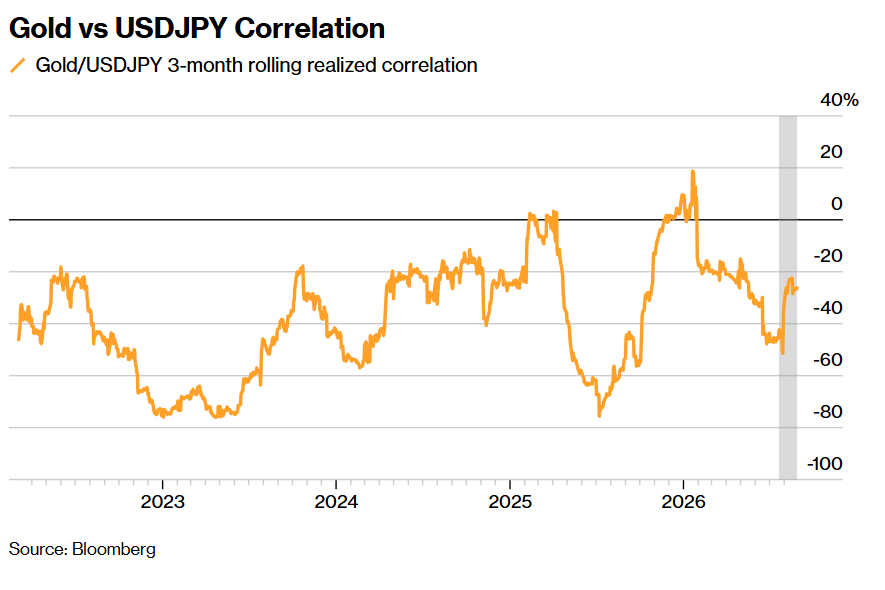
The above chart shows the correlation between gold and the dollar against the yen.
Gold is not the only one benefiting from the weakening dollar; Bitcoin's rise has also received additional impetus from bears' recovery.
According to Coinglass statistics, between August 19 and August 21, more than $2.5 billion of bearish positions in the Bitcoin perpetual futures market were forcibly closed. This shortfall turned the initial rise driven by macroeconomic factors into a more intense market breakthrough, while also attracting capital back into the US-listed Bitcoin spot exchange traded funds (that is, the Bitcoin ETF product line); since August 19, these funds have attracted more than 2 billion US dollars in capital.
The unresolved question is whether Bitcoin is becoming more and more like gold and is seen as a sustainable macro-hedging tool; or is it mainly a round of position-driven gains driven by leverage and amplification of momentum. As bears have been cleaned out on a large scale and profit settlement is actively unfolding, the next phase of Bitcoin's trend may reduce heavy reliance on forced buying forces, and more on whether new spot demand is willing to continue to rise.
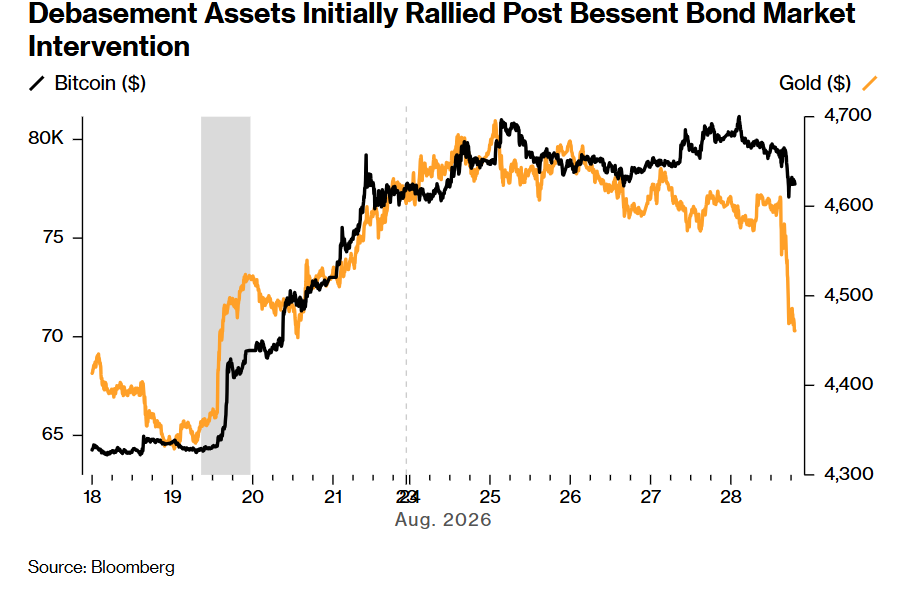
As shown in the chart above, after US Treasury Secretary Vincent led the intervention in the US bond market, currency depreciation-themed assets led by gold and Bitcoin initially rose collectively.
Despite Walsh's promise to fight inflation in Jackson Hole, boosted market bets on the Fed's interest rate hike trajectory, and weakened precious metals gains in the second half of the week, investors are still flocking to gold, which is unquestionably true.
Joseph Curry, head of structural design for equity derivatives at Bank of America in Europe, the Middle East, and Africa, said: “Over the past few months, gold dual-asset digital options have dominated the bullish trading flow of gold. Gold usually acts as a bullish force in cross-asset pairing transactions. The reason is that the investment logic of gold does not depend on a single macro outcome; under various scenarios, gold may rise.”
A gold asset allocation of 1 basis point is enough to leverage 1.4%, and gold ushered in a revaluation of capital flows
Gold's medium- to long-term structural bullish logic is becoming stronger, but the short-term price trajectory is not necessarily steeper and smoother. The core of this pricing round has been expanded from a single opportunity cost framework of “falling real interest rates — rising gold” to a fiscal credit framework (Fiscal-Credit Framework) co-driven by fiscal credit risk, dilution of the purchasing power of the dollar, diversification of central bank reserves, and private asset reallocation.
When long-term yields rise due to strong economic growth, gold is usually under pressure; however, if rising yields are due to fiscal deficits, term premiums, and deteriorating creditworthiness of sovereign debt, high interest rates can occur simultaneously with the upward trajectory of a bullish gold price. At the same time, Bezent's expansion of long-term US debt repurchases is therefore viewed by the market as a sign of potential “financial depression,” reigniting “currency depreciation transactions” driving the gold bullish theme; however, Walsh's hawkish speech still caused spot gold to fall 2.9% to 4,567.23 US dollars in a single day, proving that the traditional transmission mechanism between the US dollar and real interest rates did not work; only that it no longer has a monopoly on gold pricing.
The “niche market” paradox of gold is the most explosive part of this long-term bullish logic: although the total value of gold on the ground exceeds 30 trillion US dollars, and the average daily transaction volume exceeds 300 billion US dollars, large stocks belong to central bank reserves, jewelry, and long-term holdings. The huge transactions in the London market also mainly come from repeated exchanges between banks, market makers, and algorithmic transactions. The free circulation market that can actually absorb new long-term capital is far less than the nominal market value. Goldman Sachs statistics show that gold exchange-traded funds (or gold ETFs) only accounted for 0.17% of the US private finance portfolio in December last year; strictly speaking, for every 0.01 percentage point, or 1 basis point increase in the share of gold assets allocated by institutions or retail investors under any logic, the gold price estimated by the Goldman Sachs model increased by about 1.4%.
Another Wall Street financial giant, J.P. Morgan Chase's May 2025 scenario analysis shows that foreign investors hold about 57 trillion US dollars of US assets. If 0.5%, or about 273.6 billion US dollars, is converted to gold within 4 years, this is equivalent to about 70 billion US dollars per year. The model corresponds to an annualized increase of about 18%, and may push the price of gold to 6,000 US dollars in early 2029. These projected Wall Street figures can be described as revealing the extremely high elasticity of capital flows.
The demand structure provided realistic support for this revaluation, not just theoretical assumptions: the net inflow of global gold exchange trading funds in July was about 3 billion US dollars, the total holdings rebounded to 4068 tons, and the asset management scale reached 530 billion US dollars; the central bank's net gold purchase volume also rebounded significantly from 57 tons in the first quarter of 2026 to 289 tons in the second quarter, indicating that the official sector has a clear countercyclical ability when prices fall.
Meanwhile, investors are increasingly using call spread (Call Spread), dual-asset digital options (Dual-Digital Options), and cross-asset portfolios rather than chasing call options unprotected; neither implied volatility nor bullish bias returned to extreme levels in the first quarter. All of this means that the market's upward belief is deepening, but price expectations are more restrained — investors are willing to maintain asymmetric upward exposure, but are also actively limiting premium costs and rising risks, so it is more sustainable than the speculative frenzy at the beginning of the year. The $4,900-5,300 discussed in the options market is closer to the mid-term trading range, and the $5,000 mark is likely to be the next core pricing hub.
As September approaches, Bank of America gave an “investment reminder”: stock assets may lose blood, and gold-led commodities will take over the main allocation line
For some institutional investors, gold has been upgraded from cyclical interest rate trading to strategic dollar credit insurance; the pullback caused by the hawkish shock is more likely to be a stress test for a bull market, rather than confirming a trend reversal with just one speech.
At a time when the scale of credit market debt issuance linked to AI computing power infrastructure construction is surging, and concerns about the “bursting of the AI credit bubble” are rapidly heating up, and the yield on US bonds with a 10-year term or more rapidly rising and suppressing the NASDAQ 100 index, the seasonal statistics shown in a research report prepared by Wall Street financial giant Bank of America further suggest that September, the second year of the US presidency, is generally not conducive to high-risk equity assets such as stocks, especially technology stocks that rely on huge forward cash flow, long capital return cycles, and are highly sensitive to changes in risk-free returns on the denominator side. It is more beneficial to crude oil and commodity assets such as gold and silver.
Historical data charts compiled by Bank of America show that major stock indexes in the US stock market generally did not perform well during this period in September. The Nasdaq 100 Index (NDX) showed a clear bearish trend: historically, in September, the second year of the US presidential cycle, the index fell 70% for a long time, with an average return of − 0.66%. Similarly, the Russell 2000 Index (RTY), the benchmark index for small-cap stocks in the US stock market, also faced a historically weak month during this cycle, with a decline probability of about 64%.
Commodities performed more favourably. Among them, Brent crude oil also showed strong support — rising about 67% of the time in September of the second year of the presidential cycle; silver, which has always fluctuated sharply, usually had an average increase of about 1.73% in September of the second year of the presidential cycle over the years.
Another precious metal, gold, performed similarly strong during the same period in history. Wall Street's recent bullish sentiment on gold has intensified as the US Treasury unexpectedly increases its repurchases of long-term treasury bonds and global financial market concerns about the US government's repeated record high debt burdens have intensified. As US Treasury Secretary Bessentley strengthened the trading logic of weak dollar and currency depreciation, gold rose sharply. Over the past three weeks, the gold futures market has poured into record buying orders of more than 22 billion US dollars on a large scale, and positions have quickly turned crowded.
Dalio, founder of the Bridgewater Fund, recently issued another warning about the US financial situation. He believes that US Treasury Secretary Bessent announced an expansion of long-term treasury bond repurchases this week, combined with phenomena such as the sharp rise in long-term US bond yields and Japan's reduction in exposure to the US bond market, which may mean that the US treasury is nearing a critical turning point; if the debt problem is not addressed in a timely manner, the US may face a more serious debt crisis in the next few years, and Dalio suggests investors increase their gold holdings.
The “Bull & Bear Indicator” (Bull & Bear Indicator), compiled exclusively by Bank of America, has risen to 9.5 and is in the “sale” range, so the Bank of America strategy team framework led by Bank of America senior strategist Michael Hartnett, who has the title of “Wall Street's Most Valid Strategist,” advocates using gold to hedge against dollar credit dilution and the commodities and natural resources needed for AI construction, while shorting AI bonds, and wary of highly leveraged hyperscale cloud vendors, private credit, and cyclical financial assets. The Bank of America strategist team said that if long-term yields continue to rise and the dollar weakens at the same time, exposure to highly leveraged AI infrastructure, low-rated data center bonds, and private credit should be reduced, and shift to gold, energy, resource stocks, and short-term high-quality credit.