
- PRICING
- LIVE QUOTES
- LEARN
- HELP


EN
Prediction: USA Rare Earth Doubles Before 2028
Key Points
USA Rare Earth has performed decently in 2026 but still trades more than 50% lower than its 52-week high.
In 2027, defense contractors cannot use Chinese rare earths for U.S military systems.
This could be a major catalyst for USA Rare Earth, as defense contractors may seek to lock in the mining company's future supply of rare earths.
The market doesn't know what to think about USA Rare Earth (NASDAQ: USAR). Its 52-week price chart has a Jack-o'-lantern smile, with peaks in the $40s and troughs in the $10s. Wide price swings aren't uncommon for a growth stock, but USAR gives the unmistakable impression that Wall Street simply can't make up its mind.
Surely, some of that confusion is owed to the mismatch between USAR's business and valuation, which at times has been truly absurd. Last October, for instance, the metal company had a market cap north of $5 billion while generating essentially zero revenue.
Missed Nvidia in 2009? This Rare Signal Is Flashing Again. In 2009, a "Double Down" signal flashed for a little-known chipmaker called Nvidia. For the first time in years, that same "Total Conviction" signal is flashing for a company 1/100th the size of Nvidia. Continue »
Starting in 2027, however, the bull case for USAR is going to get stronger -- strong enough, I think, to make it rally back to its former highs. Here's why.
A ban on Chinese rare-earth magnets and alloys will send USAR higher
USAR is in a critical position: It owns a particularly heavy rare-earth deposit in Texas. The metals found there are used to make rare-earth magnets, whose tech applications span aviation, defense, clean energy, and other industries.
The U.S. has long been uncomfortably dependent on China for rare-earth magnets. The security of that dependence was always wobbly, but it reached a critical point in the recent tit-for-tat trade war between China and the U.S. That means the U.S. government has been extremely aggressive in establishing its own rare-earth supply chain, from policies that support miners to direct investments in companies themselves.
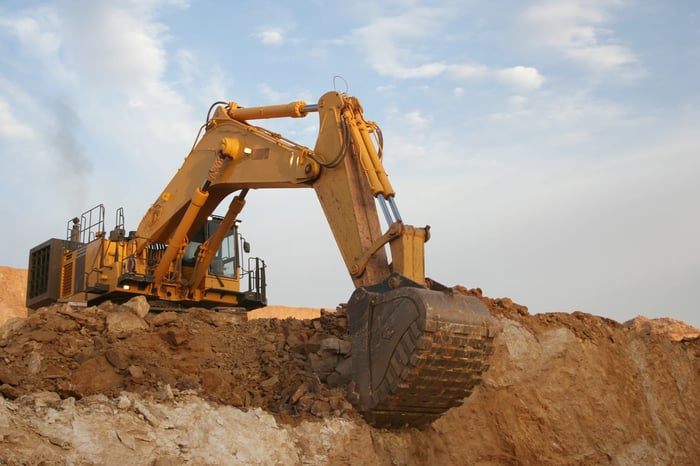
Image source: Getty Images.
That brings us here. Starting on Jan. 1, 2027, rare-earth magnets sourced from China will be barred from use in American military systems. Defense contractors will need to ensure that everything from the mining and refining of rare earth to the production of magnets occurs outside of China. Waivers -- that is, special permission from the government -- are also becoming harder to obtain, which means defense companies will have greater incentive to work with U.S. suppliers.
That will put USAR in an unusually favorable position. Not only does it own one of the country's largest and most diverse rare-earth deposits in the U.S. -- Round Top in Texas -- but it is also building two magnet factories in Oklahoma and South Carolina. Together, those assets will give USAR something few domestic miners have: a largely U.S.-based magnet supply chain.
An important caveat
Round Top is significantly rich in the "core four" rare earths used in defense: neodymium, praseodymium, dysprosium, and terbium. And USAR is developing innovative extraction technology tailored to Round Top to make its mining there less expensive and more efficient.
The only catch: It is not an operating mine, and it won't become one until at least 2028. So it's unlikely that USAR will be supplying rare-earth magnets to defense companies next year. But that doesn't mean it won't take advantage of the changed environment to ink agreements with defense clients for future sales.
Indeed, I predict that USAR will enter agreements with defense clients before 2027, with more to come next year. The U.S. cannot meet the strict requirements of this new rule without the help of USAR, and defense clients will likely be eager to lock in future supply before that capacity comes online.
I wouldn't wait until those agreements are inked before buying USAR. If you can tolerate the ups and downs of a growth stock, I think it's worth owning now before Wall Street finally makes up its mind.
Steven Porrello has no position in any of the stocks mentioned. The Motley Fool has no position in any of the stocks mentioned. The Motley Fool has a disclosure policy.