
- PRICING
- LIVE QUOTES
- LEARN
- HELP


EN
The US Treasury yield curve is flattening! Walsh's hawkish speech boosts interest rate hikes and expected two-year yield jumps
The Zhitong Finance App learned that after Federal Reserve Chairman Walsh released a strong anti-inflation signal at the Jackson Hole Global Central Bank Annual Meeting, US short-term treasury yields rose markedly. Walsh stressed that the Federal Reserve must contain the rise in prices, and reiterated that it will push inflation back to the 2% target “fast enough”, easing to a certain extent the bond market's previous doubts about its determination to fight inflation. Following Walsh's speech, traders quickly increased their bets that the Federal Reserve could raise interest rates again next month as soon as possible.
Market conditions show that US two-year Treasury yields once rose 9 basis points to 4.32%; in stark contrast, the 30-year US Treasury yield fell 2 basis points to 5.17%, and the US Treasury yield curve clearly flattened.
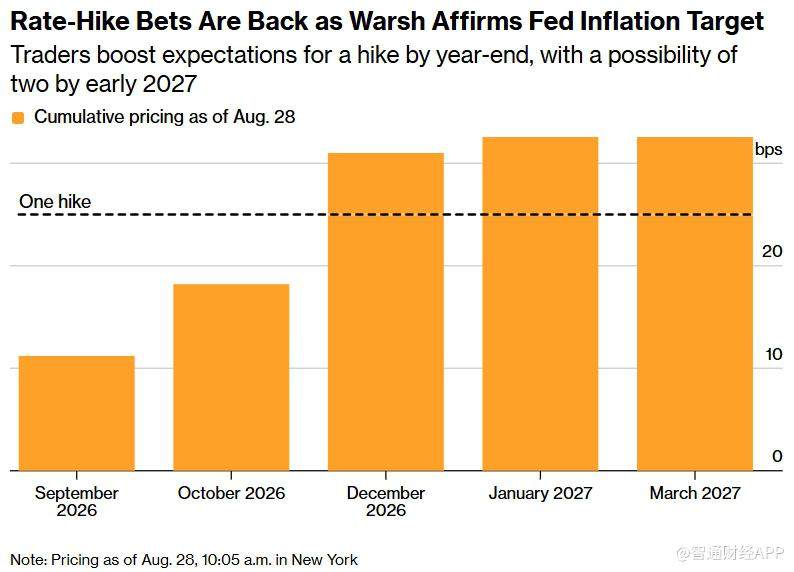
This trend reflects that the market is repricing the outlook for the Federal Reserve's policy. If the Federal Reserve further curbs demand and inflation by raising short-term interest rates, future long-term inflationary pressure is likely to decline, thereby limiting the room for long-term borrowing costs to rise.
Walsh warned on Friday that there was no “meaningful slowdown” in US inflation and promised to push inflation back “fast enough” to the Federal Reserve's 2% target. At the same time, he clearly emphasized that the 2% inflation target is “firm and unshakable,” further dispelling the market's previous doubts about the Fed's possible adjustment of the inflation target.
Shiyan Cao, portfolio manager at Winshore Capital Partners, said that the market interpreted Walsh's speech as clearly biased. “People think he's a hawk.” Cao said that Walsh “hinted at a certain sense of urgency” in reducing inflation.
After the speech, the interest rate market quickly raised its bets on the Federal Reserve's interest rate hike. The interest rate swap market shows that traders currently expect the probability that the Federal Reserve will raise interest rates by 25 basis points at the September 16 policy meeting is over 50%.
Meanwhile, the market believes that it is almost a foregone conclusion to raise interest rates at least once before the end of this year. This is a clear change from the market pricing before the speech. Walsh's statement means that even if some economic data shows signs of cooling recently, the Federal Reserve may still give higher priority to controlling inflation.
After Walsh's speech, the most obvious change in the US bond market was not that all term yields rose at the same time; instead, there was a typical flattening of the yield curve. Two-year US bonds are highly sensitive to the Fed's policy interest rate expectations, so as expectations of interest rate hikes heat up rapidly, the two-year yield rises sharply. Meanwhile, the 30-year yield declined slightly.
This combination of “short-term rise and long-term decline” means that investors believe that the Federal Reserve may need to adopt a tighter monetary policy in the near future, but higher short-term interest rates are expected to eventually depress inflation and economic demand, thereby reducing the risk that long-term inflation and long-term interest rates will continue to rise in the future.
In other words, the bond market is betting that the Federal Reserve may be more hawkish in the short term, but if anti-inflationary policies work, long-term price pressure may be controlled.
The current market reaction also shows that Walsh has allayed bond investors' doubts about its policy stance in the past few months to a certain extent.
When attending the press conference as Chairman of the Federal Reserve for the first time in June of this year, Walsh showed a clearly hawkish stance, stressing the need to reduce inflation, which has continued to be high since the global economy reopened in 2021 due to the pandemic.
However, the Federal Reserve once again decided to keep interest rates unchanged in July, and Walsh did not clearly explain whether interest rates could be raised this year at the press conference after the meeting, causing the market to question the Fed's determination to fight inflation. At that time, long-term US bonds were clearly sold off, and long-term yields rose sharply. Investors are demanding higher yields to offset the risk that future inflation may continue to be high.
However, in Jackson Hole's speech this time, Walsh not only clearly reiterated the 2% inflation target, but also stated that the current financial environment is not really restrictive. At the same time, he emphasized that if potential inflation does not fall fast enough, the Federal Reserve still “has work to do.”
These statements clearly strengthened the market's expectations for further interest rate hikes.
George Catrambone, head of fixed income at DWS Americas, said that Walsh's speech actually gave the policy guidelines that the market had hoped to obtain until now. “Whatever you call it, this is the forward-looking guidance the market wanted at the July FOMC meeting,” said Catrambone.
He believes that Walsh's statement even far exceeds market expectations, including downplaying the risk of capital inflation, and clearly believes that the current monetary policy is actually not very restrictive. “It's a pretty big 180-degree shift.”
Overall, Walsh's Jackson Hole speech clearly changed the market's pricing on the Fed's short-term policy path. The rapid rise in two-year US Treasury yields, the flattening yield curve, and the probability of interest rate hikes rising above 50% in September all indicate that investors are preparing again for a more hawkish US Federal Reserve.
With inflation still above the 2% target, the core message of Walsh's speech is very clear: the Federal Reserve has yet to think that the task of fighting inflation has been completed. If price pressure does not continue and cools down quickly, further interest rate hikes are still a realistic policy option.