
- PRICING
- LIVE QUOTES
- LEARN
- HELP


EN
“Administrative Measures on Personal Housing Loans (Trial)” issued: The ratio of monthly mortgage expenses to income is kept below 50%
The Zhitong Finance App learned that on August 28, the State Financial Supervisory Administration and the People's Bank of China issued a notice to issue the “Administrative Measures on Personal Housing Loans (Trial)”. Among them, it is proposed that lenders should focus on assessing the borrower's ability to repay, and reasonably set the upper limit of the borrower's monthly mortgage expenditure to income ratio and the upper limit of all monthly debt expenses to income ratio based on factors such as local real estate market conditions, borrower income and debt situation. Among them, the monthly mortgage expenditure to income ratio should be controlled below 50% (including 50%), and the ratio of all monthly debt expenses to income should be controlled below 60% (including 60%). For a loan applied for a single application, the income in the above calculation formula refers to the applicant's own disposable income. If the lender calculates the income of the applicant's spouse, it should first be investigated and verified, and the spouse's debts included together. For a loan applied for jointly, the income in the above calculation formula refers to the disposable income of the main applicant and the co-applicant, and the co-applicant's debts are included together.
It is also proposed that interest rates on personal housing loans should follow the principle of marketization, be determined through negotiations between borrowers and lenders on the premise of complying with relevant national regulations and industry self-regulatory management requirements, and that pricing benchmarks and pricing methods are implemented in accordance with relevant regulations. The lender shall establish a differentiated risk pricing management mechanism for customers to reasonably determine the specific interest rate level based on local real estate market conditions, the borrower's credit status, and ability to repay. The lender shall reasonably determine the loan period, which shall not exceed 40 years.
The full text is as follows:
Personal Housing Loan Administration Measures (Trial)
Chapter I General Provisions
Article 1. These Measures are formulated in accordance with laws and regulations such as the Civil Code of the People's Republic of China, the Banking Supervision and Administration Law of the People's Republic of China, and the Commercial Banking Law of the People's Republic of China, and “Opinions on Reforming and Improving Real Estate Credit Management to Promote the Accelerated Construction of a New Model for Real Estate Development” to regulate the personal housing loan business, protect the legitimate rights and interests of borrowers, promote the healthy development of the personal housing loan business, and accelerate the construction of a new model of real estate development.
Article 2 A lender referred to in these Measures refers to a financial institution established by law within the People's Republic of China to absorb public deposits, such as commercial banks, rural cooperative banks, rural credit cooperatives, etc.
Article 3 A personal housing loan referred to in these Measures refers to a loan issued by a lender to an eligible borrower to purchase a home.
Article 4 When carrying out personal housing loan business, lenders shall follow the principles of compliance with the law, prudent management, equality and voluntariness, fairness and honesty.
Article 5. A lender shall establish an effective management mechanism for the whole process of personal housing loans, and formulate a loan management system and operating procedures.
Article 6 The State Administration of Financial Supervision and Administration and its dispatched agencies shall supervise and administer the personal housing loan business in accordance with law.
Chapter II Loan Targets and Conditions
Article 7. Borrowers shall also meet the following conditions:
(1) A citizen of the People's Republic of China who has full civil capacity or an overseas natural person who complies with relevant national regulations;
(2) Have a valid and valid ID;
(3) Good credit status;
(4) Have the will and ability to repay;
(5) Ability to pay the down payment for the purchased house;
(6) An effective guarantee approved by the lender can be provided;
(7) Other conditions specified by the lender.
Article 8. The down payment ratio for personal housing loans shall not be lower than the minimum down payment ratio determined by the People's Bank of China and the State Financial Supervision and Administration. The lender can reasonably determine the specific down payment ratio based on factors such as local real estate market conditions, housing project conditions, and the borrower's credit status and ability to repay.
Article 9 The lender shall verify the true status of the borrower's down payment, and the deposit already paid by the borrower may be included in the calculation of the down payment. If the lender discovers that the borrower is using loan funds to pay the down payment, it shall stop issuing personal housing loans to the borrower.
Article 10. The lender shall focus on assessing the borrower's ability to repay, and reasonably set the upper limit of the borrower's monthly mortgage expenditure to income ratio and the upper limit of all monthly debt expenses to income ratio based on factors such as local real estate market conditions, borrower income and debt situation. Among these, the monthly mortgage expenditure to income ratio is controlled below 50% (including 50%), and the ratio of all monthly debt expenses to income is controlled below 60% (including 60%). The calculation formula is:
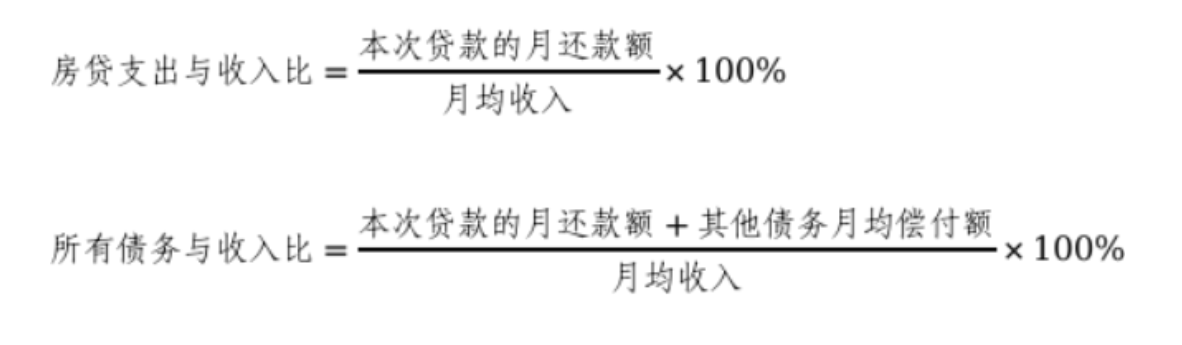
For a loan applied for a single application, the income in the above calculation formula refers to the applicant's own disposable income. If the lender calculates the income of the applicant's spouse, it should first be investigated and verified, and the spouse's debts included together. For a loan applied for jointly, the income in the above calculation formula refers to the disposable income of the main applicant and the co-applicant, and the co-applicant's debts are included together.
Article 11 The lender shall require the borrower to use the purchased house as a collateral guarantee for the loan. Those who buy an existing house or retrade housing should apply for mortgage registration before the loan is issued. Those who purchase pre-sale commercial housing shall apply for pre-mortgage registration before the loan is issued, and promptly complete the mortgage registration procedure after meeting the relevant conditions.
Where it is impossible to apply for mortgage registration or mortgage advance registration before the loan is issued, a phased guarantee shall be provided by means of other property mortgages, pledges, or introduction of guarantors.
Article 12 Interest rates on personal housing loans shall follow the principle of marketization, and shall be determined through negotiations between the borrowers and lenders on the premise of complying with relevant national regulations and industry self-regulatory management requirements, and pricing benchmarks and pricing methods shall be implemented in accordance with relevant regulations.
The lender shall establish a differentiated risk pricing management mechanism for customers to reasonably determine the specific interest rate level based on local real estate market conditions, the borrower's credit status, and ability to repay.
Article 13 The lender shall reasonably determine the loan period, which shall not exceed 40 years.
Article 14 The borrower may negotiate and agree on a loan repayment plan with the lender. If the loan period is within 1 year (including 1 year), it may implement one-time debt repayment or monthly debt repayment and interest; if the loan period is 1 year or more, monthly debt repayment and interest may be made.
Chapter III Loan Approval and Issuance
Article 15 The lender shall require the borrower to submit a personal housing loan application in writing, and require the borrower to provide the following information that can prove that it meets the loan conditions:
(1) Borrower's identification documents;
(2) Documents proving the borrower's ability to repay;
(3) Real estate transaction contracts, agreements or other approval documents signed and filed online;
(4) A list of collateral, proof of ownership, proof of value, and proof that the person authorized to dispose of the pledge (pledge); written documents of the guarantor agreeing to provide the guarantee and proof of credit of the guarantor;
(5) Other documents or information required by the lender.
Article 16 After accepting the borrower's loan application, the lender shall perform due diligence duties and conduct a combination of on-site field investigation and off-site indirect investigation, using methods and methods such as on-site verification, telephone inquiries, information consultation, and other digital electronic investigations to investigate and verify the authenticity, accuracy, and completeness of the details of the loan application and related circumstances, and form an investigation and evaluation opinion.
Article 17 A lender shall establish and implement a loan interview system. Before the lender makes the final approval of the loan application, the loan manager should directly interview the borrower at least once to understand the basic situation of the borrower and the purpose of the loan.
Article 18 The lender shall sign a written loan contract with the borrower and sign a guarantee contract or clause at the same time. The lender shall require the borrower to sign the loan contract and other relevant documents in person.
Article 19 The lender shall follow the principles of objectivity and prudence, evaluate or value the collateral provided by the borrower, and reasonably determine the value of the collateral. The value of the collateral is determined based on the lower of the transaction price or assessed price of the property in the sale transaction.
Article 20 Where a borrower buys a property corresponding to an unsettled loan, the lender may provide loan services with secured transfer to achieve an effective link between registration, loan, repayment, and final payment settlement.
Article 21. This chapter shall be implemented in accordance with the relevant provisions of Articles 19 to 21, 23 to 25, and 27 to 31 of the “Measures for the Administration of Personal Loans” relating to outstanding matters such as loan review and risk assessment, approval and issuance, signing of agreements, and collateral pledge registration.
Article 22 Where a borrower buys an existing house, the lender shall issue a loan after the sale is registered, and the loan funds shall be paid to the fund account opened by the housing project development enterprise at the host bank through a fiduciary payment method.
Where a borrower buys pre-sale commercial housing, the lender shall issue a loan after completion and filing, and the loan funds shall be paid to the pre-sale funds supervision account through a fiduciary payment method.
Where a borrower buys a retransactional home, the lender shall issue a loan after implementing the guarantee (including necessary phased guarantees), and the loan funds shall be paid to the account agreed in the loan contract through a fiduciary payment method. Where the State Financial Supervisory Authority stipulates otherwise on the real estate mortgage loan business, its regulations shall apply.
Article 23. Lenders shall strengthen the management, monitoring and evaluation of personal housing loan cooperative institutions, clarify the qualifications of cooperative institutions, establish a list management system and conflict of interest prevention mechanism, regularly review and update the list, and promptly take measures such as terminating cooperation and recovering losses for irregularities and breaches of contract between cooperative agencies in business cooperation. Lenders must not cooperate with illegal loan intermediaries.
Where personal housing loans involve cooperative institutions, core risk control matters involving the borrower's true intentions, income level, debt situation, and access to external evaluation agencies in credit approval, contract signing, and loan investigations shall be carried out independently and effectively by the lender. Where lenders entrust specific matters to cooperating institutions, they shall strengthen cost and expense management, not damage the legitimate rights and interests of borrowers, and ensure that related risks are manageable.
The cooperative agencies mentioned in the preceding paragraph include but are not limited to real estate development companies, real estate transaction intermediaries, evaluation agencies, guarantee companies, etc.
Chapter IV After-loan Services and Management
Article 24 The lender shall follow up, check, monitor and analyze changes in the borrower's credit and guarantee situation to ensure the safety of loan assets.
Article 25 The lender shall re-evaluate the value of the collateral at least every year during the life of the loan, and continuously monitor the status, ownership, etc. of the collateral to ensure that the risk is manageable.
For personal housing loans that have already been issued, until the borrower has fully repaid the loan, the lender must not use the net value of the mortgaged property after re-evaluation as collateral to add a home purchase loan.
Article 26 Where a borrower applies for a loan extension, the lender shall carefully evaluate the reasons for the extension and the feasibility of subsequent repayment arrangements. Where an extension is agreed, the extension period shall be reasonably determined based on the source of repayment, etc., and follow-up management of the loan shall be strengthened, and risks classified according to the actual risk situation.
The cumulative extension period shall not exceed half of the original loan term, and the sum of the original loan term and extension period shall not exceed 40 years.
Article 27. During the life of a loan, the elements of a loan contract shall be changed through negotiation and agreement between the borrower and lender, and a change agreement shall be signed in accordance with law.
Article 28. In the event of a dispute over a loan contract, both parties to the loan shall promptly negotiate to resolve it. If negotiations fail, they may apply for arbitration or file a lawsuit with the People's Court in accordance with law.
Article 29 The lender shall recover the principal and interest of the loan as agreed in the loan contract.
For loans not repaid as agreed in the loan contract, the lender shall take measures such as settlement, reorganization by agreement, transfer or cancellation of claims.
Article 30 After the borrower has repaid all of the principal and interest of the loan as agreed in the contract, the loan contract is terminated, and the lender shall promptly release the guarantee in accordance with the contract agreement. Where real estate is used as collateral, when the mortgage is lifted, the original registration department shall go to the original registration department to complete the mortgage cancellation registration procedure.
Article 31. If the borrower has any of the following circumstances, the lender may pursue the borrower for breach of contract or corresponding legal liability:
(1) Failure to repay loan principal and interest on time;
(2) Providing false documents or information, which has or is likely to cause loan losses;
(3) Dismantling, selling, transferring, or gifting property or interests that have been secured or pledged without the lender's consent;
(4) Unauthorized modification of loan use and misappropriation of loans;
(5) Refusing or obstructing the lender from supervising and inspecting the loan usage;
(6) Entering into a contract or agreement with another natural person, legal person or economic organization that harms the rights and interests of the lender;
(7) Where the guarantor violates the guarantee contract or loses the ability to bear joint and several liability, the value of the collateral is reduced due to the actions of the mortgagee, the material decrease significantly affects the lender's ability to achieve the pledge, and the borrower fails to promptly restore the value of the collateral or provide a new guarantee or new mortgage (pledge) as required;
(8) Other relevant circumstances stipulated by laws and regulations such as the “Civil Code of the People's Republic of China”.
Article 32. Lenders shall implement the responsibility for personal housing loan management to specific departments and positions, and establish assessment and accountability mechanisms for each position.
Chapter V: Supervision and Management
Article 33 The State Administration of Financial Supervision and Administration and its dispatching agencies may put forward relevant prudential supervision requirements for the management of personal housing loans on the basis of the lender's operation and management situation, risk level, and personal housing loan business development and the operation of the real estate market.
Article 34 Where a lender handles personal housing loan business in violation of the provisions of these Measures, the State Financial Supervision and Administration and its dispatching agency shall order them to make corrections within a limited period of time, and may take relevant supervisory measures or administrative penalties on them in accordance with laws and regulations such as the “Banking Supervision and Administration Law of the People's Republic of China”, “Commercial Banking Law of the People's Republic of China”, “Measures for the Administration of Personal Loans”, etc., as appropriate.
Chapter 6 Supplementary Provisions
Article 35. Loans for the purchase of allotted affordable housing shall be implemented with reference to these Measures.
Article 36 These Measures shall be interpreted by the State Administration of Financial Supervision and Administration and the People's Bank of China.
Article 37 These Measures take effect from the date of publication. The “Administrative Measures on Personal Housing Loans” (Yinfa [1998] No. 190) were abolished at the same time. Where other regulations relating to personal housing loans are inconsistent with these Measures, these Measures shall prevail.
For projects that have obtained a pre-sale license before the implementation of these Measures, the conditions for issuing personal housing loans may be implemented in accordance with the original regulations.
This article was selected from the “Official Website of the State Financial Supervisory Administration”; Zhitong Finance Editor: Huang Xiaodong.