
- PRICING
- LIVE QUOTES
- LEARN
- HELP


EN
The AI infrastructure frenzy is sweeping the US! The surge in imports of computing power equipment drove the trade deficit to a new high since March 2025
The Zhitong Finance App learned that while long-term US bond yields continued to rise and global investors focused on the Jackson Hole central bank meeting and US economic data, the commodity trade deficit unexpectedly widened to 118.8 billion US dollars in July, far exceeding market expectations of US$100.5 billion, and the largest since March 2025. It is called a “prosperous trade deficit”; behind this, capital equipment imports dominate and drive total imports to grow by 3.7%. At the same time, commodity exports fell 2.9%, highlighting the further differentiation between US domestic investment demand and foreign trade performance.
From an asset pricing perspective, if the US deficit data continues to expand, it will drag down real GDP in the third quarter through net export channels, but imports of capital equipment, especially artificial intelligence-related equipment, continued to grow strongly, which is enough to show that corporate capital expenditure — especially investment and construction processes closely linked to artificial intelligence computing power infrastructure — are still in full swing.
As Nvidia once again announces strong performance that has surpassed expectations and an unusually explosive performance outlook, the AI computing power-themed trading hotspot is likely to not only revolve around the Nvidia GPU computing power cluster, but also further accelerate its spread to the entire AI computing power industry chain, such as HBM/DRAM/NAND, COWS/3D advanced packaging, data center CPUs, optical interconnection, and data center power chain infrastructure, forming a new round of “main rising” supermarkets at the industrial chain level.
Morgan Stanley predicts that by 2028, close to $3 trillion of AI-related infrastructure investment will flow through the global economy, and more than 80% of spending is still ahead. According to Goldman Sachs's latest calculation data, the global AI capital expenditure benchmark model is expected to grow from $765 billion per year in 2026 to 1.6 trillion US dollars per year in 2031, and the cumulative capital expenditure from 2026 to 2031 is estimated to be about 7.6 trillion US dollars. The power demand for US data centers is expected to rise from 31 GW in 2025 to 66 GW in 2027. This will directly spill AI computing power infrastructure investment into server CPUs, DRAM/NAND/HBM, advanced packaging, liquid cooling, power equipment, transformers, gas turbines, grid-connected equipment, data Links such as central REITs and engineering construction.
As imports surged due to a recovery in inbound transportation of capital and equipment, the US commodity trade deficit widened to the largest size since the beginning of last year.
According to data released by the US Department of Commerce on Thursday, the commodity trade deficit increased 17.2% from the previous month to US$118.8 billion, the largest since March 2025. Earlier, the agency's survey of economists showed that the median economists' estimate was a deficit of only $100.5 billion. These figures are not adjusted for inflation.
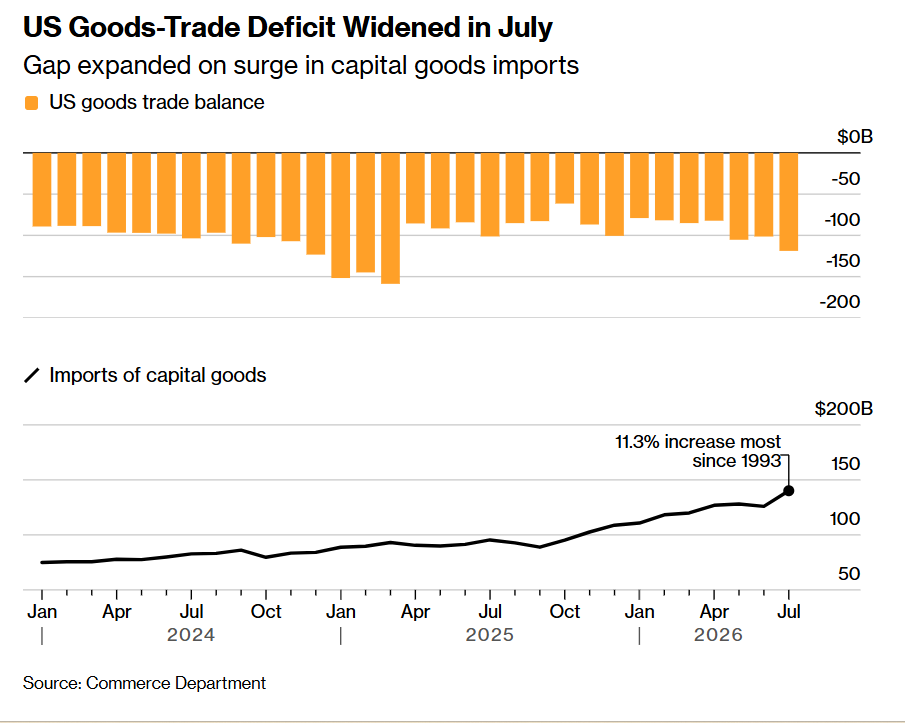
The US commodity import data for July exceeded expectations by 3.7%, while US merchandise exports fell by 2.9%. Imports of capital goods (mainly including computers and accessories, semiconductors and telecommunication equipment) recorded the biggest increase since 1993.
The trade deficit has continued to fluctuate in recent months because the Iran war has driven up global demand for US crude oil and refined petroleum products, while US companies continue to hoard commodities and raw materials under the pressure of energy inflation to mitigate any negative effects caused by supply chain disruptions. At a time when imports of artificial intelligence-related infrastructure hardware and equipment are still strong, companies are also adapting to changing tariff rates.
The $118.8 billion deficit reflects the boom in AI! The US is using import torrents to forge an AI computing power empire
US commodity imports increased 3.7% month-on-month to US$318.2 billion in July, with inbound transportation of capital equipment rebounding markedly, while commodity exports fell 2.9% to US$199.4 billion; this is highly consistent with the physical delivery logic of artificial intelligence data centers continuing to import high-performance AI server components, AI computing power core accelerators, network infrastructure equipment, data center power systems, and liquid cooling components. However, preliminary data from the Ministry of Commerce has yet to disclose sufficient segmented artificial intelligence import amounts. Changes in tariffs, supply chain preparation caused by the Iran war, and imports of other capital goods have also amplified the deficit.
After cross-verification with Nvidia's earnings report, the evidence chain that the US AI computing power infrastructure process is in full swing is clearly more complete. Nvidia's revenue for the second quarter of fiscal year 2027 increased 106% year over year to US$96.2 billion, data center revenue increased 117% year over year to US$89 billion, and revenue guidance for the third fiscal quarter reached US$108 billion, fluctuating 2% up and down; management also anticipated a 70% increase in revenue for fiscal year 2028, and emphasized that this outlook is still constrained by supply capacity, and the Vera Rubin platform has also entered a phase of full mass production climbing.
In other words, Nvidia's earnings report verified “orders and computing power requirements,” while capital equipment imports verified that “chips, servers, and data center infrastructure are being transported across borders and converted into real assets within the US.” The Minneapolis Federal Reserve research further shows that artificial intelligence-related products already accounted for 23% of US imports in 2025, an increase of 73% over 2023, while imports of non-artificial intelligence increased by only 3% during the same period; without a wave of artificial intelligence construction, the US commodity trade deficit in 2025 may have been reduced by nearly 200 billion US dollars.
According to retail inventory data released along with commodity trade data, inventory increased by 0.7%. Wholesalers continue to increase inventory.
Trade and inventory data will help the government's preliminary estimate of gross domestic product (GDP) for the third quarter, which will be released in October. Ahead of the release of the latest commodity trade report, the Federal Reserve Bank of Atlanta's GDPNow model predicts that net exports will reduce GDP growth by 0.14 percent. In the second quarter, the drag of net exports on GDP growth reached 1.14 percentage points.
More complete trade data for July, including trade in services account balances and inflation-adjusted commodity trade data, will be released on September 3.