
- PRICING
- LIVE QUOTES
- LEARN
- HELP


EN
Tight inventories, cutoff in the Middle East, gas rush in Asia... Will European gas prices rise to 100 euros again this winter after a lapse of four years?
The Zhitong Finance App learned that as winter approaches, Europe is facing a serious situation where it is difficult to replenish natural gas inventories. This may increase competition with Asia for the supply of liquefied natural gas (LNG) and push natural gas prices to break through 100 euros (about 117 US dollars) per megawatt hour for the first time since the energy crisis four years ago.
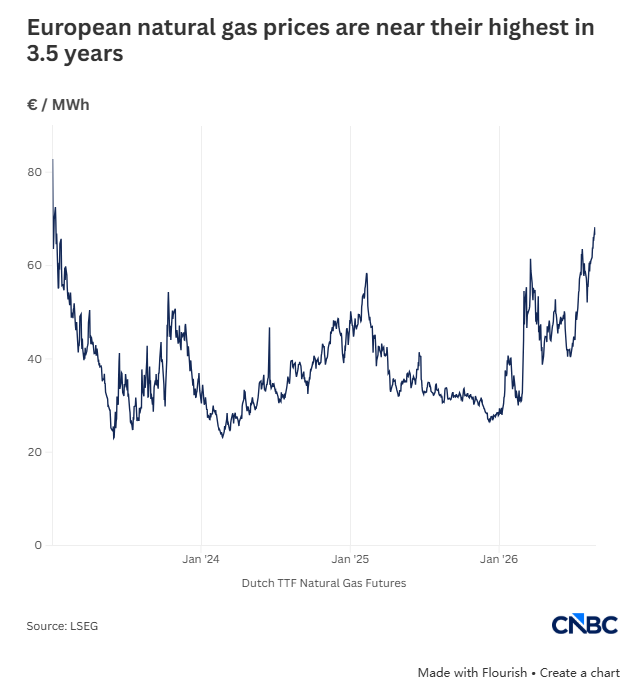
On Tuesday, Europe's benchmark gas price — the Dutch TTF futures contract — once climbed above €68 per megawatt hour, the highest level since early 2023, before falling slightly.
Tancred Fullop, a senior stock analyst at Morningstar, said that if the winter climate is severe and supply continues to be limited, the price of natural gas may rise further to the range of 90 to 120 euros per megawatt-hour.
Goldman Sachs analysts pointed out in a research report released on Sunday that if LNG exports in the Middle East “only return to normal at a slow pace by 2027,” natural gas futures prices must rise above 100 euros per megawatt hour to effectively curb Asian demand, thus ensuring that Europe maintains inventory levels throughout the winter.
Europe's current concern is that natural gas inventories are already at historically low levels.
During the European gas replenishment season, the blockage of shipping in the Strait of Hormuz seriously limited LNG exports from major Gulf gas producers such as Qatar.
At the same time, Europe is experiencing extremely hot weather this summer, and electricity demand for energy-intensive appliances such as air conditioners has risen sharply. At this time, demand for natural gas (which is widely used for heating and cooking) is at a seasonal low. Natural gas accounts for about one-sixth of the EU's total electricity generation.
Unfavorable weather conditions have also reduced the supply of alternative energy sources. High temperatures forced nuclear power plants to shut down or cut production, and regional nuclear power generation declined, while wind power also weakened in summer.
According to data from the European Gas Infrastructure Agency, the current EU gas inventory level is only about 63%, which is one of the lowest levels in the same period since records were recorded, and about 18 percentage points lower than the five-year average.
Matt Drinkwater, head of European gas at energy consulting firm Energy Aspects, said in an email: “Europe is currently entering winter with insufficient gas storage buffers, making it difficult to cope with the cold waves at the end of winter, especially because the more gas storage capacity gets empty, the less gas it can extract on peak days.”
Drinkwater also pointed out that the intensifying El Niño phenomenon may make Northeast Asia warmer in early winter, thereby reducing demand, but it may also “increase the risk of abnormally cold in late winter.”
The Strait of Hormuz reopens hope
One key variable is whether the Middle East can resume significant LNG exports before winter arrives.
Both crude oil and natural gas futures prices declined somewhat on Wednesday due to expectations that Iran and Oman are expected to reach an agreement to ensure safe passage through the Strait of Hormuz.
Drinkwater said that if LNG exports to the Middle East recover significantly, even though Europe may still enter the winter with “low inventories,” it will at least be able to keep more reserves during the severe cold months of January and February.
However, given the complex and changing geopolitical situation around this important waterway, the situation is full of uncertainty.
Drinkwater warned that if LNG traffic in the Middle East fails to return to a high level before winter, Europe will face high gas prices, rising household energy bills, and in the worst case, it may even limit industrial gas use.
Competition with Asia for LNG spot shipments will also continue to be intense, as global supply growth will be limited over the next 12 months. Consulting agency Wood Mackenzie predicts it will be difficult for new development projects in Qatar to reach full production before the second half of 2027.
The agency described Europe as “nearing the brink of an energy crisis” and that there are few short-term alternatives in terms of natural gas demand. At this time, the deadline for the EU to completely ban imports of Russian LNG from the beginning of 2027 is also getting closer.
Morningstar Fullop said that at the current price level, considering transportation costs, Europe still has a slight advantage in attracting flexible LNG shipments from the US, but if supply from other sources continues to be limited, Europe will need far more LNG than the current US.
Fullop said, “We estimate that Europe will need about 64 billion cubic meters of US LNG, accounting for about 77% of total US exports. To attract such a high proportion of supply, Europe must provide a net return significantly higher than Asia. In the upper end range, high gas prices will also cause the market to rebalance by suppressing industrial demand and fuel substitution.”