
- PRICING
- LIVE QUOTES
- LEARN
- HELP


EN
Omdia: The number of satellite IoT connections is expected to reach 197.6 million in 2035, a CAGR of 31%
The Zhitong Finance App learned that Omdia's latest research shows that the Satellite Internet of Things (Satellite IoT) is entering a phase of rapid expansion. The number of connections is expected to grow from 7.7 million in 2023 to 197.7 million in 2035, with a compound annual growth rate (CAGR) of 31%.
Low Earth Orbit (LEO) Connectivity Leads Satellite IoT Growth
The number of IoT connections to low Earth orbit (LEO) satellites is expected to grow rapidly at a CAGR of 88.6% during the forecast period, mainly due to accelerated satellite deployment, increased bandwidth and service availability, and reduced connectivity costs. The geosynchronous orbit (GEO) satellite market will also drive industry growth, but the growth rate is expected to be relatively moderate, with a compound annual growth rate of 7.3%.
John Canali, chief analyst at Omdia Internet of Things (IoT), said: “Technological advancements in the satellite market are significant, but the timing of technology development is just as important. As the IoT market continues to mature, companies are increasingly demanding the ability to cover no connection gaps around the world and maintain greater connectivity resilience when terrestrial networks are unavailable. As IoT devices support more and more data-intensive models and automated applications, these needs will become more urgent.”
Omdia anticipates that satellite connectivity will be increasingly used in several key IoT vertices, including agriculture and environmental monitoring, defense and military, energy and utilities, and transportation and logistics.
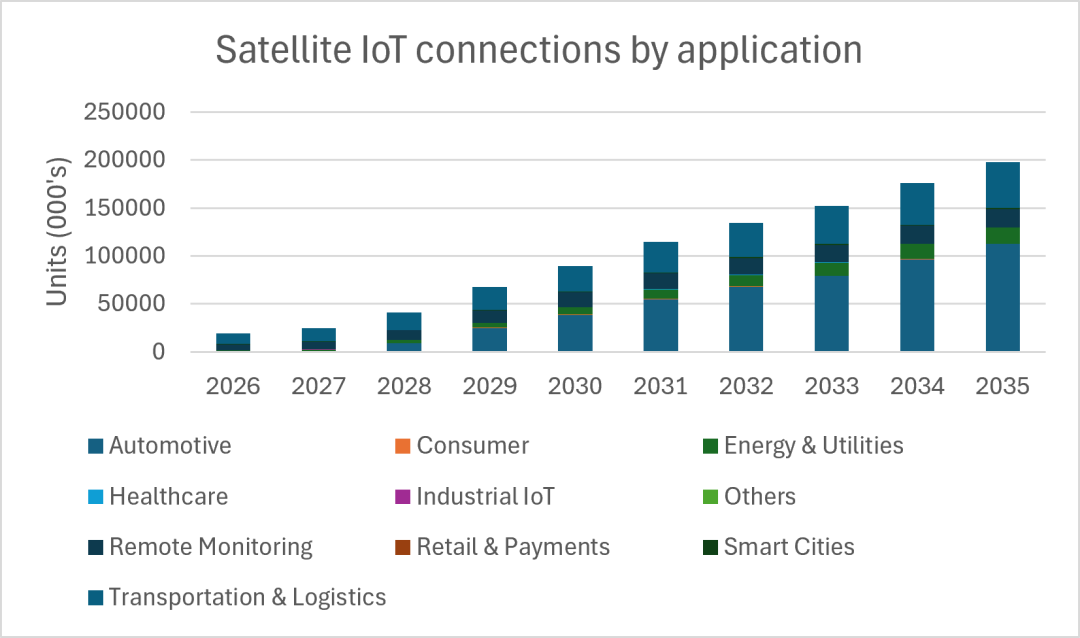
The automotive industry is expected to become one of the major adopters of satellite connections. The number of connected cars is expected to increase dramatically from just 11,000 in 2023 to over 112 million in 2035, with a compound annual growth rate (CAGR) of 115%. Major automakers, including Geely, Tesla, BMW, and Stellantis, are actively testing and deploying satellite connectivity solutions to build a true “network of networks (network of networks)” that enable vehicles to dynamically switch between terrestrial and non-terrestrial networks to achieve more seamless connectivity.