
- PRICING
- LIVE QUOTES
- LEARN
- HELP


EN
SpaceX Intends to Launch Its First Nvidia-Powered AI Satellites in Late 2027. What This Means for SPCX and NVDA.
SpaceX (SPCX) is accelerating its most ambitious infrastructure bet beyond Earth. Elon Musk confirmed on Aug. 24 that SpaceX and Nvidia had designed a space-optimized system for the company’s first Starmind AI satellite, targeted for launch in late 2027.
Nvidia (NVDA) separately said the satellite will extend the same accelerated-computing architecture used in terrestrial AI factories into orbit. The timing is significant because SpaceX only began trading in June 2026.
SpaceX has already committed tens of billions of dollars to terrestrial AI infrastructure. It now sees orbital computing as a long-term extension of that investment, with Nvidia serving as its exclusive AI-chip supplier.
These two heavyweights are linking their fortunes through a shared bet on space-based AI. Will orbital data centers prove a genuine breakthrough for both companies, or simply the latest high-stakes chapter in an already capital-intensive AI buildout? Let’s dive in.
SpaceX’s First Public Earnings Report
SpaceX (SPCX) is a $1.8 trillion aerospace and technology company that designs reusable rockets, launches satellites, and provides space transportation services for commercial, government, and scientific customers. It also operates Starlink satellite broadband, delivers Starshield systems to government clients, and is expanding into AI infrastructure.
SPCX traded at $137.95 on Aug. 25, up 2.2% from its $135 June 12 IPO price and 19.88% over one month.
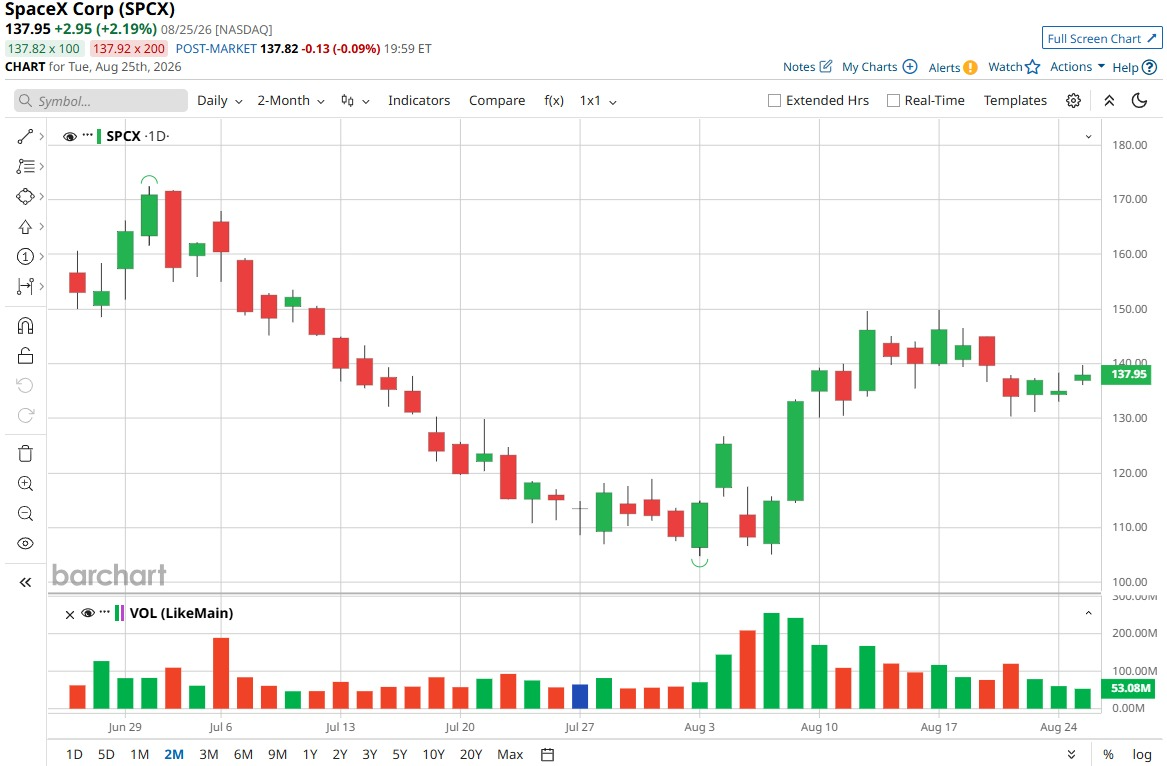
At 95.91x sales and 14.08x book value, SPCX commands steep premiums to sector medians of 1.22x and 1.94x, respectively.
SpaceX released its first public earnings report on Aug. 4, delivering a smaller-than-expected $0.09-per-share loss. Its result compared favorably with analysts’ projected $0.26-per-share loss, signaling stronger near-term performance than anticipated.
This quarter’s revenue reached $7.81 billion, exceeding the $6.93 billion consensus forecast by $880 million. It also represented 92% year-over-year sales growth. The connectivity segment, anchored by Starlink, produced $1.66 billion in quarterly operating income, providing the cash-generation base.
SpaceX’s space segment posted a $542 million operating loss during the quarter. Its AI unit recorded a wider $1.26 billion operating loss.
That spending became the market’s central concern after the earnings release. The company raised second-quarter capital expenditures sixfold to $18.40 billion, with most of the spending directed toward AI.
SpaceX Builds Its Orbital Compute Network
SpaceX and Nvidia announced on Aug. 4 that they will design the compute payload for the Starmind AI1 satellite, which is expected to process heavy AI workloads in space using Nvidia’s newest hardware.
Starmind AI1 is the opening step in SpaceX’s much larger orbital-computing plan. The company ultimately envisions deploying up to 1 million AI satellites that would function as a single data center circling Earth.
To support that goal, Elon Musk said SpaceX agreed to use Nvidia GPUs exclusively because “the Vera Rubin architecture is the best architecture.” The decision strongly endorses Nvidia from a customer capable of developing proprietary chips or choosing competing hardware.
Nvidia’s Vera Rubin platform will sit at the center of the project. The company says the architecture can deliver up to 25x the AI performance of H100 chips in orbit.
Building an orbital network at that scale also requires substantially more launch capacity. SpaceX plans to invest $100B in a 125,000-acre spaceport in Vermilion Parish, Louisiana, about 200 miles west of New Orleans.
Louisiana officials cited ample natural gas supplies and access to varied launch trajectories as key site advantages. The project would become SpaceX’s fourth and largest launch facility. It could support thousands of reusable Starship missions annually.
Alphabet’s Google (GOOG) (GOOGL) has also increased its financial and commercial ties to SpaceX. The company invested $94 billion in SPCX, a 100x increase from its original $900 million investment, making it the company’s largest institutional shareholder.
Google additionally agreed before SpaceX’s IPO to lease roughly 110,000 GPUs from its AI infrastructure. The contract runs from October 2026 through June 2029 and requires monthly payments of $920 million. Anthropic has a similar arrangement with SpaceX.
Analysts Weigh In on SpaceX
When SpaceX next reports quarterly results, Wall Street expects $0.09 in September-quarter earnings per share, versus a $0.09 per-share loss in the prior quarter, implying a 200% sequential improvement.
That outlook follows a better-than-expected second-quarter release. Argus Research senior analyst Steve Silver upgraded SPCX to “Buy” and maintained his $160 price target, implying 16.0% upside from its Aug. 25 close.
Silver downplayed concerns over elevated capital expenditures. He said he is “encouraged by rapid payback on these investments, given robust growth in computing capacity.”
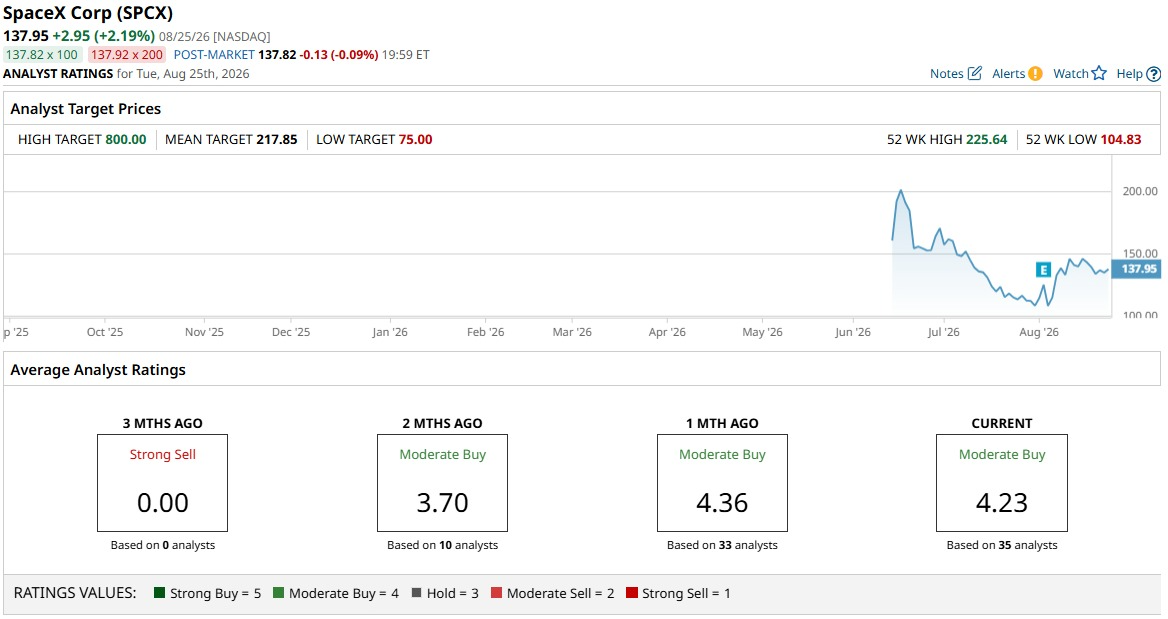
Other analysts see much greater upside. Morgan Stanley analyst Adam Jonas set a $300 price target for SPCX, implying 117.5% upside from its Aug. 25 closing price of $137.95. Raymond James holds the Street-high $800 target, implying 479.9% upside from SPCX’s Aug. 25 price.
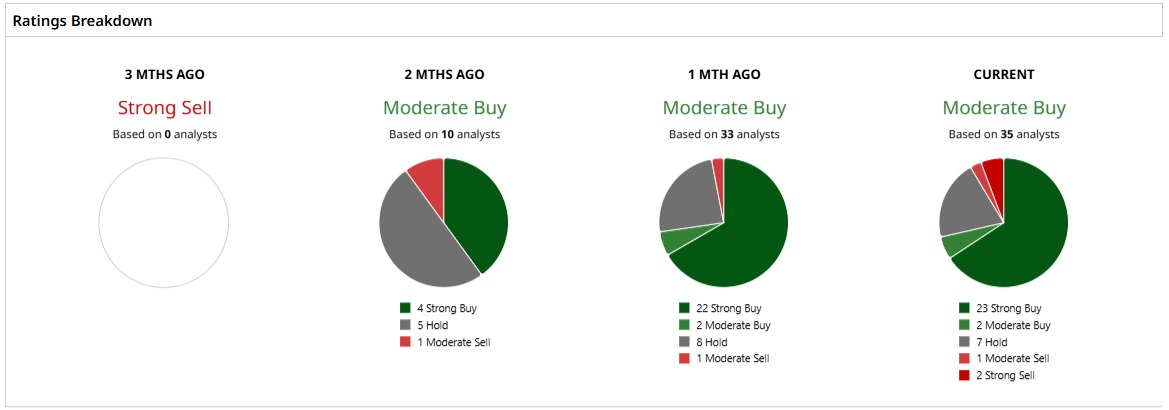
The consensus rating among 35 surveyed analysts is a “Moderate Buy.” Their average $217.85 target implies 57.9% upside from the Aug. 25 closing price.
Conclusion
SpaceX’s Nvidia-powered satellite plan could expand its AI opportunity beyond Earth, while giving Nvidia another high-profile deployment for its Vera Rubin platform. The most likely near-term outcome is greater spending before meaningful orbital revenue arrives. Starlink and ground-based compute deals should remain the main drivers for SPCX. If SpaceX proves the economics of orbital computing, both SPCX and NVDA could gain a powerful new growth catalyst.
On the date of publication, Ebube Jones did not have (either directly or indirectly) positions in any of the securities mentioned in this article. All information and data in this article is solely for informational purposes. For more information please view the Barchart Disclosure Policy here.