
- PRICING
- LIVE QUOTES
- LEARN
- HELP


EN
Reproduce “at any cost”! The US Treasury Secretary took steps to suppress long-term US bond yields, and star fund managers turned urgently
The Zhitong Finance App learned that Vishal Kanduja, head of the fixed income team at Morgan Stanley Investment Management Company, said that Treasury Secretary Bezent is preparing to “do whatever it takes” to stop yields from rising, so he is cutting bearish bets on US long-term treasury bonds.
Canduja, who has performed well, said he reduced his exposure to trading with a steep yield curve (that is, betting that the yield spread on 30-year and 5-year treasury bonds will widen) because he believes there is less room for growth in this transaction.
In an interview, he said, “It will be difficult to keep a lot of steep bets in your portfolio because you now have an uneconomical buyer on the long term.”
This buyer is the US Treasury. The Treasury Department last week announced plans to at least double the size of repurchases of cash notes (10-year to 30-year US bonds) to prevent further spikes in borrowing costs. Since the announcement of the plan, the yield gap between 5-year and 30-year treasury bonds has narrowed by about 10 basis points.
“Scott Bessent is actually in a showdown,” Canduja said. He said that Bezent's action was equivalent to a “whatever the cost” moment, referring to the statement made by former European Central Bank President Mario Draghi in 2012 when he promised to defend the euro. Draghi's intervention at the time finally helped put an end to Europe's sovereign debt crisis.
The Eaton Vance Bond Fund, which Kanduja and Brian Ellis jointly managed, reached a total return of 4.4 billion US dollars. The annualized return over the past ten years was 3.2%, which is about double the earnings of the Bloomberg US Composite Bond Index. According to Morningstar's data, the fund's performance over this period beat out about 97% of its peers. As of this Monday, the fund has risen about 0.3% this year, while the benchmark index has declined by 0.2%.
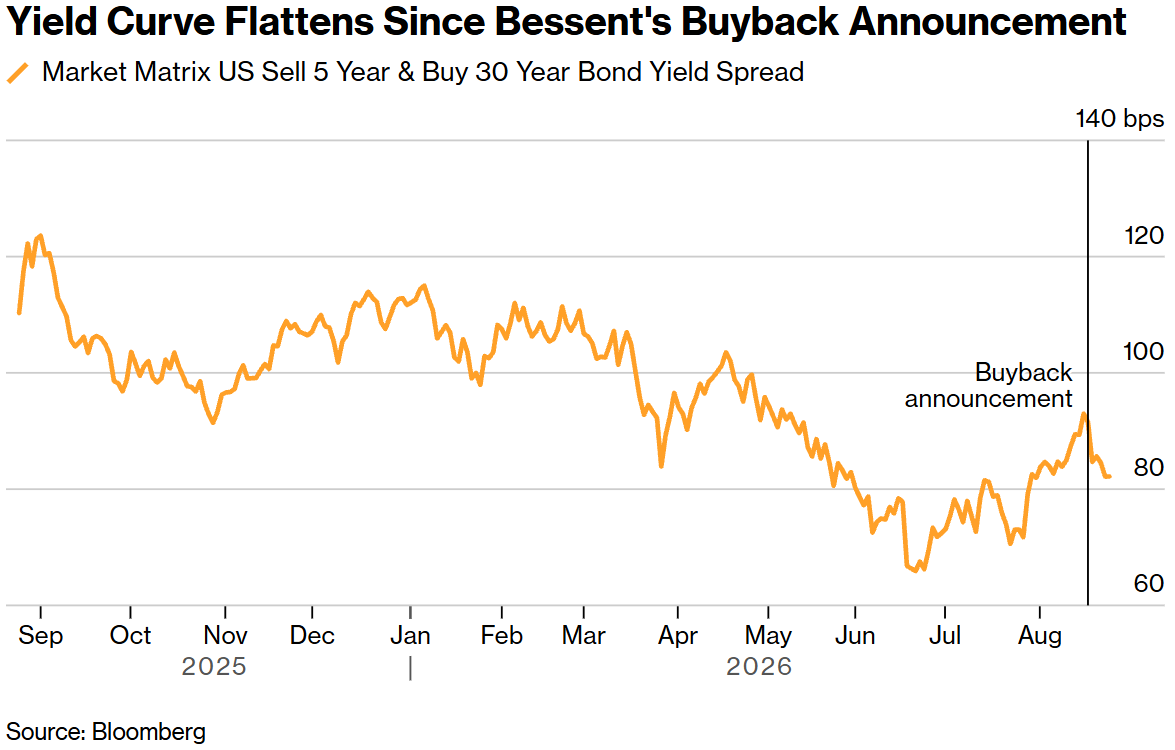
The yield curve has leveled off since Bezent announced its buyback plan
Bezent's unexpected plan — announced just two weeks after the Treasury released the old bond repurchase schedule — provided market support by reducing the supply of long-term bonds. Barclays strategists estimate that the increased repurchases could reach $64 billion a year, equivalent to about 15% of the current annual supply of 20- and 30-year treasury bonds.
Kanduja called it “quantitative easing,” and said that since the Ministry of Finance is removing some long-term risks from the market, this intervention may also boost risky assets. As a result, he raised investment-grade corporate bonds, cut lower risk home mortgage-backed securities (MBS), and bet that the dollar would weaken against high-yield emerging market currencies.
Bezent's move drew criticism and was deemed unlikely to have a lasting impact. Potential concerns remain, including inflation, fiscal deficits, and the bond market's already facing a massive supply of debt from tech companies to finance AI infrastructure. Bezent's former mentor, famous investor Drucken Miller, claimed in an op-ed that the intervention was a mistake.
Strategists at Deutsche Bank, J.P. Morgan Chase, and Goldman Sachs Group also expect that as long-term yields eventually rise, the yield curve will continue to steep.
Canduja said he expected the intervention of the Ministry of Finance to limit the earnings of so-called “steep transactions” that fund managers had previously poured in.
In addition to buybacks, Besant also hinted that he might reduce the issuance of long-term debt and took measures seen as easing the pressure on Japan to sell off US bonds.
“This is a series of unconventional steps,” Kanduja said. “The signal that was sent was extremely strong.”
He added that the Ministry of Finance may also shift borrowing to shorter-term treasury bonds or encourage banks to buy more government bonds. “You need the determination to 'do whatever the cost' to stop this trend.”