
- PRICING
- LIVE QUOTES
- LEARN
- HELP


EN
Four and a half years are the most optimistic! German exporters' confidence rebounded: EU demand became the key engine, but weak exports to China and the shadow of the automobile crisis have not dissipated
The Zhitong Finance App learned that German exporters' confidence climbed to the highest point in four and a half years in August, mainly driven by optimism about the business prospects of EU partners. This data adds new evidence to the recovery trend of Europe's largest economy.
According to the latest survey released by the German Ifo Institute for Economic Research on Wednesday, the export expectations index for August rose sharply from -2.8 points in July to 9.6 points, the highest level since February 2022, and also the biggest monthly increase in more than six years.
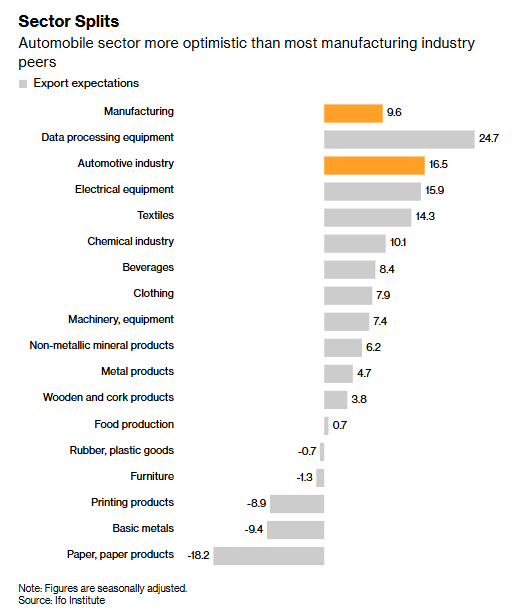
Ifo economist Klaus Wollaber said: “The export industry is picking up at an accelerated pace. Exports to the EU are particularly strong, while exports to China are still weak.” According to the survey, data processing equipment, electrical equipment and car manufacturers are the main forces driving the improvement in confidence, even though the automotive industry is still facing its worst crisis in decades.
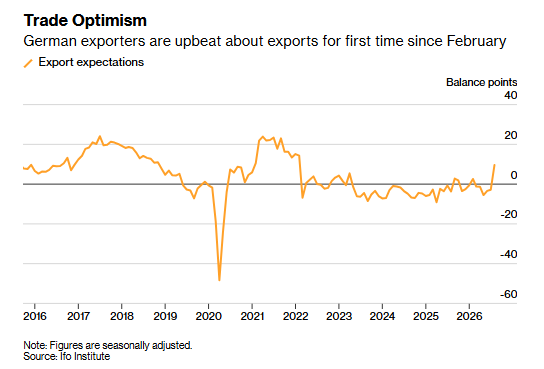
Official data released on Tuesday also confirmed the recovery in exports. According to data from the German Federal Statistical Office, Germany's economic growth in the second quarter was stronger than the initial value, and exports increased 2.0% month-on-month, which is one of the important reasons why economic performance exceeded expectations. This shows that after years of stagnation, the country's economic growth has finally begun to accumulate momentum. Furthermore, Ifo's overall corporate expectations index rose more than analysts' average expectations in August.
By industry, manufacturers of electrical equipment, data processing equipment, and electronic and optical products are very optimistic about export prospects, reflecting the acceleration of the digitization process and high investment in the field of artificial intelligence (AI). Export expectations from the automotive industry and metal product manufacturers have also improved markedly. In contrast, the paper industry and metal production and processing companies are expected to experience a decline in exports.
Dirk Jandula, president of the German Association of Foreign Trade and Wholesalers (BGA), said that after years of economic weakness, the return of confidence in some industries and the recovery in orders is encouraging. BGA currently expects German exports to increase by 0.6% in 2026 compared to the previous year.
However, Yandula also cautioned that it is still too early to announce that Europe's largest economy has ushered in a turning point, and it remains to be seen whether improvements can be transformed into private investment and continued growth in export momentum. He said that some of the better data came from large orders and government-supported investments, while future-oriented fields such as digitalization and AI provided additional growth impetus.
Meanwhile, German automobile exports to China have declined sharply in recent months. Volkswagen (VWAGY.US), BMW, and Mercedes-Benz (MBGYYY.US) have all lowered their performance forecasts due to poor performance in the world's largest automobile market. Major car companies are making efforts to cut costs and improve efficiency. Among them, Volkswagen is particularly difficult. It is currently in negotiations with the labor side on issues such as layoffs and factory closures.