
- PRICING
- LIVE QUOTES
- LEARN
- HELP


EN
Simply exceeding expectations will not satisfy the market! Nvidia (NVDA.US) must use Rubin demand and production capacity to calm the huge wave of “AI circular financing”
The Zhitong Finance App learned that against the backdrop of the AI computing power theme being affected by the “AI credit bubble,” rising long-term US bond yields, and geopolitical risks, the second fiscal quarter performance report and future outlook to be disclosed by the Earth's most important stock, the “AI chip superpower” NVDA.US (NVDA.US), has surpassed the performance test of a single chip leader and has become a system-level stress test for the global AI capital expenditure cycle. What the market is really concerned about is whether revenue and profit can exceed expectations, but whether the next-generation AI computing power cluster, Vera-Rubin computing power demand will show more strength than Blackwell architectures under the AI application-side expansion trend, whether AI revenue generation by hyperscale cloud computing vendors will accelerate expansion, and whether AI computing power construction will begin to shift from “grabbing GPUs at any cost” to stricter capital discipline and return on investment restrictions.
The core variables that will determine the next stage of the valuation of Nvidia and the entire AI computing power industry chain will be Blackwell's demand, Vera Rubin's demand outlook and the pace of production capacity climbing, gross profit margin, memory price increase transmission capacity, and management's judgment on the customer's forward capital expenditure. Nvidia's current projected price-earnings ratio for the next 12 months, which is about 19 times the low since the end of 2018, but it fell five times the next day after the previous six earnings reports were announced, indicating that “performance exceeding expectations” has become the default script. Only guidelines sufficient to push forward the revision of future profit forecasts can restart valuation expansion.
The more critical risk comes from the market's growing concerns about circular financing (Circular Financing). On the one hand, Nvidia is participating in an AI infrastructure financing arrangement with a scale of 500 billion US dollars, and on the other hand, it may also provide up to 105 billion US dollars in support of data center projects leased by OpenAI. The market needs to determine whether these arrangements are releasing real and financing-bound computing power requirements, or whether they are bringing part of future demand forward to the present through credit support from Nvidia itself and partner financial institutions.
If Nvidia's performance and outlook, and Nvidia's management, where Huang Renxun works can prove that there is a healthy closed loop between terminal token reasoning computing power requirements, customer cash flow, and computing power procurement, Nvidia's financial report may rekindle the AI investment boom — AI computing power topics are likely to not only revolve around Nvidia's GPU computing power clusters, but also further accelerate to HBM/DRAM/NAND, CoOS/3D advanced packaging, MLCC/ABF carriers, data center CPUs, high-performance network infrastructure, optical interconnection, liquid cooling, and data center power chains The entire AI computing power industry chain, such as infrastructure, has formed a new round of “main rising” supermarkets at the industrial chain level.
“AI referendum” after seven consecutive declines: Nvidia not only submits financial reports, but also tests the belief in computing power
Wall Street institutional investors are eagerly awaiting Nvidia's results after the US stock market on Wednesday local time (Thursday morning Beijing time), not so much to understand what these numbers mean for the chip giant, but rather to determine what they mean for investors focusing on artificial intelligence and the market as a whole.
“Nvidia is the best barometer for measuring AI computing power infrastructure spending,” said Rob Conzo, CEO of Wealth Alliance, which holds Nvidia shares in multiple portfolios. “It will help determine whether hyperscale cloud computing vendors are still expanding at an accelerated pace in terms of computing power infrastructure, or are starting to become more disciplined.”
The company's stock price experienced sharp fluctuations this year: continued to fall in winter, soared sharply in spring, and fluctuated repeatedly throughout the summer against the backdrop of AI deleveraging storms, extremely bullish position clearing, and AI credit storms. Nvidia has just experienced seven consecutive trading days of decline, tying the record for the longest continuous decline since 2019, during which time it has accumulated a 7.5% decline. Prior to that, the stock had surged 19% from the end of July to mid-August.
Overall, Nvidia has accumulated a 14% increase since 2026, which is a good performance compared to the US stock market benchmark, but it is still far from previous gains. Over the same period last year, the stock had a cumulative increase of 34%; in the same period in 2024, it surged more than 150%. The reason is not mysterious: against the backdrop of increasingly heated leveraged positions, continued high inflation, rising interest rates, and geopolitical risks, investors are increasingly cautious about whether AI computing power-themed transactions can last, whether it's the military and economic war launched by the US against Iran, a trade war between the US and Canada, or the unprecedented scale of AI-related technology companies' debt issuance, which has heightened this concern.
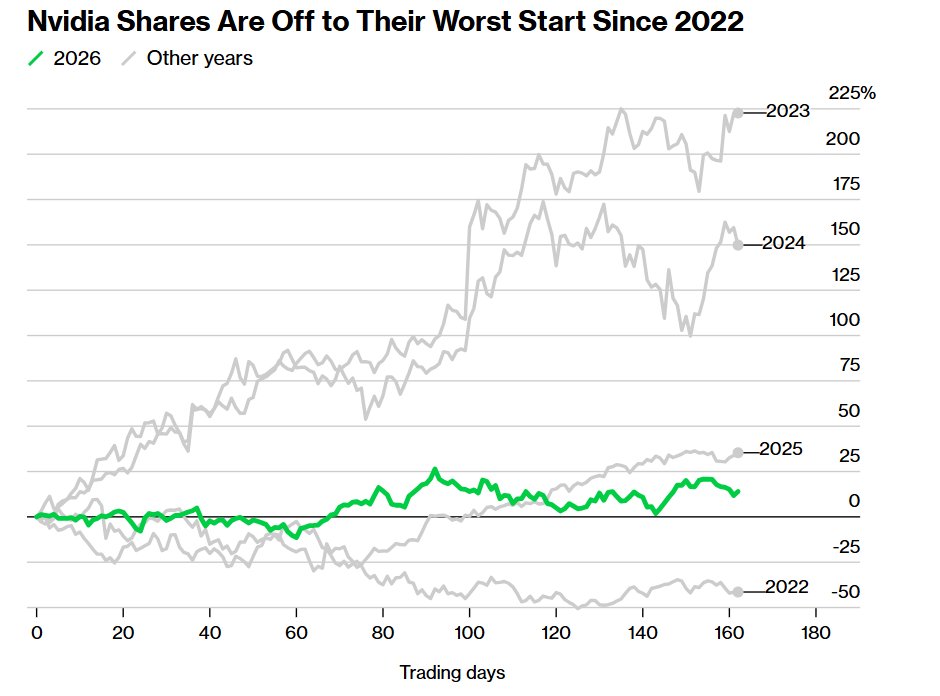
As shown in the chart above, Nvidia's stock price experienced its worst start to the year since 2022.
The Nasdaq 100 index, which is dominated by technology stocks, experienced its worst performance in more than a year in July, falling 6.6%. Investors are still selling shares of technology companies related to AI computing power infrastructure construction due to concerns about how long huge AI spending will last and that the AI debt issuance frenzy may cause a default storm. However, since bottoming out on July 29, the index has recovered most of its losses. Among them, optical communication/optical interconnection and storage companies such as Lumentum and SanDisk, as well as AI semiconductor leaders such as Maywell Technology, led the way.
Real torture beyond performance numbers: the pace of customer capital expenditure, server equipment price increases, and revolving financing
Wall Street institutional investors generally expect Nvidia to deliver impressive results in the second fiscal quarter ending July 31. According to data compiled by Bloomberg, analysts agree that the company's overall revenue will nearly double compared to the same period last year, the fastest growth rate in two years; net profit will also nearly double.
Other large technology companies, including Microsoft, Google, Amazon, and Tesla (the so-called Magnificent Seven), announced their results nearly a month ago, and Nvidia will finally reveal its detailed financial data performance for the second quarter and future quarterly results forecasts.
Wall Street unanimously expects revenue of around $92 billion and adjusted earnings per share of $2.09, of which data center business revenue is expected to reach an astonishing $85.4 billion, an increase of 107% year over year; however, Wall Street financial giant Jefferies (Jefferies) has pushed the “real bullish threshold/threshold” to $95 billion for the second fiscal quarter and approximately $108 billion for the next fiscal quarter. The options market, on the other hand, takes into account bidirectional fluctuations of about 6% to 7%, corresponding to changes in market capitalization of more than US$320 billion, and Nvidia still declined the next day after four consecutive strong earnings reports and forecasts, indicating that simply beating the market's unanimous expectations is not enough to drive a new round of strong gains in the AI computing power industry chain.
These data, which are likely to exceed the market's general average expectations, may not be the focus of the market's attention. Investors would also like to hear how CEO Wong In-hoon assesses the capital expenses, future needs of the largest cloud computing customers, and a series of recent new financing deals involving Nvidia. Due to the soaring cost of DRAM memory/memory chips, some Nvidia customers have been told that the price of servers equipped with their AI chips will rise by more than 15% under certain circumstances, so the issue of price increases will also become the focus of attention.
“This will be a very interesting financial report, but the focus isn't entirely on the numbers themselves,” Conzo said. “The market will pay far more attention to discussions on long-term guidance.”
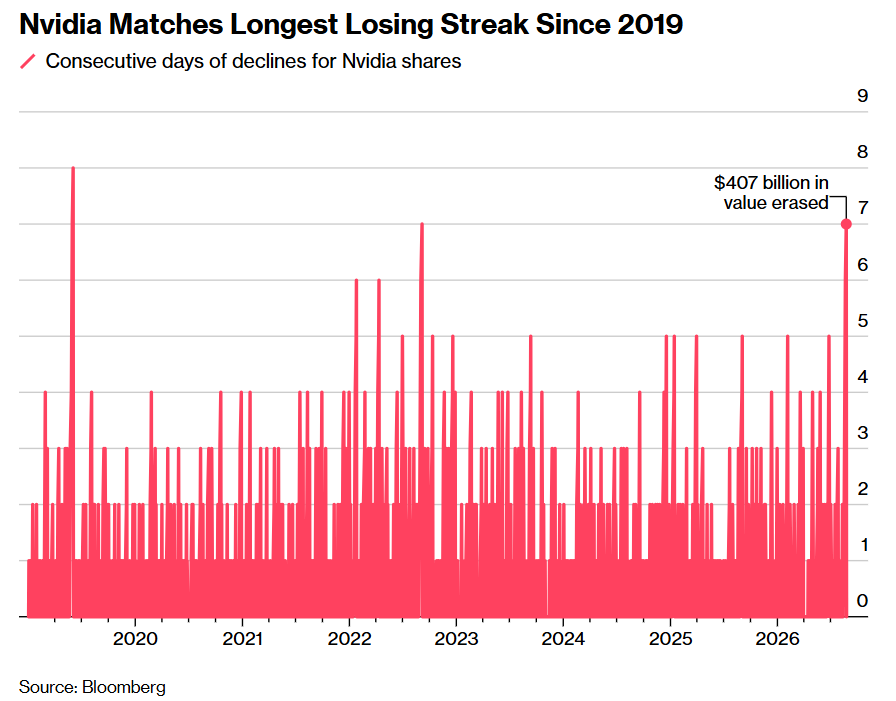
As shown in the chart above, Nvidia tied the record for the longest losing streak since 2019
Earlier this month, Nvidia said it would cooperate with Wall Street institutions such as Goldman Sachs Group, BlackRock, and Apollo Global Management to provide 500 billion US dollars in financing for the construction of global AI computing power infrastructure. Nvidia has also agreed to invest up to $105 billion to support a data center campus in Ohio that will be leased by OpenAI.
“They need to discuss these two large collaborations or agreements in great detail and ease market concerns about revolving finance to a certain extent,” said Janus Henderson senior stock analyst Sean Bucky, who holds a large number of Nvidia shares.
The core question raised by investors is: How much of Nvidia's revenue data is actually driven by its own financing? Are these arrangements creating demand, or are future needs brought forward to the present? Daniel Pilling, portfolio manager at Sands Capital Management Company, which holds a large number of Nvidia shares, believes that Hwang In-hoon's comments alone may not be enough to resolve some of the market's current concerns about AI revolving financing and AI computing power capital expenditure that can be strong for a long time.
“This is going to be a very important quarter for Nvidia. The importance is not what it does on its balance sheet, but what it does outside of its balance sheet,” said Brian Mulberry, chief market strategist at Zacks Investment Management, which holds Nvidia shares. “This actually makes Hwang In-hoon a bit like the pope in the field of AI training/reasoning — he can 'bless' any such deal.”
Nvidia, which is 19 times the valuation, stands at a crossroads: Rubin and Blackwell decide the next AI superbull market
Even though Nvidia has more than $5 trillion and the world's top market capitalization of more than $5 trillion, its stock valuation has continued to decline this year. Based on the expected profit for the next 12 months, the stock's price-earnings ratio is about 19 times, which is close to the lowest level since the end of 2018; the AI revolution had not yet fully erupted at the time, and the chip giant's market value was less than 100 billion US dollars.
“Nvidia is no longer the most exciting part of the market, or even the most exciting part of the AI computing power trading theme,” said Randy Hale, head of stock research at Huntington National Bank, which holds Nvidia shares. “Currently, the real supply is tight in the energy sector related to memory/memory chips, data center high-speed optical devices, and AI data centers. “Market momentum is shifting from semiconductors to other infrastructure bottlenecks, which may then accelerate again to hyperscale cloud computing vendors.”
From the perspective of trading before the earnings report was announced, according to data compiled by Bloomberg, Nvidia shares did not perform well after the release of the last few quarterly earnings reports. Five of the past six earnings reports fell the next day. The options market currently accounts for about 6%-7% of the two-way fluctuation after earnings reports.
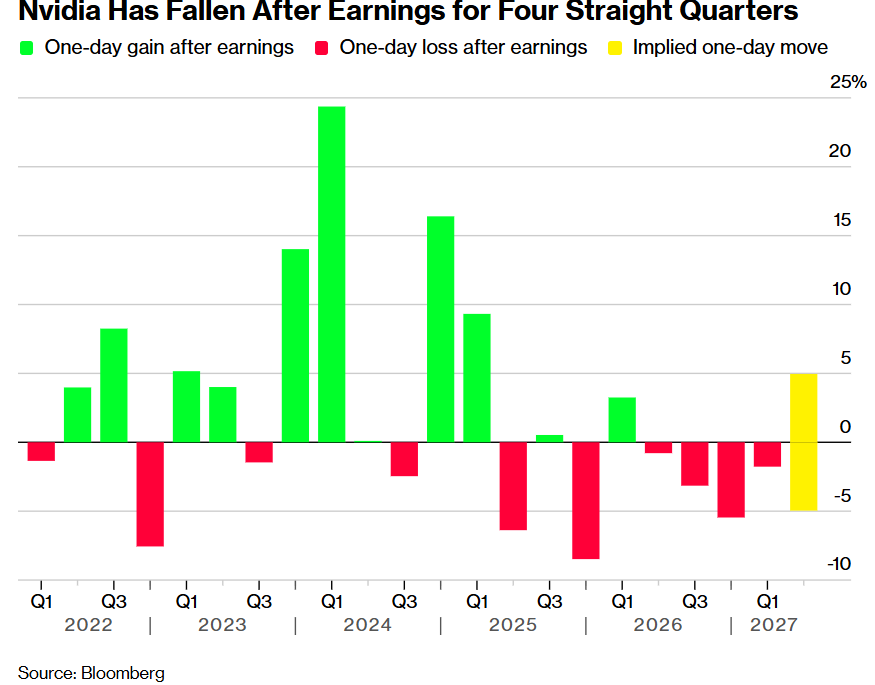
As shown in the chart above, Nvidia's stock price has been falling rather than rising for four consecutive quarters since the earnings report was announced.
Of course, strong performance and future quarterly forecasts, as well as management predictions that can calm investor sentiment, may still push Nvidia's stock price towards a new round of upward trajectory, and it is expected that a wider range of AI computing power transactions will be reactivated. Wall Street will keep a close eye on the latest information on Nvidia's Vera Rubin and Blackwell computing power cluster sales, as well as the company's gross margin outlook.
“In my opinion, Nvidia's stock price is at a critical intersection, or turning point,” said Melissa Otto, head of technology, media and telecommunications research at Visible Alpha. “We're looking forward to more visibility and the latest Nvidia management comments on Rubin and Blackwell's performance.”
Nvidia's current earnings report has been upgraded from a “chip leader quarterly report card” to a system-level stress test of the AI capital expenditure cycle: it will also verify the GPU procurement intensity of hyperscale cloud computing vendors, the financial sustainability of AI laboratories, the continuity of Blackwell's switch to Rubin, and whether huge computing power investments can be converted into token revenue and free cash flow. At a time when AI-related credit spreads are widening, long-term US bond yields are rising, and data center financing structures are being questioned, what the market really needs to confirm is “whether the AI computing power level continues to grow,” but whether the growth is still sufficient to cover higher capital, electricity, and server costs.
The core influence on Nvidia's mid-term valuation is undoubtedly whether Rubin can achieve a “seamless transition” rather than simply proving that Blackwell's demand is still strong. Jefferies expects Rubin to account for about 12% of GPU revenue in the third quarter of fiscal year 2027, rise to more than 40% in the fourth quarter, and become the leading product with shipments of about 2 million units in the first quarter of fiscal year 2028; it follows the NVL72 rack form, reuses liquid cooling infrastructure, and reduces computing tray assembly time from about 2 hours to 5 minutes, which is expected to significantly reduce manufacturing and deployment friction between generations. However, investors will also ask whether Vera CPU's independent demand, CPO optical interconnection extensions, increased memory costs can be transferred through server price increases, and whether the shortage of electricity and grid connections will prevent “chip orders” from being converted into data center revenue data on time. Therefore, the real investment significance of Rubin's demand and pace of mass production is not only higher computing power, but also whether Nvidia can standardize GPUs, CPUs, NVLink, network infrastructure components, and liquid cooling systems into “AI factories” that can be replicated and deployed.
The most sensitive long-term issues are undoubtedly OpenAI's computing power commitments and circular financing (Circular Financing). Nvidia participated in the $500 billion AI infrastructure financing platform and provided support for the Ohio project leased by OpenAI; based on this, Jefferies estimates that OpenAI's existing and planned 12 to 16 gigawatts of computing power blueprint may correspond to about $600 billion of potential revenue by 2030.
However, these strong revolving financing agreements mentioned above are not equivalent to confirmed and irrevocable accounting orders: the market requires management to disclose the extent of leasing and electricity payment support, residual value guarantees, contingent liabilities, and early release of demand. If Nvidia also surrenders higher than Jeffrey's threshold guidelines, clear financing disclosure, smooth Rubin production capacity climbing, stronger Rubin demand than Blackwell, and stable gross profit margins, AI computing power trading may re-enter the main upward wave and fully spread to HBM, optical communications, networks, liquid cooling and power equipment; if it only exceeds expectations, it avoids capital responsibility and customer return issues. Capital may continue to accelerate from the main line of computing power investment to other high-quality stocks with lower concentration of positions and sufficient free cash flow value over a long period of time blocks, etc.