
- PRICING
- LIVE QUOTES
- LEARN
- HELP


EN
After the results, it plummeted 30%! Dick Sporting Goods (DKS.US) performance has skyrocketed, and Wall Street investment banks collectively cut target prices
The Zhitong Finance App learned that a “performance avalanche” caused by a storm of promotions in the sneaker and apparel market caused Dick Sporting Goods (DKS.US), the largest sporting goods retailer in the US, to experience the worst trading day in 24 years since its launch. On Tuesday, the stock closed down 30.68% to $124.32, the biggest one-day decline since the 2002 IPO. The volume soared to 37.9 million shares, 18 times the three-month average daily turnover. Meanwhile, after the results were announced, Wall Street investment banks lowered their target prices one after another.
Earnings Report “Double Miss”: Combined, revenue soared 53%, but profits were diluted
For the second fiscal quarter ending August 1, 2026, Dick Sporting Goods handed over a “mixture of ice and fire” report card:
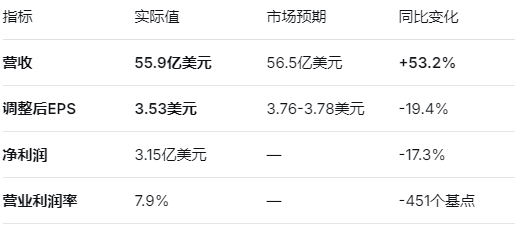
The explosive increase in revenue was entirely due to the combined contribution of the Foot Locker business, which was acquired for $2.4 billion in September 2025 — the division contributed approximately $1.74 billion in net sales this quarter. Excluding combined factors, Dick's main business net sales were US$3.85 billion, a modest increase over US$3.65 billion in the same period last year.
However, it is the deterioration of the profit side that is the root cause of market panic. The consolidated operating margin plummeted from 12.4% in the same period last year to 7.9%, a sharp drop of 451 basis points. Net profit shrunk from $381 million to $315 million. The dilution effect was also significant — 9.6 million additional shares issued during the acquisition of Foot Locker increased the weighted average diluted share capital by about 12% year over year.
Annual guide to “cliff-style downsizing”: the median EPS value plummeted 19%
The most fearful sign in the market comes from an overall reduction in the full-year guidance:
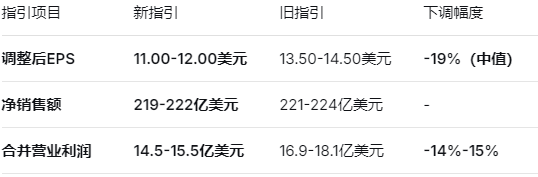
The median value of the new EPS guidance is $11.50, which is 19% lower than analysts' previous expectations of $14.20. Foot Locker's full-year outlook was reversed from profit of 110 million to 150 million US dollars, which was reversed to a loss of 40 million to 80 million US dollars. Dick's main business's annual same-store growth guideline of 2.5% to 4.0% remained unchanged, but the Foot Locker exam preparation outlook was lowered to -2.0% to 0.0%.
Core differentiation: Dick's main business grew by 4.9%, but Foot Locker is mired in promotion quagmire
Management split the business into two distinct narratives in the financial report.
Dick's main business (including brands such as Dick's and Golf Galaxy) handed over a solid report card: same-store sales increased by 4.9%, and growth in a wide range of categories of footwear, clothing, and hardware, customer unit prices rose 3.6%, and number of transactions increased 1.3%. Chairman Ed Stack said the company was still expanding its market share while the industry was under pressure.
The Foot Locker business was the only “bleeding point” in the financial report. According to test preparation standards, same-store sales declined by 3.6%, and the division lost about US$31.88 million. Stack confessed during the earnings call that after entering the second quarter, “promotions in some sports shoes and clothing markets deepened, and the company followed up pricing to maintain its share.” Foot Locker was hit even harder. Because it “relies more on traditional shoe types and sales and reproduction products,” “the number of sales volume decreased in the second quarter, and the market response of the products already sold was lower than expected by the industry and the company.”
Overstock is at the heart of the problem. Stack acknowledged that “inventory levels are piling up in some sectors of the industry,” particularly in the field of sports shoes and apparel, “causing the promotion environment to deteriorate drastically.”
The industry promotion war has been fully escalated: the double impact of inventory backlog and changes in consumer preferences
The core reason for this explosive performance is that the sneaker and apparel market is completely engulfed in a fierce promotion war. Ed Stack, the company's executive chairman, confessed during the earnings call that after entering the second quarter, “inventory levels began to accumulate in some areas of the industry,” especially in the field of sneakers and apparel, “leading to a significant increase in the promotional environment.”
Stack pointed out that part of the reason is that consumer preferences are shifting from certain traditional shoe models and clothing lines, and brands are starting to step up promotions on their own websites, and discounts then spread to the entire market. He said bluntly: “Consumers are looking for new, innovative, and unique products on the market. Some of the older shoe types and series that performed well in the past have been slowing down, and at a fairly rapid pace.”
The promotional environment has had a particularly severe impact on Foot Locker, as it relies more on traditional shoe types and sales and reproduction products. The number of sales declined in the second quarter, and the market response of products already sold “fell short of industry and company expectations.”
Dick's plunge triggered a ripple effect in the sportswear sector, and Under Armour (UAA.US) fell 3%. Dick has accumulated a cumulative decline of 32.1% during the year.
Cristina Fernández, an analyst at Telsey Advisory Group, stated: “Although several sports brands have indicated weakness in the US wholesale market in the second quarter, Dick's drastic cuts in full-year guidance were still unexpected, showing the sensitivity of the Foot Locker business to footwear market trends.”
The target price was drastically lowered by Wall Street investment banks
After the earnings report was released, Wall Street analysts set off a wave of downgrades in ratings and target prices:
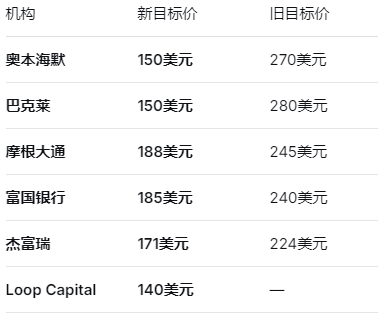
Oppenheimer's drop was the most spectacular — a direct cut of 44% from $270 to $150. Despite the massive downgrade, the consensus rating of 26 analysts from S&P Global is still “buy,” with an average target price of $224.95. The market capitalization evaporated about $5 billion on Tuesday, almost double the price it paid to acquire Foot Locker ($2.4 billion).
Commenting on the report, UBS analyst Michael Lasser said that the key question is whether the current state of the sneaker apparel market will continue for a long time and how this will affect the company's profitability.
However, according to S&P Global's survey of 26 analysts, the overall consensus rating is still “buy,” and the company's current price-earnings ratio is below the industry average, and the dividend ratio is 4%. Barclays pointed out that despite facing a promotional environment, Dick's Sporting Goods core business is still strong, and the long-term development prospects are still steady. Citibank is also still optimistic about the company's long-term prospects, but at the same time admits that the lowered profit margin before interest and tax and Foot Locker's sales expectations were a major negative surprise.