
- PRICING
- LIVE QUOTES
- LEARN
- HELP


EN
Supply pressure continues to intensify, and copper prices have risen for four consecutive days and are approaching record highs
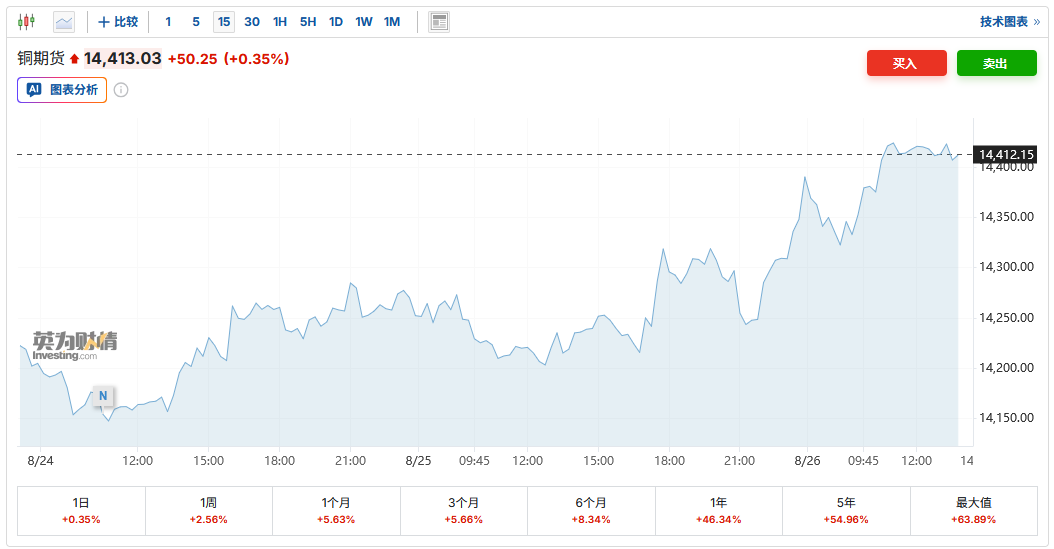
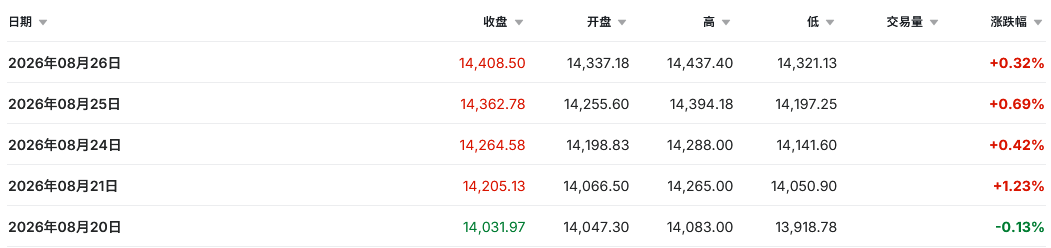
The Zhitong Finance App learned that although large-scale deliveries of copper to the London Metal Exchange (LME) last week eased one of the biggest tight positions in the history of the copper market, copper prices rose for the fourth consecutive trading day and are approaching historic highs due to short-term supply still tightening. As of press release, LME copper futures rose 0.35% to 14413.03 US dollars/ton, and once rose to 14437.40 US dollars/ton during the day, approaching the historical high of 14527.50 US dollars/ton set in January this year.
Previously, due to traders planning for the possibility that the US Trump administration might announce import tariffs on refined copper, large amounts of copper resources flowed to the US, and copper stocks in other regions of the world were continuously withdrawn. According to shipping data compiled by IHS Markit, about 56,000 tons of copper arrived in the US in the first two weeks of August. Excluding July's record imports of 223,000 tons of copper, the import volume in August is basically in line with the average monthly level of the past year or so.
Notably, although the June 30 deadline for US Secretary of Commerce Lutnick to submit tariff proposals has passed, the White House has yet to announce the final policy. Producers, consumers, and traders are closely watching whether Trump will further extend current trade protection measures for semi-finished copper products to refined raw materials such as copper.
Meanwhile, according to data from the consulting agency Project Blue, global copper market supply declined by about 338,000 tons in the first half of this year due to the blockage of mining production in Indonesia, the Democratic Republic of the Congo, and Chile. As long-term demand from artificial intelligence (AI), renewable energy, and power grid construction continues to grow, any disruption in mine operations will further increase supply pressure.
This situation eventually led to a sharp widening of the LME copper price gap last week. Spot copper prices were once more than 500 US dollars per ton higher than the three-month futures price. Although this spread has narrowed since then, it is still significantly higher than normal. On Wednesday, the price of the LME September contract was 150 US dollars per ton higher than the October contract, and the difference was less than 50 US dollars last weekend.
Furthermore, easing concerns about the geopolitical conflict in the Middle East also boosted copper prices. According to reports, Iran and Oman issued a joint statement on August 25 to establish a safe maritime channel jointly agreed upon by both parties in the Strait of Hormuz. According to the statement, the proposed framework includes establishing a safe shipping corridor mutually agreed upon by both parties in the Strait of Hormuz, reaching joint arrangements for the operation of the corridor, establishing a coordination mechanism involving the two countries' coast guards, and continuing coordination on future management, information exchange, traffic management, and related navigation and safety services in the Strait of Hormuz. The statement said that in view of the current situation in the Strait of Hormuz and the serious consequences of the recent war, the two sides discussed a phased framework to provide a practical implementation basis for follow-up work.
Iran's Deputy Foreign Minister Garibabadi said that according to the new understanding between Iran and Oman on the Strait of Hormuz route, routes entering the Persian Gulf will pass through Iranian waters, and routes leaving the Persian Gulf will pass through Amman and Iranian waters. No warships will be allowed to pass through this strait; only merchant ships will be allowed to pass through this strait. However, Garibabadi also said that the understanding between Iran and Oman does not mean the immediate opening of the Strait of Hormuz. The above traffic arrangement is a temporary measure, and the two countries will then begin negotiations on the establishment of a new permanent route within 30 to 60 days.
Also, according to reports, US Secretary of State Rubio recently told several US Union foreign ministers that the US is not expected to launch a new attack on Iran for the time being, and the current focus is shifting to other means of pressure, including economic sanctions. The US State Department is preparing to allow evacuated diplomats back to the Middle East, probably as soon as this week. The market believes that this trend shows that the US side does not expect an all-out war in the region.
Looking at the medium to long term, copper prices are still expected to be supported. On the demand side, copper is widely used in various fields such as electric vehicle batteries and data centers. Under the wave of rapid advances in global artificial intelligence (AI) computing power infrastructure, data centers are becoming veritable “new copper mines.” Copper, a traditional industrial metal, has become a core material supporting the development of the artificial intelligence industry due to its irreplaceable electrical and thermal conductivity. The Morgan Stanley report predicts that global data center copper consumption will increase to 740,000 tons in 2026, contributing 0.6 percentage points to the increase in global copper demand; by 2027, data center copper consumption is expected to reach 1 million tons (2.8% of total demand), and further increase to 1.3 million tons (accounting for 3.3%) in 2028, with a compound annual growth rate of 40%.
In an earlier report, Jefferies estimated that by 2030, total global copper demand will reach 30.93 million tons, with a compound annual growth rate of 2.1% from 2025 to 2030. Among them, electric vehicles led the way with a growth rate of 9.6%, and data centers and renewable energy (wind power+photovoltaics, excluding power grids) also reached 6.1% and 6.7%, respectively. On the supply side, it is difficult to keep up with the pace. The global copper supply in 2030 is expected to be only 3.09 million tons, which would mean a gap of about 840,000 tons.
Jefferies put it bluntly: “Even in a world where the global GDP growth rate is only 2%, the copper market will still experience significant supply and demand shortages over the next 12 months and more.” This means that the core driving force behind this round of rising copper prices is not short-term excitement fueled by macro-sentiment, but rather a real “physical shortage” on the supply side. The copper market may be leaving the cyclical cycle of “rising for three years and falling for two years” in the past, and it is likely that it is facing a mismatch between supply and demand that will continue for several years.