
- PRICING
- LIVE QUOTES
- LEARN
- HELP


EN
FedEx (FDX) Stock May Be 34% Undervalued As Job Cuts Begin
FedEx stock has surged over the past year, yet valuation checks suggest the shares may still trade below an estimate of intrinsic value based on a Discounted Cash Flow (DCF) approach and earnings multiples that both screen as undervalued.
- FedEx has delivered a 82.8% return over the past year, which puts fresh focus on whether that move has already priced in the company’s improvement plans or still leaves room relative to fundamentals.
- The ongoing Network 2.0 consolidation, including facility closures and job cuts in Southern California, can support efficiency and cash flow over time. However, execution risk and restructuring costs may weigh on how quickly those benefits show up in the numbers.
- The stock earns a mixed value profile, with FedEx screening as undervalued on both a Discounted Cash Flow (DCF) estimate and market multiples. At the same time, broader checks show it is undervalued in 4 of 6 areas, which points to an opportunity but not a uniformly cheap picture.
The issue now is whether FedEx’s recent rally has already captured most of that apparent discount or if the current price still sits meaningfully below its intrinsic value estimate.
Does FedEx Look Undervalued on Cash Flow?
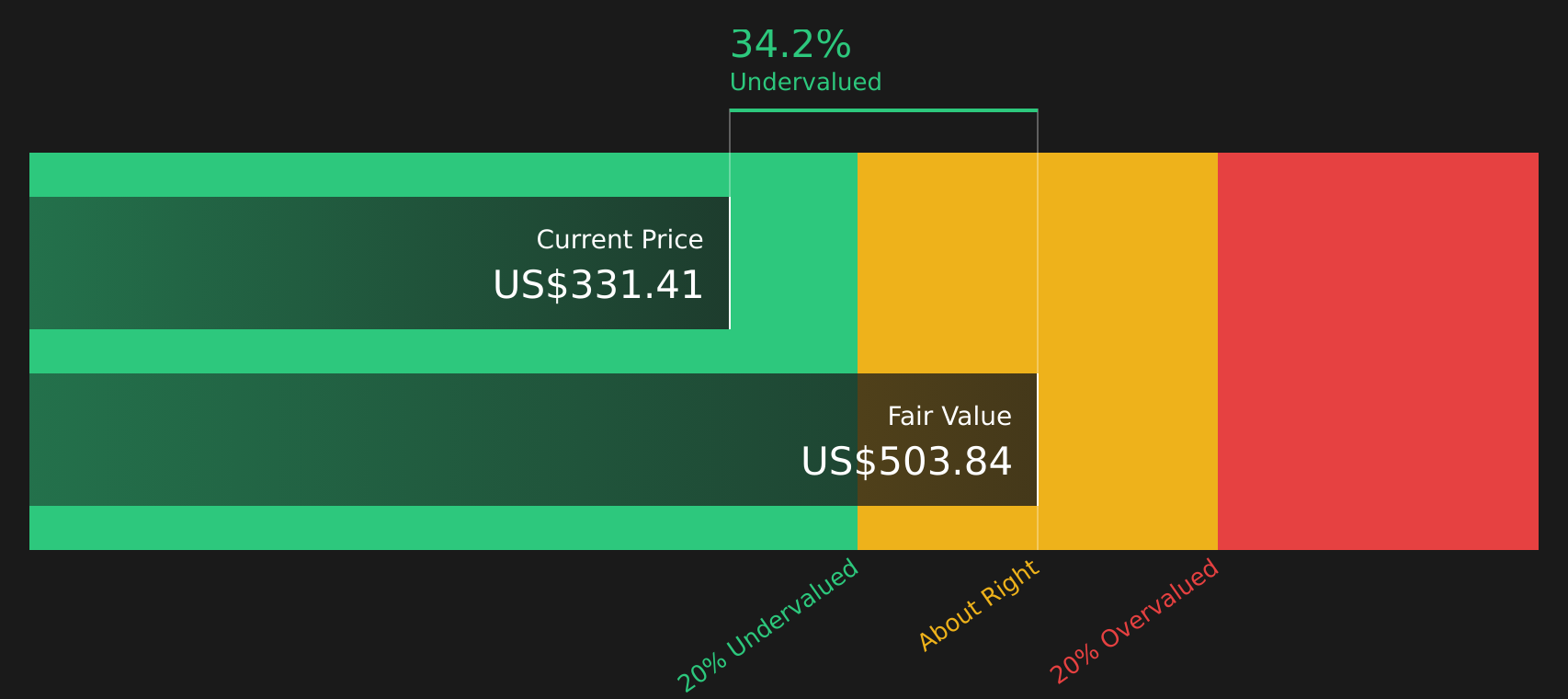
The Discounted Cash Flow (DCF) model estimates what FedEx is worth today based on projected future cash generation. For FedEx, the latest twelve-month free cash flow is about $4.4b, and the model assumes those cash flows keep growing from this base rather than shrinking.
On these projections, the DCF suggests an intrinsic value of about $504 per share, which is roughly 33.8% above the current share price estimate used in the model. On this cash flow view, the stock screens as undervalued. FedEx’s Network 2.0 consolidation, including the planned closure of the Victorville facility and related job cuts in Southern California, helps explain why some investors remain cautious even while the cash flow model indicates a higher value.
Putting it together, the Discounted Cash Flow estimate indicates FedEx stock currently looks undervalued relative to its projected cash generation.
Our Discounted Cash Flow (DCF) analysis suggests FedEx is undervalued by 33.8%. Track this in your watchlist or portfolio, or discover 49 more high quality undervalued stocks.
Is FedEx a Bargain on Earnings?
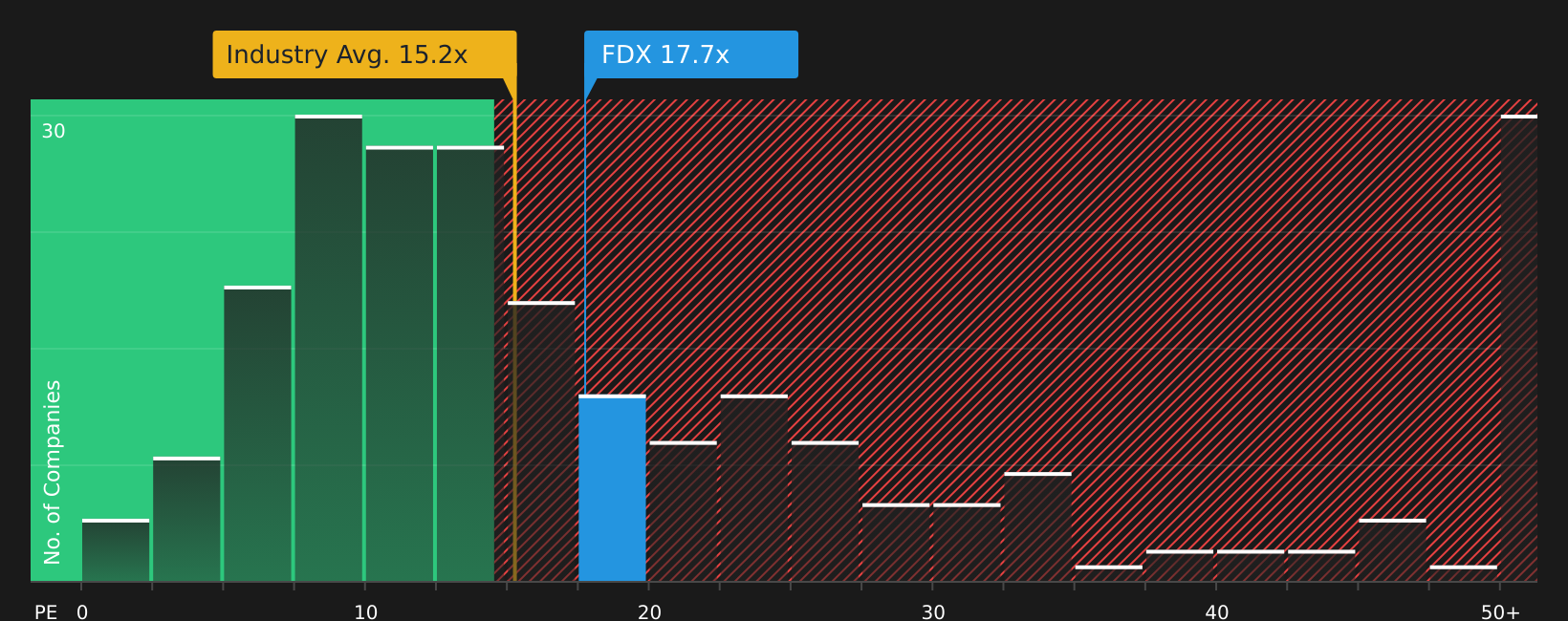
P/E is often a useful yardstick for FedEx because earnings are a key driver for a mature, profitable logistics business. It lets you see what investors are currently willing to pay for each dollar of FedEx earnings.
FedEx trades on a P/E of 17.8x, which is above the logistics industry average of 15.3x but below the peer group average of 20.9x. A tailored fair P/E ratio for FedEx, which considers the company’s specific growth profile, margins, size, and risk factors, is estimated at 23.5x. That is noticeably higher than the current multiple and indicates a discount on this framework rather than an aggressive valuation.
So even after the strong share price move, FedEx still trades at a lower P/E than the level suggested by this fair ratio model and below the wider peer average.
On the P/E multiple, FedEx stock currently appears undervalued relative to what investors might expect to pay for its earnings profile.
See what the numbers say about this price — find out in our valuation breakdown.
The FedEx Narrative: What Would Justify Today's Price?
Simply Wall St’s Narratives for FedEx are designed to close the gap between the valuation puzzle above and the assumptions that actually need to hold. They lay out the specific paths for FedEx’s future growth, margins, and earnings that would make the stock worth materially more or less than today’s price, and they turn single valuation outputs into sets of trackable conditions you can monitor over time on the company’s Community page.
FedEx investors are weighing two very different stories about how the Network 2.0 rebuild and Freight spin reshape the stock over the next few years.
Bull case: 5% undervalued
"FedEx's DRIVE initiative is achieving significant cost savings, with a target of $2.2 billion for FY '25 and a total of $4 billion compared to the FY '23 baseline..."
Read the full Bull Case to see why FedEx could be undervalued
Bear case: 47% overvalued
"The ongoing rise of integrated e-commerce giants like Amazon, low-cost regional carriers, and disintermediation by shippers building their own logistics networks will likely intensify price competition and reduce industry-wide yields..."
Read the full Bear Case to see why FedEx could be overvalued
Do you think there's more to the story for FedEx? Head over to our Community to see what others are saying!
The Bottom Line
FedEx looks undervalued on both the Discounted Cash Flow (DCF) intrinsic value estimate and the earnings multiple checks, although the broader value score is only mixed rather than a clear-cut signal. That combination indicates potential upside if the company can translate its consolidation plans into durable cash flow and margin improvement. The key question now is whether execution on Network 2.0 and related cost programs will be strong enough to support the intrinsic value estimate, as opposed to the current market view that still reflects meaningful risk.
This article by Simply Wall St is general in nature. We provide commentary based on historical data and analyst forecasts only using an unbiased methodology and our articles are not intended to be financial advice. It does not constitute a recommendation to buy or sell any stock, and does not take account of your objectives, or your financial situation. We aim to bring you long-term focused analysis driven by fundamental data. Note that our analysis may not factor in the latest price-sensitive company announcements or qualitative material. Simply Wall St has no position in any stocks mentioned.
Have feedback on this article? Concerned about the content? Get in touch with us directly. Alternatively, email editorial-team@simplywallst.com