
- PRICING
- LIVE QUOTES
- LEARN
- HELP


EN
NTT (TSE:9432) Stock Looks Reasonable On Earnings But Stretched On Cash Flow
NTT has produced a 69.2% return over the past 5 years, and at around ¥169.2 per share the stock no longer looks obviously cheap or stretched on headline metrics, with both the intrinsic value work and market multiples pointing to something closer to fair value.
- A 69.2% return over 5 years suggests NTT has already rewarded patient shareholders, so any new upside case now leans more on valuation discipline than on catching up from a depressed base.
- For long term holders, the main support for valuation can come from the company’s ability to convert revenue into stable cash flows, while any sustained pressure on margins or higher capital needs may limit how much investors are willing to pay for that cash flow stream.
- On Simply Wall St’s broader checks, NTT scores 3 out of 6, which is a mixed picture rather than a clear bargain or clear overvaluation.
The stock’s next move may depend on whether the current market price already captures what NTT’s Discounted Cash Flow (DCF) based intrinsic value estimate implies, or if there is still a reasonable gap either way.
Does NTT Look Fairly Valued on Cash Flow?
The Discounted Cash Flow (DCF) model here focuses on what NTT’s future cash flows could be worth today. The latest twelve month free cash flow is reported as a loss of ¥774.8b, which means the model leans heavily on a recovery path, with analysts and extensions assuming growing free cash flow over the coming decade before settling into a more mature phase.
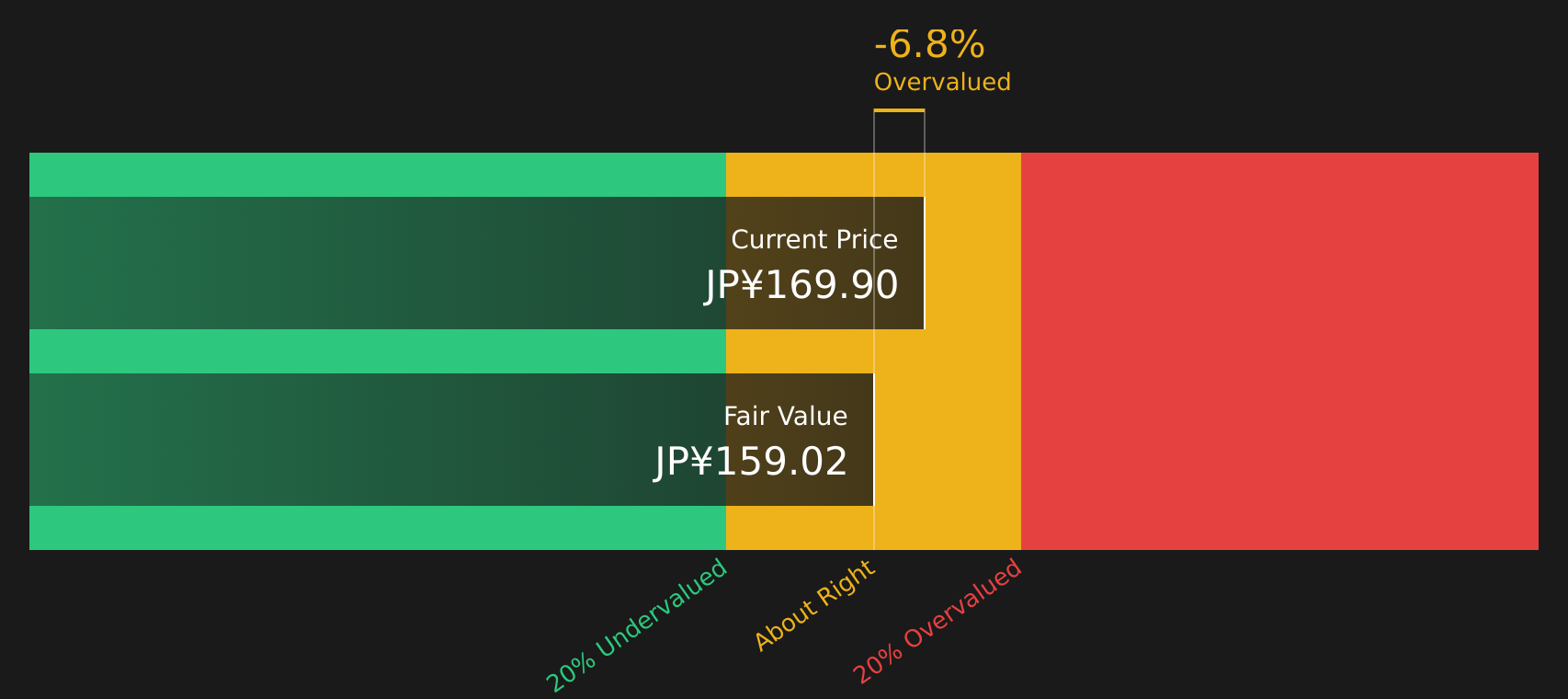
On these assumptions the DCF model points to an intrinsic value of about ¥158.84 per share. That sits slightly below the current market price of around ¥169.20, which implies the stock screens as roughly 6.5% overvalued on this method. The gap is not extreme, so for you as an investor the key question is whether you are comfortable with the implied turn from recent cash flow pressure to healthier long term levels.
On this DCF view, NTT currently looks about fairly valued with a slight tilt toward being overvalued.
NTT is fairly valued according to our Discounted Cash Flow (DCF), but this can change at a moment's notice. Track the value in your watchlist or portfolio and be alerted on when to act.
Is NTT Fairly Priced on Earnings?
The P/E ratio is a common way to compare what you pay for each unit of NTT’s earnings against similar telecom companies. NTT currently trades at about 13.1x earnings, which is below both the broader telecom industry average of roughly 17.0x and the peer group average of about 16.5x.
The fair P/E ratio for NTT, based on factors such as size, industry and risk profile, is estimated at about 13.3x. That sits close to the current 13.1x level, so the market price is largely in line with what this earnings based framework would imply. The modest discount to industry and peer averages indicates that investors are pricing NTT slightly more conservatively than some telecom stocks, but not in a way that suggests a clear bargain or premium.
On the P/E yardstick, NTT appears roughly fairly valued with only a small discount relative to its tailored fair multiple.

See what the numbers say about this price — find out in our valuation breakdown.
The NTT Narrative: What Would Justify Today's Price?
Simply Wall St Narratives pick up where the NTT valuation puzzle leaves off and spell out what kind of future path for growth, margins and earnings would need to hold for the stock to be worth meaningfully more or less than today’s price. They sit on the company’s Community page. Each narrative ties its number to a clear view on how NTT’s growth, profitability and risks could evolve, which you can revisit as fresh information comes through.
Community views on NTT are split. One camp sees long term digital infrastructure upside, while the other focuses on balance sheet and domestic headwinds.
Bull case: roughly fairly valued
"NTT's investment in proprietary technologies (e.g., IOWN, advanced LLMs like tsuzumi 2, and photonics) positions it to benefit from surging connectivity and low-latency compute requirements…"
Read the full Bull Case to see why NTT could be undervalued
Bear case: 18% overvalued
"The sustainability of recent profit growth is in question, as NTT's increase in operating profit has relied heavily on selling data center assets into REITs, a process which management has admitted is difficult to maintain at current scale going forward…"
Read the full Bear Case to see why NTT could be overvalued
Do you think there's more to the story for NTT? Head over to our Community to see what others are saying!
The Bottom Line
For NTT, the Discounted Cash Flow (DCF) work points to an intrinsic value that is a little below the current share price, while the P/E based view suggests the stock is priced about right compared with its tailored fair multiple. Together, the checks imply NTT is no longer clearly cheap and that future returns are more likely to depend on how effectively it converts revenue into steady free cash flow. The key question from here is whether NTT can support healthier long term cash generation without needing materially higher capital spending or sacrificing margins.
This article by Simply Wall St is general in nature. We provide commentary based on historical data and analyst forecasts only using an unbiased methodology and our articles are not intended to be financial advice. It does not constitute a recommendation to buy or sell any stock, and does not take account of your objectives, or your financial situation. We aim to bring you long-term focused analysis driven by fundamental data. Note that our analysis may not factor in the latest price-sensitive company announcements or qualitative material. Simply Wall St has no position in any stocks mentioned.
Have feedback on this article? Concerned about the content? Get in touch with us directly. Alternatively, email editorial-team@simplywallst.com