
- PRICING
- LIVE QUOTES
- LEARN
- HELP


EN
The “big test” for the US stock software sector is imminent! Earnings will verify the success of the rebound after the summer spike
The Zhitong Finance App learned that in the past month, the US stock software sector has performed strongly, and investors are betting that these previously sluggish stocks have regained their foothold. And the financial reports released one after another this week will be a key litmus test for whether this round of rebound is sustainable.
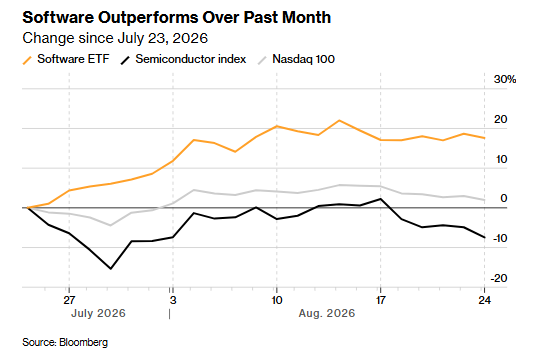
Since hitting a recent low on July 23, the extended technology software industry ETF-iShares (IGV.US) has accumulated an increase of 18%, significantly outperforming the Nasdaq 100 Index and the “Big Seven”, which mainly focuses on technology stocks.
In the same time period, the software and services sector became the best-performing industry in the S&P 500 index during the same period, soaring 24% in a single month, while the general market benchmark index rose only 3.3% during the same period. However, before bottoming out on July 23, this sector was the third-worst performing sector in the S&P 500 this year. Due to the market's general pessimism about the prospects of software developers in an AI-dominated pattern, it once fell 22% during the year.
This week, the market will face an intensive test of financial reports from a number of key software companies, including those seen as likely to be impacted by AI. After the US stock market on Tuesday, INTU.US (INTU.US) will be the first to release results; it will be followed by SEFTSE (CRM.US) and CrowdStrike (CRWD.US) on Wednesday; ADSK.US (ADSK.US) and Workday (WDAY.US) will appear on Thursday.
Greg Martin, co-founder and managing director of Rainmaker Securities, said: “The financial results allow investors to take a close look at whether AI is actually disrupting these businesses. So far, there appears to be no sign of slowing growth or shrinking profits.”
Currently, market sentiment continues to pick up; at least at this stage, AI has not eroded the industry's growth prospects. At the same time, more and more investors are beginning to favor relatively low valuations in the software sector, especially considering that many companies are expected to become mergers and acquisitions targets. For example, there is news that private equity firm Silver Lake Capital is in talks to acquire Workday. Although the deal is yet to be confirmed, the rumor itself has been viewed as a bullish signal.
Martin pointed out, “If savvy buyers like Silver Lake Capital showed interest, then the worst disruptive scenario did not occur.”
This round of market has even reversed a popular hedging strategy in the market this year — going long on chip stocks (the biggest beneficiaries of huge AI spending) and shorting software stocks (thought to be vulnerable to AI). Over the past month, the trend has reversed: since the low on July 23, the S&P North American Extended Technology Software Index jumped 19%, while the Philadelphia Semiconductor Index fell 4.9% over the same period.
According to the compiled data, the profit performance of US stocks in the current financial reporting season was impressive. The 13 software companies that have announced results in the S&P 500 have all exceeded expectations, with an average increase of 10%. Only 1 did not meet expectations in terms of revenue.
Morgan Stanley analyst George Webb wrote in an August 20 report: “The risk of AI disruption has not been eliminated, but the resilience of profits in the first half of 2026, the increasingly diversified basic model ecosystem, and the gradual realization of AI monetization capabilities in the 2027 fiscal year provide a more favorable background for optimism about this sector.”
For example, the financial report released by Microsoft (MSFT.US) on July 30 showed that its cloud computing business achieved the fastest growth in four years, and the stock price then recorded the biggest one-day increase since October 2008. Palantir Technologies (PLTR.US) shares surged nearly 30% after announcing results on August 3, and its CEO Alex Karp attributed the strong outlook to “extraordinary” demand.
According to industry research data, the market generally expects software companies' profits to grow 15% in 2026, and this forecast has increased slightly in recent weeks. Revenue growth is expected to be 14.6% this year.
As earnings improve and the S&P North America Software Index fell by about 3% during the year despite a recent rebound, investors can expect to find quite a few valuation gaps. The index's current price-earnings ratio is about 27 times the expected profit for the next 12 months, which is about 34 times lower than its 10-year average.
Looking at constituent stocks, Saifushi's stock price corresponds to the expected profit of only 14 times, which is close to the lowest level in history, far below its 10-year average of 43 times. Workday's forward price-earnings ratio is about 17 times, also close to the historic low set in June, and far below its 5-year average of 36 times. Caijie's price-earnings ratio is less than 14 times, compared to 32 times the average for the past 10 years.
Jack Ablin, chief investment strategist at Cresset Asset Management (the company holds IGV), said: “The key question is whether this is a real value depression or a mirage. The initial harsh bearish view was indeed too extreme, but the final impact of AI on software is uncertain. Currently, we tend to avoid these contentious areas.”
As of now, expectations for mergers and acquisitions are an important driver of enthusiasm in the sector. According to compiled data, the US software industry has completed nearly 364 billion US dollars of transactions so far this year, an increase of 98% over the same period when the M&A market almost froze last year. Private equity investors or large technology companies with strong financial resources may bid for some software companies, bringing a broad boost to the entire sector.
Rainmaker's Martin said, “There's a lot of money in the market chasing deals. Expectations of more mergers and acquisitions or industry consolidation will provide bottom support for software valuations.”