
- PRICING
- LIVE QUOTES
- LEARN
- HELP


EN
Bank of America raised the target price of 10 software stocks in one go! Workday (WDAY.US) surged 46% to lead, AI fears ebb tide, and valuation repairs accelerated
The Zhitong Finance App learned that as market concerns about artificial intelligence disrupting traditional software companies have begun to subside, Bank of America's valuation prospects for the software sector are turning optimistic, and the target prices for 10 software stocks have been raised one after another.
However, this research report released on August 19 is not a comprehensive bullish signal. Bank of America analysts Tal Liani, Koji Ikeda, and Matt Bullock maintained their original profit forecasts and fundamental judgments unchanged. Analysts pointed out that this round of increase is more reflective of investors' willingness to pay higher premiums for the software business after some infrastructure software companies have handed over impressive financial reports and against the backdrop of improved sentiment among large-cap stocks and application software companies.
The individual stocks that Bank of America raised their target prices this time include ServiceNow (NOW.US), Figma (FIG.US), Workday (WDAY.US), Adobe (ADBE.US), Snowflake (SNOW.US), GitLab (GTLB.US), Amplitude (AMPL.US), Box (BOX.US), Asana (ASAN.US), and Zeta Global (ZETA.US).
Despite this, Bank of America remains picky in stock selection, favoring targets that have higher growth potential and are expected to turn AI applications into actual revenue.
ServiceNow: One of Bank of America's Preferred Large-Cap Software Stocks
Bank of America maintained the ServiceNow “buy” rating and raised the target price from $130 to $150. Based on the share price of $119.49 mentioned in the report, the new target price implied an upward margin of more than 25.5%. This increase also reflects an increase in the overall valuation of the software sector.
ServiceNow's current remaining performance obligation (CRPO) under the constant exchange rate in the second quarter increased by 21.5% year-on-year, exceeding Wall Street's expectations of 19.5%; subscription revenue at the constant exchange rate increased 23%, which is also higher than the market forecast of 21.9%.
AI is becoming an important driver of its performance. The report shows that ServiceNow's AI annualized contract value has exceeded 1 billion US dollars, which is expected to exceed the company's target of 1.5 billion US dollars in fiscal year 2026.
Bank of America believes that ServiceNow's ability to control enterprise workflow context and historical data gives it the unique advantage of developing intelligent AI (agentic AI) products for managed and secure enterprise workflows. This advantage should support the company to achieve a ten-percent revenue growth and continuous free cash flow expansion.
Snowflake: AI-driven sharp increase in price target close to 20%
Snowflake is another key recommended target by Bank of America. The bank raised its target price from $330 to $395, an increase of nearly 20%, while maintaining a “buy” rating. Based on the $325.33 share price mentioned in the report, the new target price implied an upward margin of about 21%.
Bank of America analysts said they are more confident in the health of Snowflake's demand and believe that the company can continue to monetize AI products. The bank expects Snowflake's sales growth rate to be around 22% in the 2027 calendar year, which is far higher than the average of 11% in the infrastructure software industry. In terms of free cash flow profit margin, Bank of America predicts Snowflake can reach 25%, which is better than the industry average of 18%. Analysts believe the company should enjoy a larger valuation premium as it expects Snowflake to achieve faster growth and higher profitability.
Another long-term positive factor comes from market space: Bank of America estimates that the overall addressable market for AI software is as high as $155 billion.
Workday: Target price increased sharply by 46%, but maintained a neutral rating
Workday is one of the individual stocks with the biggest adjustments this time. The Bank of America raised its target price sharply from $140 to $205, an increase of more than 46%. However, Bank of America maintained its “neutral” rating.
Analysts explained that this increase mainly reflects the expansion of the overall valuation multiples of large enterprise software companies, as well as a premium on the “possibility of acquisition.” Bank of America believes that Workday's market position in the field of human capital management and financial software, its 97% overall retention rate, and steady ability to generate cash flow all support its higher valuation. The company is also advancing AI strategies, including launching the AI interface and smart platform Sana, and Flex Credits, a consumption-based monetization model.
But Bank of America is not ready to characterize it as an inflection point for AI-driven growth. The bank expects Workday's revenue growth to gradually slow from 16.4% in FY2025 to 11.5% in FY2027, 11.3% in FY2028, and 10.3% in FY2029. Analysts think the stock's risk-reward ratio is roughly balanced.
Adobe: Bank of America maintains a bearish stance, and the target price is far below the current price
Bank of America does not treat all software stocks equally by raising the target price in this round. The bank raised Adobe's price target from $190 to $220, but maintained a “outperforming market” rating. More importantly, the target price of $220 is still far below the $263.14 share price mentioned in the report, which means there is a potential downside of nearly 16%.
Bank of America acknowledged that Adobe has strong professional workflow barriers, impressive profit margins, and steady cash flow generation capabilities, but is concerned about the impact of AI — including AI lowering the threshold for professional content generation, and the rise of cheaper AI native competitors.
Bank of America pointed out that Adobe's AI priority annualized recurring revenue (ARR) still accounts for less than 2% of total ARR, and has failed to drive a meaningful acceleration in overall growth. The bank expects Adobe's revenue growth to slow from 10.5% in FY2025 to 8.8% in FY2027 and 8.7% in FY2028. Unless there is more clear evidence that standardized AI can re-accelerate growth, Bank of America believes there is a shortage of catalysts for upgrading ratings to optimism in the short term.
Figma: AI adoption rate draws attention, Bank of America reaffirms “buying”
Bank of America also reaffirmed Figma's “buy” rating and raised the target price from $30 to $33. Figma's second-quarter revenue increased 48.2% year over year, with a net dollar retention rate of 136%. The number of customers with annualized recurring revenue of over $100,000 increased 46% year over year. Another key development variable is AI usage — Bank of America data shows that over 80% of Figma customers with ARR over $10,000 consume AI credits every week. Analysts believe that Figma's increasingly rich AI capabilities can help it break through traditional designer user groups, extend to software development workflows, and ultimately drive more seats and consumption growth.
Target price adjustment summary:
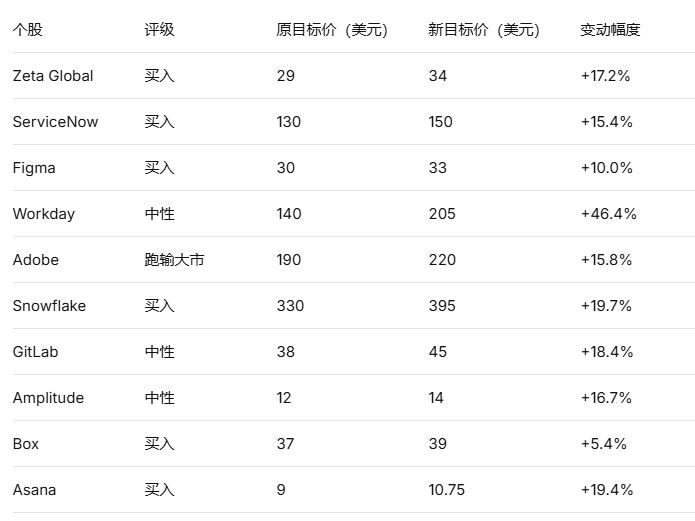
Bank of America also confirmed “buy” ratings for Box, Asana, and Zeta, and maintained “neutral” ratings for GitLab and Amplitude.
AI concerns have subsided, but rain and dew are not uniform
Software stocks have long faced a fundamental question: whether generative AI will expand their market space or encroach on the profit base of subscription-based software companies — these companies are the cornerstone of the industry's profits.
This round of Bank of America revaluation shows that investors are no longer inclined to price the worst case scenario for the entire industry. However, the bank's sharp comparison of attitudes between ServiceNow, Snowflake, and Adobe revealed an important difference: concerns about the impact of AI on software stocks may be fading, but Bank of America does not think every software stock can be a winner.