
- PRICING
- LIVE QUOTES
- LEARN
- HELP


EN
Under Trump, mergers and acquisitions in the US banking industry have begun! Wells Fargo (WFC.US) and Citibank (C.US) “have enough ammunition”. Are these 5 regional banks most likely to be targeted?
The Zhitong Finance App learned, however, that anyone attending a major banking summit or attending a quarterly earnings conference call with a listed bank always comes up over and over again: Under the Trump administration, the merger and acquisition window is already wide open. Which institution will take the lead in the acquisition?
Over the past few years, bound by regulatory restrictions, large banks have been left to stand idly by. Now, they can finally reconsider buying other banking institutions — even regional banks with assets over $100 billion, which are no longer out of reach.
Although J.P. Morgan Chase (JPM.US) and Bank of America (BAC.US) have been banned from carrying out such transactions because they account for more than 10% of national deposits, two giant banks are still expected to launch large-scale acquisitions: Citigroup (C.US) and Wells Fargo (WFC.US). According to analysis by investment bankers, consultants, and investors, as the third and fourth largest banks in the US, the two still have plenty of room to merge a sizable regional bank under the national deposit limit rules.
“Two years ago, it was almost impossible for a bank of this size to be approved to buy any target,” said Brian Graham, co-founder of consulting firm Klaros. “Today, they can hopefully facilitate the deal. I'd be surprised if they weren't actively exploring.”
Over the past decade, both institutions have been in a “punitive period” — Citi is subject to consent orders, while Wells Fargo is constrained by growth restrictions. Now, both have cleared key regulatory barriers and officially entered the expansion phase.
A major acquisition — similar to the one J.P. Morgan completed during the crisis of 2023 and 2008 — would bring thousands of branches and tens of billions of dollars in savings to Wells Fargo or Citigroup.
For Citi, which has only about 650 branches in the US, this will provide a much-needed low-cost funding source; for Wells Fargo, which already has a large branch network, such transactions will help further expand the scale effect and explore the space for cost reduction.
“This is an intense competition of scale, and the window is very limited,” KBW analyst Chris McGratty said of the general need for industry consolidation. “If we want to act, now is the right time.”
Although the total number of banks in the US exceeds 4,200, there are only a few that can actually be targeted by Wells Fargo or Citibank. The ideal target would need to be large enough to have a substantial impact, and at the same time not be too large, so as not to cause the buyer to break through the 10% national deposit limit. Furthermore, a complementary branch network, a good cultural fit, and a good deposit base are all necessary conditions, making it difficult to have a good reason for most potential transactions.
Selected according to the above criteria, five regional banks stood out and became strong candidates for the two giants.
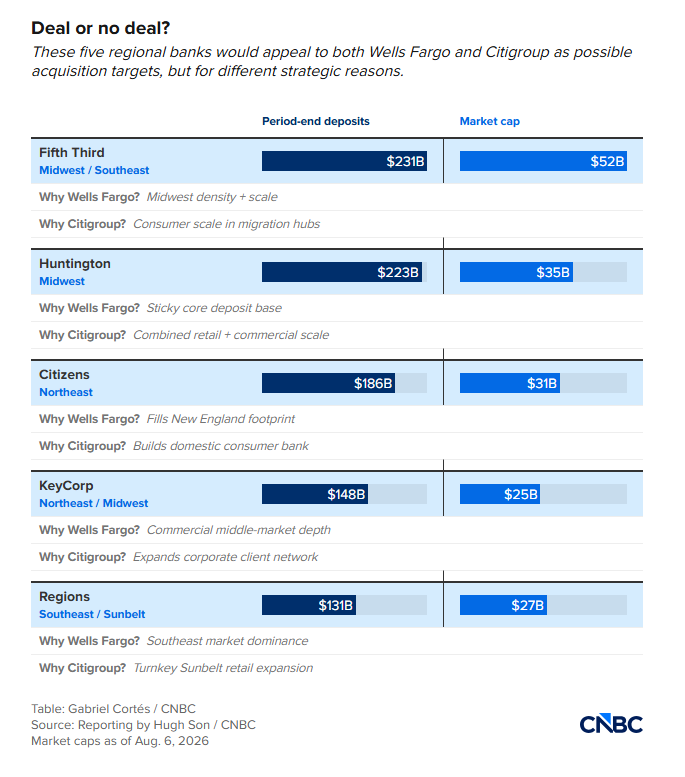
FITB.US (FITB.US) has a comprehensive business engine covering commerce and retail in the Midwest, while rapidly expanding its layout in high-growth regions in the southeast. Huntington Bank (HBAN.US) has a low-cost deposit base and continues to expand its branch network in growing markets such as Texas and the Carolinas.
Citizens (CFG.US) has intense retail and commercial coverage in affluent Mid-Atlantic and New England cities. KeyCorp (KEY.US) is carrying the mid-market commercial banking business, extending branches from the Great Lakes region to the Pacific Northwest.
Finally, Regional Finance (RF.US) has built a retail deposit network in the rapidly growing Southern Corridor, which includes Texas and Florida.
In addition to the above list, for Wells Fargo Bank (ZION.US) is a potential target worth paying attention to because it has established extensive business relationships in high-growth western states and is highly compatible with its current layout.
For Citi, First Horizon National Bank (FHN.US) has become a reasonable and viable potential acquisition target due to its rapidly expanding business footprint in the US Sunshine Zone.
Wells Fargo and Citigroup declined to comment. Of the regional banks mentioned above, with the exception of Huntington, Zion, and First Horizon, which did not respond, the rest declined to comment.
“We will consider it carefully”
When asked if Citigroup is planning to acquire large banks in April, CEO Jane Fraser said that the bank is currently focusing on endogenous growth rather than mergers and acquisitions.
Despite this, according to reports in March, Citibank executives have allegedly discussed the possibility of buying a large regional bank to strengthen the deposit base. Citi responded at the time, calling the report “unfounded speculation,” and the company's stock price fell by more than 4% on the same day.
According to many analysts covering the bank, Citi still needs to prove that it can achieve higher returns through internal reforms. At a time when Citi is trying to simplify its structure, merging a large regional bank will bring multiple burdens such as branches, employees, technical systems, and integration risks.
“A deposit transaction would be a major disruptor for Citi,” KBW's McGrady said.
By contrast, Wells Fargo CEO Charlie Schaff has unleashed his openness to transformative transactions — whether it's the acquisition of banks or credit card institutions — even though he also emphasized that endogenous growth remains the focus.
“We should always consider ways to enhance the value of our franchises, including mergers and acquisitions,” Schaff wrote in a March shareholder letter, acknowledging that regulators have become more friendly towards the deal.
Schaff said that although “we don't feel pressured to pursue” deals, “if an excellent opportunity exists, we will definitely take a close look at it.”
The problem, however, is that the wave of mergers and acquisitions that many expected since Trump returned to the White House in 2025 has yet to come true. In fact, according to EY data, the amount of North American bank mergers and acquisitions in the first six months of 2026 fell by more than half year on year to 30.1 billion US dollars.
Admittedly, regulatory barriers may be being lowered, but few banks are willing to sell easily at a time when both profits and stock prices are rising.
“Most companies have good profit margins and strong share price performance, which has greatly raised the threshold for sale,” said Frank Sorrentino, head of M&A at Stephens Bank. “Everyone sees themselves as a buyer, not a seller.”
Activist investors who actively push banks to increase shareholder returns point out that executives are now used to comparing the economic benefits of acquisitions with share buybacks, which adds more careful consideration to trading decisions.
The rise of regional banking giants?
Sorrentino believes that the present is still a favorable time for mergers and acquisitions, which he called “the best environment we have seen since the financial crisis.”
Last year, Congress overturned restrictions on the merger of the Monetary Supervisory Service during the Biden era, and the Federal Deposit Insurance Company also restored its long-standing merger guidelines. In fact, it resumed the rapid review process and lowered the threshold for regulatory release.
When it comes to major acquisitions, Wells Fargo has one advantage that Citi doesn't have: stronger stock valuations. This may make it easier for deals to gain internal and external recognition, particularly when the target can fill a geographic or product gap.
However, another path for regional banks to break through is collaboration between peers.
There has been speculation within the banking industry for many years that two of the three superregional banks — PNC Financial Group (PNC.US), Bank of America (USB.US), and Truist Financial (TFC.US) — may eventually merge to create a new banking giant capable of challenging the giants.
In a recent research report, Bain & Co., predicts that by 2030, mergers between regional banks will spawn 1 to 3 large emerging banks with assets of at least $1 trillion. The consulting firm's forecasting model based on two decades of data also found that the number of regional banks would be reduced from 49 to a minimum of 30.
“We expect more banks, especially regional players, to enhance their capabilities through mergers and acquisitions,” said Bain.
This idea has never faded away. If Wells Fargo and Citi choose to stand still, then regional banks will have to wonder: can they bear the cost of continuing to “sit on the cold bench” — or must they merge with each other to keep up with the times?