
- PRICING
- LIVE QUOTES
- LEARN
- HELP


EN
Commonwealth Bank Stock And 2 ASX Income Shares For Steady Dividends
With global bond yields sitting at multi year highs as central banks keep policy tight, reliable income has become harder to find without taking extra risk. That is where Dividend Powerhouses with yields above 5% and stable coverage become interesting. This article highlights three stocks from the Dividend Powerhouses screener that offer consistent cash payouts so you can see how some investors are trying to put today’s higher yield world to work.
The stocks in the article below are only a small sample of what income focused investors are looking at, and the full Dividend Powerhouses screen surfaced 28 more companies with similar yield and coverage profiles that are not covered here. To see the complete list and quickly identify which of these high yield payers best fit your own criteria, head straight into the Dividend Powerhouses (3%+ Yield) screener.
Computershare (ASX:CPU)
Computershare is a global administrator that helps companies manage their share registers, corporate actions and employee share plans, which creates recurring fee income that can support regular dividends. Its largest revenue contributor is Issuer Services at about US$1.3b, followed by Corporate Trust at around US$1.0b and Employee Share Plans at roughly US$585 million, with smaller contributions from corporate and other activities. The stock has a market cap of about A$22.7b, which puts it firmly in large cap territory for Australian investors.
Income focused investors may find Computershare interesting because the share registry and issuer services business throws off steady fee income that supports ongoing dividends. Recent full year revenue of about US$3.2b and net income of US$618.7 million point to meaningful scale. At the same time, management is investing heavily in digitisation and AI to improve margins, and using a strong balance sheet to fund buybacks and potential acquisitions. However, there are real questions about an unstable dividend history, reliance on interest rate sensitive margin income and client churn in registry services that could test dividend reliability for a 3%+ yield strategy.
Computershare’s steady fee engine and significant digitisation efforts could be masking a bigger story for income hunters. Get the full picture with the 3 key rewards and 1 important warning sign

QBE Insurance Group (ASX:QBE)
QBE Insurance Group is a global insurer that underwrites a wide range of commercial and personal policies where the core underwriting profits and investment income are key to supporting its dividend profile. It generates most of its revenue from International insurance at about US$12.2b, with North America contributing roughly US$8.3b, Australia Pacific around US$5.8b, and a small amount from Corporate and Other activities. The stock has a market cap of about A$33.4b, placing QBE Insurance Group among the larger financials on the ASX.
Income focused investors looking at QBE Insurance Group are often drawn to how its global underwriting book, Lloyd’s syndicate management and investment portfolio combine to produce recurring cashflows that can underpin a well covered, 3%+ dividend. Recent updates show solid earnings, strong credit ratings and active capital management through buybacks and debt redemptions, which all support that income story. The catch is that QBE’s dividend record has been patchy and underwriting margins remain exposed to pricing pressure, large loss events and inflation. How those strengths and risks balance out for a long term dividend portfolio is where the real story gets interesting.
QBE Insurance Group’s global underwriting and investment engine may be setting up a different income story than its patchy dividend past suggests. See how the strengths and pressure points stack up in the 3 key rewards and 1 important warning sign

Commonwealth Bank of Australia (ASX:CBA)
Commonwealth Bank of Australia is a universal bank that provides everyday transaction accounts, savings, home loans, business lending, cards and insurance. Its large Retail and Business Banking arms generate the steady net interest income that supports its >3% dividend yield. Retail Banking Services contribute about A$13.4b of revenue and Business Banking around A$9.7b, with further contributions from New Zealand at roughly A$3.0b and Institutional Banking and Markets at about A$2.9b. Together, these help keep dividend coverage anchored in recurring banking earnings. The stock has a market cap of roughly A$264.1b, making it one of the largest listed companies in Australia.
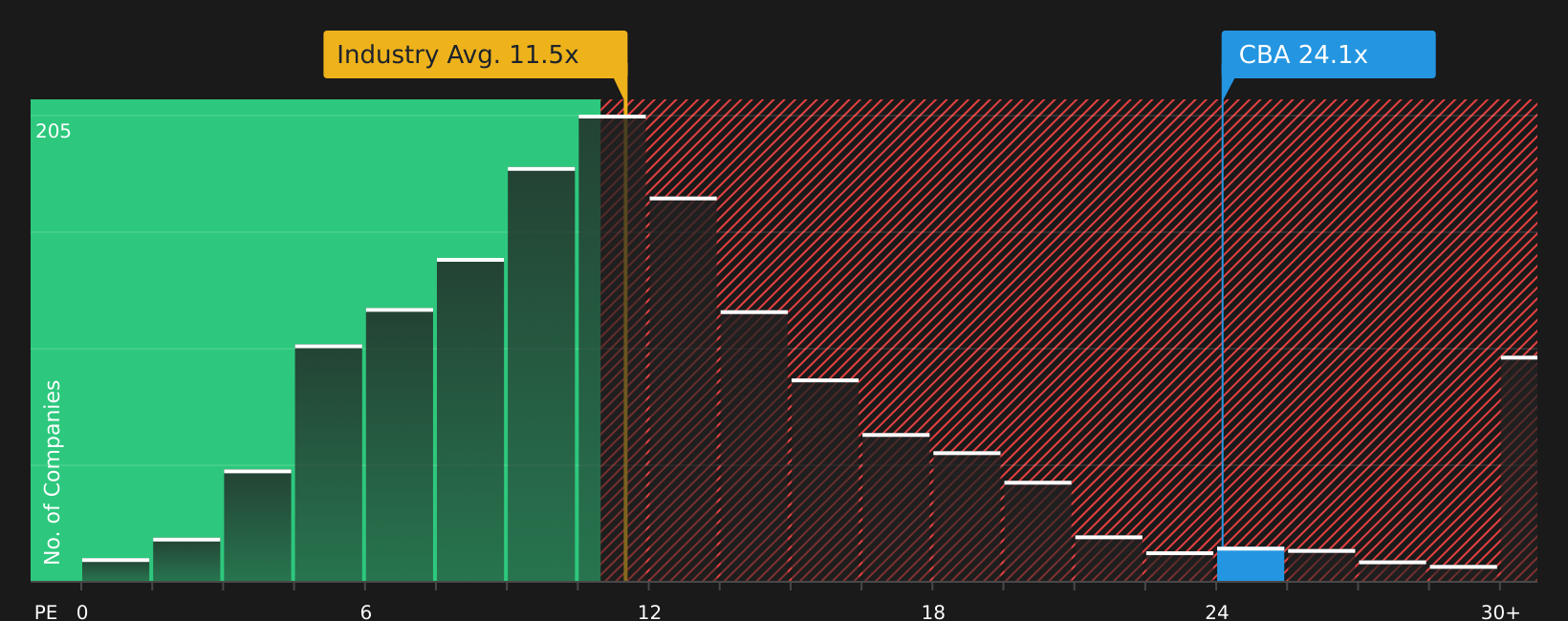
Commonwealth Bank of Australia appeals to dividend-focused investors because its sizeable payouts are backed by earnings from a dominant retail and business banking franchise, supported by net profit margins above 30% and strong capital levels. At the same time, this is a premium priced stock facing rising digital competition, heavy technology spending and a large exposure to Australian mortgages, which could pressure margins and earnings if conditions soften. Recent dividend increases, solid full year earnings and an ongoing buyback highlight both confidence and discipline, while insider selling and an analyst target below the current price indicate that expectations may already be elevated. The key issue for investors is whether this premium income engine still offers enough long term reward to justify the risks that come with it.
Commonwealth Bank of Australia’s premium valuation and strong margins suggest investors may be missing a key twist in this income story. For the full context, see the analysis report for Commonwealth Bank of Australia
Seeking Fresh Alternatives Beyond Dividends
Markets move fast and today’s quiet stock could be tomorrow’s breakout. Use fresh ideas before the momentum is fully caught and while some opportunities may still be under the radar. Consider acting promptly when you have completed your own research.
- Spot cash generative companies with strong footing and let the list of solid balance sheet and fundamentals (21 results) guide you toward businesses that may be better positioned to handle drops in sentiment.
- Explore early AI momentum by scanning 76 profitable AI stocks that aren't just burning cash that already generate earnings and may avoid some of the risks associated with cash burning hype cycles.
- Seek exposure to potential supply constraints by checking 28 best rare earth metal stocks focused on producers that could be positioned to benefit if demand remains elevated.
This article by Simply Wall St is general in nature. We provide commentary based on historical data and analyst forecasts only using an unbiased methodology and our articles are not intended to be financial advice. It does not constitute a recommendation to buy or sell any stock, and does not take account of your objectives, or your financial situation. We aim to bring you long-term focused analysis driven by fundamental data. Note that our analysis may not factor in the latest price-sensitive company announcements or qualitative material. Simply Wall St has no position in any stocks mentioned.
Have feedback on this article? Concerned about the content? Get in touch with us directly. Alternatively, email editorial-team@simplywallst.com