
- PRICING
- LIVE QUOTES
- LEARN
- HELP


EN
The 50% tariff breaks through the Canadian dollar's rebound logic! USD/CAD approaches 1.40, bears regroup
The Zhitong Finance App learned that the collapse of US-Canada trade negotiations and the US imposing 50% tariffs on Canadian goods worth billions of dollars are jointly drastically reducing the Canadian dollar in the short term through the three paths of “downgraded growth expectations+cooling of Canadian interest rate hikes + reconstruction of short positions”; if the Canadian side implements “equal retaliation,” it may further weaken business confidence and economic recovery momentum.
The short-term risk of the Canadian dollar is still on the downside. The US dollar may test 1.40 or even depreciate the Canadian dollar to 1.41 points in the third quarter, but if the US's own interest rate hike expectations cool down at the same time, it may limit the exchange rate from continuing to break through 1.40 sharply, which means that trading opportunities are closer to repricing within a high fluctuation range rather than a definitive one-sided dollar market.
After trade negotiations between Canada and the US broke down, the Canadian dollar is heading towards the worst trading day in more than two months against the US dollar. According to the latest statistics, the Canadian dollar once fell 0.6% against the US dollar to 1.3844 Canadian dollars, the highest decline among all G10 currencies, and probably the worst performance since June 17. Market observers say the sell-off is likely to continue to expand because Washington recently imposed 50% tariffs on Canadian goods worth several billion dollars, threatening the continued recovery of the economy that was originally expected in the coming months.
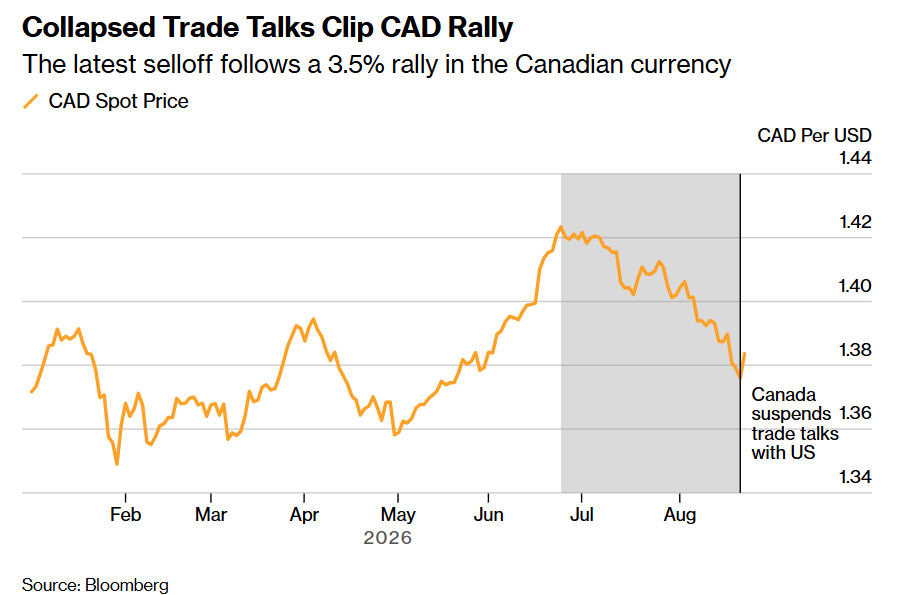
As shown in the chart above, the breakdown of trade negotiations has curtailed the rise in the Canadian dollar exchange rate — before the latest round of sell-off, the Canadian dollar had accumulated a 3.5% increase.
Derrick Halpenny, head of global market research at Mitsubishi UFJ Financial Group in Europe, the Middle East and Africa, said that Canadian Prime Minister Mark Carney promised “equal retaliation” against US tariffs, posing a further risk to investor confidence. Mitsubishi UFJ Financial Group expects the Canadian dollar to fall to 1.41 Canadian dollars per dollar in the third quarter. Halpeni pointed out, “The longer this escalating trade war remains unresolved, the more downside risks will increase.”
This marks a sharp reversal in the trend of the Canadian dollar, which has continued to rise since late June. According to data from the US Commodity Futures Trading Commission, the current position structure of the Canadian dollar shows that there is still room for further expansion in the latest round of sell-off. In late July, bearish positions on the Canadian dollar rose to a two-year high; over the past month, hedge funds continued to cut positions betting on the weakening of the Canadian dollar, which left room for them to re-establish these bearish bets.
Elias Haddad, head of global market strategy at Brown Brothers Harriman, said that the swap market is currently priced at a cumulative total of about 70 basis points of interest rate hikes in Canada up to June; once these expectations fall, the Canadian dollar will continue to be under pressure in the short term.
Haddad pointed out that the escalating trade war is likely to weaken market expectations for Canada's interest rate hikes in the next few months; however, there is also a risk that the US interest rate hike expectations will cool down. Coupled with the possibility that the US Treasury may introduce measures to reduce the yield on US long-term treasury bonds, these trends “should together limit the excessive rise of the dollar against the Canadian dollar above 1.4,000.”
According to information, talks between the US and Canada broke down on August 21 after three days of intensive negotiations and a brief delay in US tariffs. Currently, there are no arrangements for a new round of negotiations. The US side claims that Canada has refused to implement previously agreed provisions and continues to demand additional concessions in fields such as steel, aluminum, automobiles, and cork; Canada accuses the US side of temporarily adding “uneconomical and unfair” conditions, including restricting Canada from reaching trade agreements with third countries and harming the competitiveness of its manufacturing industry on issues such as the treatment of medium and heavy trucks.
The United States has now invoked section 338 of the 1930 Tariff Act to levy 50% tariffs on nearly 20 billion US dollars of Canadian goods, covering wine, dairy products, cement, furniture, clothing, and ice hockey equipment, etc., which is equivalent to about 5% of Canada's exports to the US, and no longer grants exemptions under the US-Mexico-Canada Agreement (USMCA). This also means that with the exception of this batch of products of nearly 20 billion US dollars, which are clearly covered by section 338 tariffs, other Canadian products that meet the rules of origin can still enjoy USMCA benefits in principle; however, products subject to other special tariffs, such as steel, aluminum, automobiles, and cork, are not necessarily exempt from tax.
The Canadian side has suspended negotiations and announced that it will implement “equal retaliation” against US goods starting September 8. The targets include steel, dairy products, home appliances, agricultural equipment, pulp, paper, and electronics, while preparing to provide aid to the affected industries that may last for several years. From an asset pricing perspective, the $20 billion scale is not enough to hit North American trade as a whole, but it will have a highly concentrated growth impact on Canadian exporters of automobiles, trees, alcohol, and small to medium, etc., reducing expectations for Canadian interest rate hikes and increasing the Canadian dollar risk premium; the US will bear the rising costs of some manufacturing inputs and consumer goods. The real systemic risk is that the two sides have moved from “exchanging tariff relief” to “forcing each other to make concessions in retaliation,” which not only increases the cost of the entire North American supply chain, but also makes future USMCA contract renewals and investment decisions face higher policy discounts.