
- PRICING
- LIVE QUOTES
- LEARN
- HELP


EN
The $40 trillion debt mountain peaked, but the AI computing infrastructure frenzy couldn't stop! The trillion-dollar giant wave lasts a supercycle of computing power
The Zhitong Finance App learned that a team led by Andrew Sheets (Andrew Sheets), a senior strategist from Wall Street financial giant Morgan Stanley, recently said that the US government has accumulated about 40 trillion US dollars of federal debt, but rising government debt has not stopped the historic wave of AI-related technology company corporate loans, nor has it shaken the still resilient US household spending.
This also means that, according to the Daimo strategist team, the US $40 trillion federal debt has yet to trigger a “credit squeeze” in the corporate and residential sector — in particular, stable corporate leverage ratios, the scale of debt issuance may still set a record, household debt burdens are lower than in 2000 and 2019, and stronger consumer spending and corporate profits continue to weigh on the negative impact of rising interest rates/US bond yield curves on US stocks and the global stock market. The 6.2% yield on US long-term investment-grade bonds and the return on 30-year US bonds are about 300 basis points higher than expected inflation, and are continuing to raise the opportunity cost of stocks; it is not the total amount of debt itself that may actually end the “equity and debt” pattern, but the high financing costs ultimately slow down corporate profit growth.
America's $40 trillion debt has yet to close corporate credit channels, which means that the AI computing power supercycle is currently facing “rising financing costs” rather than “exhaustion of financing supply.” The share of US corporate debt in GDP is roughly the same as ten years ago and is significantly lower than the pre-pandemic level. Morgan Stanley still expects a record amount of corporate bonds to be issued this year; about 67% of GDP is not at an extreme level, and consumer resilience is also supporting corporate profits.
As a result, hyperscale cloud computing vendors (that is, Hyperscalers), the world's top AI laboratories such as Anthropic and OpenAI, and AI data center developers led by “new cloud” forces can still use investment-grade bonds, project financing, and private credit portfolios to combine the near-endless future token revenue expectations and actual cash flow generated from AI product subscriptions, API calls, and cloud services with AI GPU computing power cabinets, HBM/DRAM/NAND storage components, data center CPU and optical interconnection systems, Strong orders from the entire AI computing power industry chain, such as the power infrastructure chain and liquid cooling systems, are closely linked. America's total debt has surpassed $40 trillion, yet it has yet to create a “crowding out effect” of the private sector in the classical sense of the word.
In other words, the $40 trillion debt did not end the AI computing power investment boom. Instead, AI computing power infrastructure construction entered the second stage of “credit is still open and capital is more expensive”. It is likely that AI computing power infrastructure will still be in a high-intensity construction cycle for the next 2-3 years.
While the capital market remains open, hyperscale cloud vendors can rely on balance sheets to issue investment-grade bonds. AI laboratories can obtain capital through equity capital, computing power procurement commitments, and third-party guarantees, and data center developers can obtain project financing or private credit through long-term leases, power contracts, and project assets; these capital is ultimately converted into orders for GPUs, HBM, optical interconnects, power supply, distribution, and cooling systems, and the final source of debt repayment is actual cash flow generated by AI subscriptions, API calls, and cloud services. It is not simply an expected sharp increase in future token revenue.
Another major Wall Street bank, Goldman Sachs, expects the cumulative capital expenditure of large technology companies to be about 5.3 trillion US dollars from 2025 to 2030; the share of debt financing in AI capital expenditure may rise from about 33% in 2026 to 35% in 2027, and direct debt issuance by hyperscale cloud vendors alone may reach about 250 billion US dollars, not including project financing. These data predictions and AI computing infrastructure trends indicate that $40 trillion of US debt has not yet closed the corporate credit floodgates, and that investment-grade bonds, project financing supported by long-term leases, private credit, and supplier guarantees are still jointly driving the implementation of computing power assets.
The $40 trillion debt mountain has reached its peak, and the corporate financing torrent has yet to subside! Damo: The real danger for US stocks is not interest rates, but profits are stalling
About half of the US federal debt has increased over the past decade, and the government debt of the world's major economies as a share of GDP has also risen. With the exception of the UK, fiscal deficits in various countries are expected to remain high for a long time, thus making the scale of government borrowing continue to be high.
Despite the continued rise in benchmark interest rates and long-term treasury bond yields, corporate balance sheets have shown relatively strong resilience. The share of US corporate debt in GDP has not changed much compared to ten years ago, and is still significantly below pre-pandemic levels; at the same time, the Morgan Stanley credit strategist team continues to predict that the scale of corporate bond issuance this year will set a record. Hitz said that rising yields should not be expected to stop the current unprecedented wave of AI computing power-related financing.
The financial situation of American households has also remained relatively healthy. Household debt currently accounts for about 67% of the US GDP, down from about 70% in 2000 and near the record point of 74% once experienced in 2019. Hitz pointed out that although interest rates and long-term US bond yields continue to rise, household spending remains resilient.
For financial markets, the more important and more serious question is whether the yield/benchmark interest rate will eventually rise to a level sufficient to attract investors to shift asset allocation requirements from stocks on a large scale to bonds. According to Morgan Stanley statistics, the US 30-year Treasury yield curve currently provides a yield of about 300 basis points higher than expected inflation, while the yield on long-term US investment-grade bonds has reached 6.2%.
To date, such transfers of funds have not occurred on a large scale. Although the yield on US 10-year Treasury bonds has risen by about 50 basis points since this year, the benchmark index for US stocks, the S&P 500 index, has risen strongly by 13% since this year. Under the AI boom that has fully erupted since 2023, the strong profit growth trend of technology companies has helped stock assets continue to be competitive in the face of higher bond yields.
For the team of Dahmo strategists led by Hitz, the most critical question is whether profit growth in the stock market can continue to be resilient while borrowing costs continue to rise. In the future, once the profit growth rate slows significantly, the importance of the relationship between the rise in the yield curve of US bonds with a long-term term of 10 years or more and the overall valuation of the stock market will increase significantly to the market.
Token consumption is 24 times greater, and 10 trillion US dollars of institutional capital spread further along the AI computing power bottleneck! The $40 trillion debt mountain cannot seal the floodgates of credit expansion
Wall Street financial giant Goldman Sachs's latest 10 trillion dollar institutional holdings report reveals that “AI beliefs” have not completely subsided, but rather that capital has begun to spread from GPU core leaders to “irreplaceable infrastructure bottlenecks.” Goldman Sachs statistics cover 991 hedge funds with a total stock position of $5.4 trillion, as well as 504 large active mutual funds that manage $4.6 trillion in equity assets.
The two types of capital are gaining cross-institutional consensus on bottlenecks in the AI computing power industry chain, such as storage product lines such as Bloom Energy, Flex, and Seagate Technology, data center power chains, and server manufacturing. Nine of the top ten most popular hedge fund holdings are AI-related, with Amazon ranking first for the 11th consecutive quarter; Mutual Fund's allocation for Nvidia and AMD is still 100 and 60 basis points lower, respectively, which means that AI transactions have not yet reached the limit of positions in the entire market, but potential increases must be triggered by profit fulfillment rather than simply theme popularity.
The underlying logic of this diffusion and rotation is that AI evolves from the “underlying computing power chip supermarket” to the full-stack AI computing power capital cycle: the increase in the number of GPU/TPU/AI ASICs will simultaneously amplify servers, memory, enterprise-grade NAND storage components, Ethernet switches, optical modules, data center optical communication/optical interconnections, high-speed connectors, server cabinet slides, cooling and power distribution requirements; the larger the scale of training and inference clusters, the higher the number of ports, the value and interconnection complexity of single cabinets.
Morgan Stanley predicts that by 2028, close to $3 trillion of AI-related infrastructure investment will flow through the global economy, and more than 80% of spending is still ahead. According to Goldman Sachs's latest calculation data, the global AI capital expenditure benchmark model is expected to grow from $765 billion per year in 2026 to 1.6 trillion US dollars per year in 2031, and the cumulative capital expenditure from 2026 to 2031 is estimated to be about 7.6 trillion US dollars. The power demand for US data centers is expected to rise from 31 GW in 2025 to 66 GW in 2027. This will directly spill AI computing power infrastructure investment into server CPUs, DRAM/NAND/HBM, advanced packaging, liquid cooling, power equipment, transformers, gas turbines, grid-connected equipment, data Links such as central REITs and engineering construction.
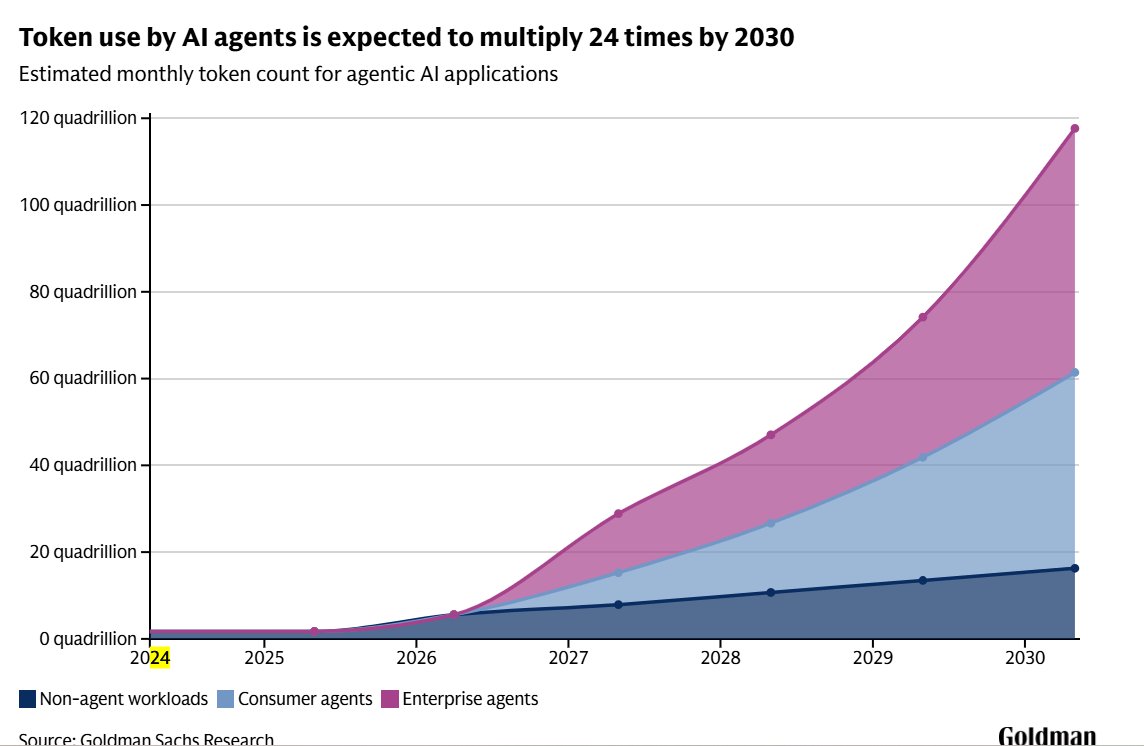
The core increase in AI computing power demand comes from AI moving from “answering questions” to “execution workflows”: agents require continuous planning, calling tools, verifying results, and retrying failures. The token consumption of a single task may reach 10, 20 times, or even 50 times that of traditional chat queries; the world model also extends the boundaries of computing power from text to robots, industrial simulations, and physical systems. Goldman Sachs officially predicts that by 2030, global token consumption may increase 24 times to 120 trillion per month; at the same time, the unit cost of inference tokens will drop by 60% to 70% each year, forming the “Jevons Paradox effect” (Jevons Paradox) of “cost reduction — application diffusion — increase in total demand”.
The $40 trillion debt did not end the AI computing power investment boom; instead, the industry entered the second phase of “credit is still open and capital is more expensive.” The yield on 30-year US Treasury bonds is about 5.23%, and the yield on long-term investment-grade corporate bonds has reached 6.2%, which means that every AI project must prove that its internal rate of return (IRR) can cover increasing capital costs; therefore, subsequent capital will not indiscriminately pour into all concept stocks, and priority will be given to GPU clusters with long-term orders, free cash flow, pricing power, and key bottlenecks, HBM/DRAM/NAND storage, high-speed data center networks and optical interconnections, and new cloud vendors. If the commercialization of tokens continues to materialize, the corporate financing torrent will prolong the AI capital expenditure cycle; if profits slow down or long-term yields rise uncontrollably again, driven by a “bond alert,” highly leveraged new cloud vendors and projects that rely on external guarantees will first suffer both valuation and credit losses.