
- PRICING
- LIVE QUOTES
- LEARN
- HELP


EN
Treasury Yield Swings Put These Bank Stocks In Focus
Wild swings in U.S. Treasury yields, a stronger or weaker dollar, and noisy signals from the Federal Reserve are quickly reshaping how investors think about risk. That mix can reward the banks and brokers closest to the Treasury market, or leave them exposed when conditions tighten. This article walks through three stocks linked to these crosscurrents and explains how the same news can create both opportunity and caution for your portfolio.
The stocks covered below are just a sample of this theme, and the full screen surfaced 53 more companies with equally compelling, but different, Treasury-linked stories that are not covered in this article.
To go straight to the source and size up this broader group for yourself, use the US Treasury-Market Intermediaries and Primary Dealer Banks screener to identify, compare, and analyze which Treasury-market intermediaries look most aligned with your own risk and return preferences.
China International Capital (SEHK:3908)
Overview: China International Capital is a Beijing based global investment bank and broker dealer that helps governments and companies raise money, underwrites bond and equity deals, and trades across fixed income, currencies, commodities, and equities, giving it direct exposure to sovereign bond and rates markets that resemble U.S. Treasury activity. It also runs asset management, private equity, and wealth management businesses that plug clients into fixed income, repo style financing, and custody services.
Market Cap: HK$156.2b
Investors looking for a way to access volatile global bond markets may want to pay attention to China International Capital. Its mix of investment banking, FICC trading, and custody services means more potential activity when sovereign issuance is busy and rate expectations keep shifting. Analysts cite potential for earnings and revenue growth, and the stock trades on a P/E that sits below both sector and broader industry averages, which can indicate a market that may not fully reflect its role as a primary dealer type intermediary. The flip side is meaningful funding risk, with reliance on wholesale funding instead of deposits, and a relatively young management team. Those factors can increase the risk profile when Treasury style markets become stressed.
China International Capital’s lower P/E and global bond exposure can appear to offer an underappreciated way into volatile rates markets. Before you decide how that fits your portfolio, review the analysis report for China International Capital

Build your own Treasury-intermediary shortlist
China International Capital and the two other stocks in this article all came from a single screener, but the real value is in creating filters that match how you think about risk and return. Use our customisable Screener to mix valuation, growth, balance sheet and risk signals into your own watchlist, or tap into any of our curated Investing Ideas.
Banco Santander (BME:SAN)
Overview: Banco Santander is a large Madrid based bank that serves individuals, businesses, and public entities worldwide through retail and commercial banking, digital consumer finance, corporate and investment banking, wealth management, insurance, and payment services. Its wholesale and markets arm gives it a role in sovereign bond and fixed income intermediation that fits this Treasury market theme.
Operations: Banco Santander generates the largest share of its reported business revenue from Segment Adjustment at €22.7b and Corporate & Investment Banking at €8.4b, followed by Openbank at €6.6b, Payment Solutions at €4.1b, and Wealth Management & Insurance at €4.4b. Corporate Centre activities reduce the total by €890m.
Market Cap: €182.3b
Investors watching U.S. Treasury volatility may find Banco Santander interesting because its global corporate and investment bank leans heavily on fixed income, client driven trading, and debt capital markets that can see more activity when yields and issuance shift. The pending integration of Webster Financial in the U.S. adds another layer of funding, customer deposits, and potential Treasury related flows, on top of initiatives in digital banking and payments. At the same time, higher bad loan levels and a relatively low allowance coverage ratio leave less room for credit missteps, and insider selling may give some readers pause. For those willing to weigh that trade off, the mix of scale and wholesale reach means there is more to unpack in Santander’s story.
Banco Santander’s global wholesale reach and U.S. expansion point to a bigger story that many investors may be underestimating. Weigh that scale against credit risks in the 3 key rewards and 4 important warning signs

EFG Holding CompanyE (CASE:HRHO)
Overview: EFG Holding CompanyE is an Egypt based investment bank and financial services group that focuses on capital markets activity across MENA and internationally, offering brokerage, investment banking, asset management, and private equity services to governments, corporations, and investors. Alongside this intermediary role, it runs commercial banking and a broad set of non bank financing products that range from consumer and SME lending to microfinance and insurance.
Operations: EFG Holding CompanyE generates most of its revenue from its Commercial Bank (Bank NXT) at EGP 8.4b, brokerage at EGP 7.9b, asset management at EGP 2.9b, and consumer finance at EGP 3.2b, with Egypt contributing EGP 20.1b of revenue compared with EGP 6.6b from GCC markets.
Market Cap: EGP37.8b
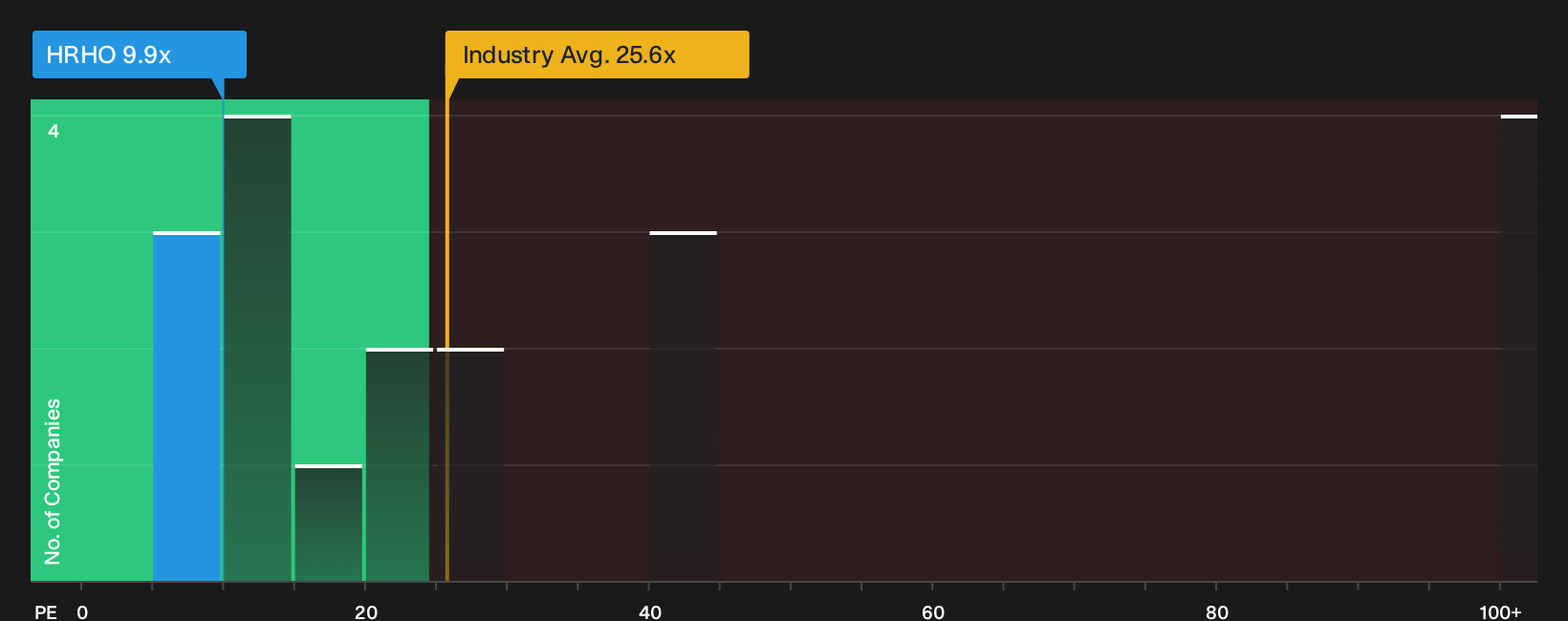
EFG Holding CompanyE provides focused exposure to MENA capital markets at a time when volatility in global sovereign debt and currencies keeps trading and issuance activity in focus. Analysts highlight its earnings profile and a fee heavy mix in brokerage, investment banking, and asset management that can be sensitive to changes in sovereign issuance and deal flow, while the 2Q26 and first half 2026 results show profits that investors can track against those expectations. The P/E sits below local and regional averages, which may appeal to investors who see value in this intermediary role. A key consideration is a higher risk funding mix, with no customer deposits and weaker free cash flow coverage of dividends, which can be relevant if funding markets become stressed.
EFG Holding CompanyE combines a fee heavy capital markets engine with an earnings profile that many investors may still be pricing cautiously. Get the fuller picture, including funding and cash flow trade offs, in the 5 key rewards and 2 important warning signs (1 is major!)
Seeking Fresh Alternatives Before Others Do
Market stories move fast. Stocks can be breaking out, momentum can be building, or quality can get caught dropping under the radar for now. Do your homework while it matters and get in early.
- Spot potential turning points in high quality companies before they start flying by scanning the curated 268 high quality undervalued stocks.
- Review structural trends in power and electrification with the focused 39 power grid technology and infrastructure stocks while the next wave of grid upgrades is still underappreciated.
- Explore structural developments in secure digital assets by checking the curated 20 cryptocurrency and blockchain stocks while many investors are still looking the other way.
This article by Simply Wall St is general in nature. We provide commentary based on historical data and analyst forecasts only using an unbiased methodology and our articles are not intended to be financial advice. It does not constitute a recommendation to buy or sell any stock, and does not take account of your objectives, or your financial situation. We aim to bring you long-term focused analysis driven by fundamental data. Note that our analysis may not factor in the latest price-sensitive company announcements or qualitative material. Simply Wall St has no position in any stocks mentioned.
Have feedback on this article? Concerned about the content? Get in touch with us directly. Alternatively, email editorial-team@simplywallst.com