
- PRICING
- LIVE QUOTES
- LEARN
- HELP


EN
Cactus (WHD) Stock Could Be 48% Undervalued With Rich Earnings Signals
Cactus stock has produced strong gains over the past few years, yet its valuation signals are split. The Discounted Cash Flow (DCF) intrinsic value estimate points to a large discount to current pricing, while market multiples and the broader checks suggest the shares are not straightforwardly cheap.
- Cactus has returned 87.7% over the last 5 years, which puts extra focus on whether the current share price at US$69.43 is still supported by fundamentals.
- The company’s ability to keep converting its operations into reliable cash flows can support the DCF based valuation case, while any pressure on profitability or capital intensity may limit how much of that implied upside investors are willing to pay for today.
- On Simply Wall St’s broader checks, Cactus scores 2 out of 6 on valuation, which leans expensive overall even though the DCF model suggests the stock may be undervalued by around 48.3%.
The issue now is whether Cactus’s current price better reflects the intrinsic value estimate or the more cautious signal from the wider valuation checks.
Is Cactus a Bargain on Cash Flow?
The Discounted Cash Flow (DCF) approach estimates what Cactus might be worth based on the cash it is expected to generate for shareholders. The model uses a 2 Stage Free Cash Flow to Equity framework, which first projects cash flows over a set period and then assumes a steadier pattern after that.
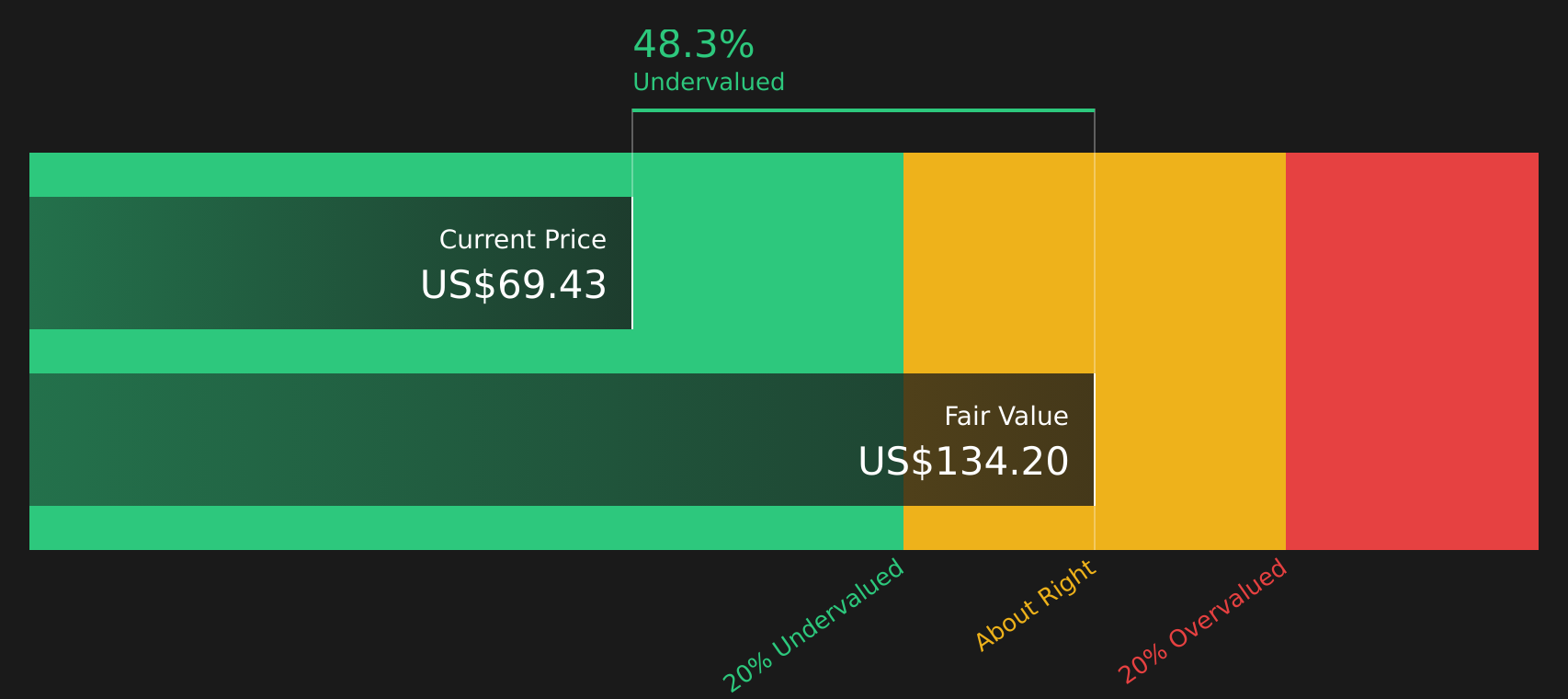
Cactus currently reports last twelve month free cash flow of about $319.8 million. The DCF framework treats this as a base level that is growing. Based on these projections, the DCF model points to an estimated intrinsic value of about $134 per share, compared with the recent price around $69. This gap implies the stock trades at roughly a 48.3% discount to the model’s intrinsic value, even though other indicators such as the high P/E ratio suggest the market is already paying a premium multiple for its earnings.
On the DCF numbers alone, Cactus stock screens as clearly undervalued relative to the current share price.
Our Discounted Cash Flow (DCF) analysis suggests Cactus is undervalued by 48.3%. Track this in your watchlist or portfolio, or discover 48 more high quality undervalued stocks.
Does Cactus Look Pricey on Earnings?
The P/E ratio is a useful yardstick for Cactus because earnings are a key driver of how investors frame the stock today. Cactus currently trades at about 59.1x earnings, which is much higher than the Energy Services industry average of roughly 25.8x and also above the wider peer group average of about 17.3x. That points to investors placing a rich price on each dollar of current earnings relative to many other energy services stocks.
Simply Wall St’s fair P/E estimate for Cactus is about 40.7x. This figure reflects what might be reasonable given the company’s size, profitability profile, industry and risk. It still comes in well below the current 59.1x multiple. The spread between the current P/E and this fair ratio suggests that, on earnings alone, Cactus carries a premium that is hard to ignore, even when considered alongside the stronger DCF-based valuation case.
On the P/E multiple, Cactus stock appears overvalued compared with both industry benchmarks and the modelled fair ratio.

See what the numbers say about this price — find out in our valuation breakdown.
The Cactus Narrative: What Would Justify Today's Price?
Simply Wall St Narratives pick up where Cactus' valuation puzzle leaves off by spelling out which combinations of future growth, margins and earnings would need to hold for the stock to be worth materially more or less than today’s price, and they sit on the company’s Community page. Each one turns its view of fair value into a specific thesis about the business that you can track over time as new information comes through.
Community views on Cactus are far apart, with one side leaning into energy security and product demand and the other focused on backlog and execution risk.
Bull case: 6% undervalued
"Cactus' expansion of SafeDrill™ and integrated wellhead systems for both land and offshore, combined with the increasing adoption of digitalized, ESG compliant oilfield solutions, supports premium pricing power and higher margin cross selling."
Read the full Bull Case to see why Cactus could be undervalued
Bear case: 22% overvalued
"Reliance on tariff mitigation, supplier concessions and customer acceptance of surcharges to sustain a 31% to 33% Pressure Control margin range increases vulnerability if trade policies shift or partners push back."
Read the full Bear Case to see why Cactus could be overvalued
Do you think there's more to the story for Cactus? Head over to our Community to see what others are saying!
The Bottom Line
Cactus offers a clear split in valuation signals. The Discounted Cash Flow (DCF) intrinsic value estimate points to a sizeable discount, while the P/E based view leans toward the stock being overvalued compared with peers and a modelled fair ratio. The weak broader valuation checks suggest investors should treat the DCF signal with caution and focus on what would need to go right in terms of cash generation and capital intensity to close that gap. The crux for Cactus from here is whether its profitability and cash conversion prove strong and repeatable enough to justify the current premium multiple.
This article by Simply Wall St is general in nature. We provide commentary based on historical data and analyst forecasts only using an unbiased methodology and our articles are not intended to be financial advice. It does not constitute a recommendation to buy or sell any stock, and does not take account of your objectives, or your financial situation. We aim to bring you long-term focused analysis driven by fundamental data. Note that our analysis may not factor in the latest price-sensitive company announcements or qualitative material. Simply Wall St has no position in any stocks mentioned.
Have feedback on this article? Concerned about the content? Get in touch with us directly. Alternatively, email editorial-team@simplywallst.com