
- PRICING
- LIVE QUOTES
- LEARN
- HELP


EN
Jibang Consulting: Global TV shipments reached 93.74 million units in the first half of the year, an annual increase of 1.3%
The Zhitong Finance App learned that according to TrendForce Jibang Consulting's latest TV industry research, the global TV market continued to be affected by factors such as higher memory prices in the second quarter of 2026 and the demand for early brand layout in the second half of the year, and shipments fell 1.1% per quarter. However, overall shipments in the first half of the year increased by 1.3% per year to 93.74 million units, a record high for the same period in recent years. The degree of differentiation in brand performance has deepened. The overall TV profits of second-tier brands and white brand manufacturers are being squeezed by memory prices, while major mainstream manufacturers have stabilized the market with cost advantages.
TrendForce Jibang Consulting estimates that slowing demand growth will cause global TV shipments to decline by 0.8% to 194.65 million units in 2026. In the short term, brand manufacturers will continue to increase product value through the popularization of QLED and mini LED and RGB Mini LED. In the long run, smart TV platforms, advertising services and content ecology will become an important key to brand competitiveness. In the future, industrial competition will no longer be limited to hardware specifications, but will develop towards an integrated business model of “hardware+platform+content”.
Large manufacturers rely on scale and cost advantages to maintain shipment expansion
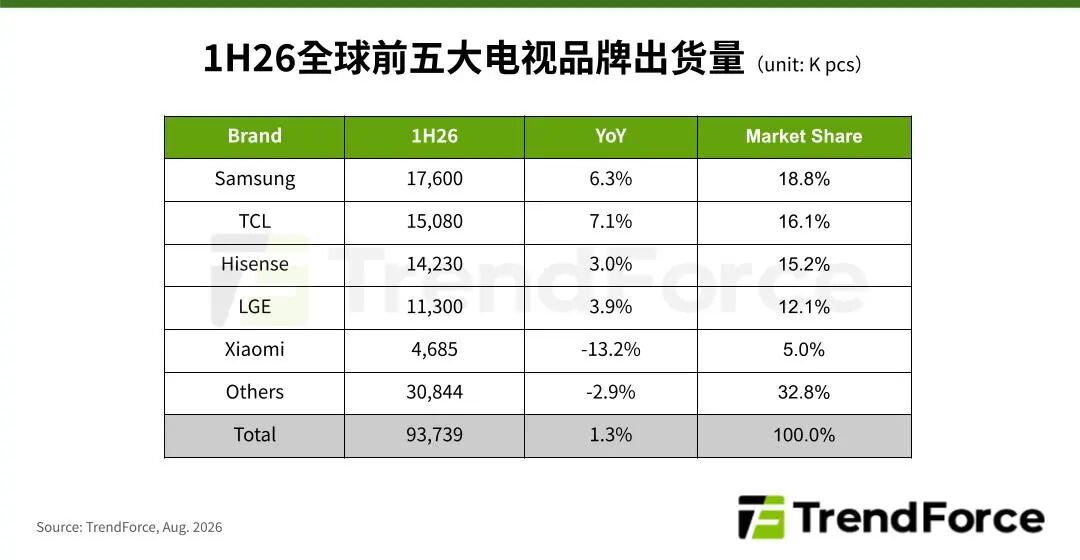
Analyzing the shipping performance of major TV brands in the first half of 2026, Samsung (Samsung) remained at the top of the list, with annual shipments increasing 6.3% to 17.6 million units, maintaining competitiveness in the high-end market with Neo QLED, OLED, and RGB Mini LED models. Its M70 and M80 series Mini LED TVs have eliminated quantum dot film to enter the mainstream market at a more competitive price. Sales are better than expected, boosting Samsung's overall mini LED TV shipments by more than 200% per year.
TCL shipped 1.58 million units in the first half of the year, an annual increase of 7.1%, ranking first among the top four brands. This year, the company increased global market coverage through product strategies adapted to local conditions, while advancing to the middle and high-end markets, using technologies such as SQD Mini LED and QLED to enhance the added value of products, and launched small to medium size FHD QLED models for some markets. The supply chain bargaining advantage brought about by the huge procurement scale helps TCL balance product upgrades with price competition.
Hisense (Hisense) focuses on large-scale, high-end strategies and uses RGB Mini LEDs to establish technical differences. In the first half of the year, its TV shipments increased 3% a year to 14.23 million units. In addition to maintaining a leading market share for products over 100 inches, its RGB Mini LED series has expanded from flagship products to more high-end markets, along with marketing for sporting events such as the FIFA World Cup, which helps enhance the brand's influence in high-end large-size markets.
LGE's shipments increased by 3.9% per year in the first half of the year, reaching 11.3 million units. Unlike in the past, which used OLED models as the main force in the high-end market, LGE increased its mini LED layout this year. It is expected that shipments in 2026 will triple that of 2025, gradually shifting to the dual track of OLED and mini LED to expand the market coverage of high-end display products.
RGB Mini LED TV shipments are estimated to exceed 1.7 million units in 2026
TrendForce Jibang Consulting points out that 2026 is an important turning point in the RGB Mini LED TV market from technology introduction to commercialization. Compared to the previous position as a flagship product showing technical strength, this year's RGB Mini LED product lineup was actively expanded by Samsung, TCL, Hisense, and Sony (Sony), increasing price competitiveness, and gradually penetrating from the ultra-high-end market to the mainstream high-end price range.
In addition, RGB Mini LEDs are superior to traditional Mini LEDs in terms of color gamut, brightness, and energy efficiency, and the brand continues to strengthen relevant specification requirements to enhance consumers' understanding of next-generation display technology. As a result, TrendForce Jibang Consulting revised the global RGB Mini LED TV shipment estimate to 1.7 million units in 2026, and there is an opportunity to move towards 2 million units, reflecting the brand's gradual shift from pursuing technological leadership to expanding market size and establishing a product ecosystem.