
- PRICING
- LIVE QUOTES
- LEARN
- HELP


EN
Soros's eldest son Q2 violently bought memory chips and AI computing power! The opening of ETF positions in the Korean stock market immediately ranked first, and TSMC's positions soared
The Zhitong Finance App learned that the 13F US stock position documents submitted by Wall Street's top hedge funds or family finance offices in the second quarter showed that their investment positions on the global AI computing power industry chain leaders such as TSM.US (TSM.US), the “king of chip foundries” and NVDA.US (NVDA.US), the AI chip superleader Nvidia (NVDA.US), are significantly divided. The most notable increase in holdings came from Soros Capital Management, an alternative asset management family office founded by Robert Soros (Robert Soros), the “financial giant” on Wall Street and the eldest son of billionaire Soros (Robert Soros). The agency completely increased its exposure to AI computing power allocations, 60% of its positions across storage, fab, GPU, and AI new cloud leaders. In particular, TSMC's holdings increased dramatically by more than 1000% to 78,430 shares worth about US$37.46 million.
Third Point, owned by billionaire Daniel Loeb (Daniel Loeb), increased TSMC's holdings by 67%, expanding its holdings from 275,000 shares to 460,000 shares in the second quarter.
Other large hedge funds or family finance offices have also chosen to increase their holdings in the world's largest chip manufacturing giant from Asia. Appaloosa (Appaloosa) increased TSMC's holdings by 24%, Duquesne (Duquesne) by 19%, Soroban Capital increased its holdings by 12%, Lansdowne Partners (Lansdowne Partners) increased its holdings by 10%, and Altimeter Capital (Altimeter Capital) slightly increased its holdings by 4%.
Steve Mandel's Lone Pine made the most significant reduction in holdings, cutting its holdings with TSMC by nearly 93% to 101,242 shares. The SoftBank Group, which is headed by legendary investor Sun Zhengyi, cut TSMC's holdings by 71%, and the number of shares held was reduced from nearly 2 million shares to 565,000 shares. Currently, TSMC only accounts for 1.5% of the investment Big Mac's total holdings, and the total value of its holdings is close to US$270 million.
Other funds that have drastically reduced their holdings of TSMC include Viking Global, SRS Investment Management, and Maverick Capital, with holdings reductions of 50%, 48%, and 43%, respectively. Although legendary Wall Street asset management giant Tiger Global (Tiger Global) cut TSMC's holdings by about 20% to 4.88 million shares, TSMC still accounts for 9.7% of its total holdings, making it the most weighted position in the fund's portfolio.
Soros's eldest son transformed his position into an “AI computing power industry chain encyclopedia”
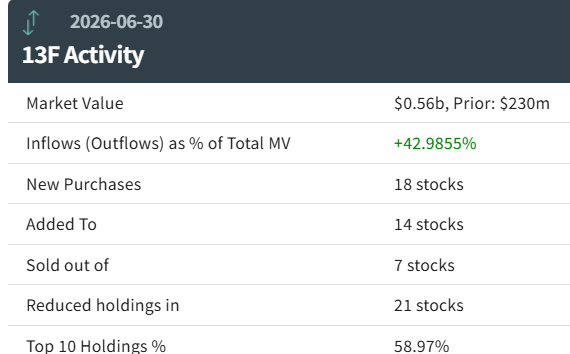
According to statistics, the total market value of Soros Capital's holdings in the second quarter was 560 million US dollars. Compared with the total market value of the previous quarter, the total market value of Soros Capital's holdings was only 230 million US dollars, which means that the size of Soros Capital's holdings more than doubled during the second quarter when the stock market was profitable and selling pressure heated up. The financial giant added 18 new holdings to its portfolio in the second quarter, increased its holdings by 14 shares, reduced its holdings by 21, and cleared 7 stocks. Among them, the top ten holdings account for about 60% of the total market value.
Specifically, the Korean market ETF, iShares MSCI Korea ETF (EWY.US), which has an “AI computing power investment theme trend vane,” ranked Soros Capital's largest holding target, holding about 212,200 shares, with a market value of about US$42.84 million, accounting for 7.66% of the portfolio, which is a newly created position in the second quarter. This layout is equivalent to betting on the bullish trajectory of the Korean stock market in the form of a national ETF, and indirectly gaining upward exposure from leaders in the memory chip and AI hardware industry chain such as Samsung Electronics and SK Hynix.
The US “memory chip giant” Micron Technology (MU.US) is the second-largest holding position, holding about 36,800 shares, with a market value of about US$42.45 million, accounting for 7.59% of the portfolio. It is also a newly created position in the second quarter. Micron and EWY entered the top two positions at the same time, highlighting that Soros Capital is focusing on AI server-driven HBM, server DRAM, and NAND storage supercycles.
TSM.US (TSM.US), the “king of chip foundries in the world,” ranked the third largest holding, holding 78,430 shares, with a market value of about US$37.46 million, accounting for 6.70% of the portfolio; in the second quarter, it increased its holdings by 73,100 shares, and the number of holdings surged 1371.48% month-on-month, and its portfolio weight jumped from 0.78% in the previous quarter to 6.70%. This is not only an ordinary increase in inventory, but also a high-intensity directional bet on advanced manufacturing processes, advanced packaging, and increasing global AI chip production capacity.
Global construction machinery and power equipment giant Caterpillar (CAT.US) has the fourth largest holding position, holding 32,800 shares, with a market value of about US$34.93 million, accounting for 6.25% of the portfolio; in the second quarter, it increased its holdings by 16,300 shares, and the number of holdings increased sharply by 98.79%, and its portfolio weight increased from 5.08% to 6.25%. This configuration shows that in addition to betting on chips, Soros Capital is also laying out “real economy sellers” brought about by the expansion of capital expenditure on data centers, power equipment, mining, and energy infrastructure.
Semiconductor equipment giant Applied Materials (AMAT.US) has the fifth largest holding position, holding 47,750 shares, with a market value of about US$34.52 million, accounting for 6.17% of the portfolio, which is a newly created position in the second quarter. The world's largest semiconductor equipment supplier's application materials cover key chip manufacturing processes such as advanced logic chips, HBM, wafer-level advanced packaging, and material engineering, making it an important beneficiary of the spread of AI computing power capital expenditure from chip design to manufacturing equipment.
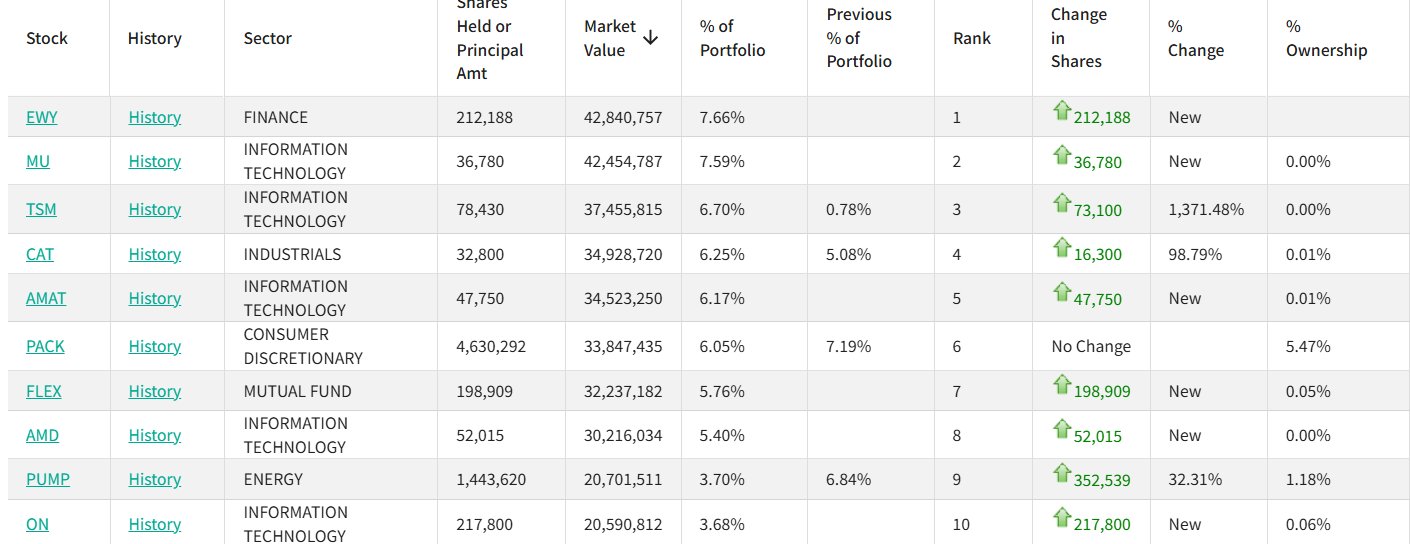
Among the top ten major stocks, Soros Capital ranked 6th to 10th as of the second quarter: Ranpak Holdings (PACK.US), Flex.US (FLEX.US), Chaowei Semiconductor (AMD.US), ProPetro Holding (PUMP.US), and Onsemi Semiconductors (ON.US). Among them, PACK held about 4.6303 million shares, with a market value of about US$33.85 million, accounting for 6.05%, and the number of shares remained unchanged; built about 198,900 FLEX shares, with a market capitalization of about US$32.24 million, accounting for 5.76%; AMD built 52,015 shares, with a market value of about US$30.22 million, accounting for 3.70%. In the second quarter, the holding of 352,539 shares increased by 32.31%; ON built 217,800 new shares, with a market value of about US$21.78 million US$20.59 million, accounting for 3.68%. The total market value of the top ten positions is about US$329.8 million, accounting for 58.96% of the total 13F portfolio.
In addition, among Soros Capital's other key holdings, the agency built 30,700 new Vaneck Semiconductor ETFs (SMH.US) in the second quarter, with a market value of about US$2014 million, accounting for 3.60%; increased its holdings of ASML.US (ASML.US) by 191.11% to 9,956 shares, with a market value of about US$1.81 million, accounting for 3.54%; and increased NVDA.US (NVDA.US) holdings by 566.21% to 77,300 shares, with a market value of about US$15.47 million, accounting for 2.77%; it also built 55,200 new shares of “AI New Cloud Leader” Nebius (NBIS.US), with a market capitalization of about US$15.24 million, accounting for 2.73%.
Combining TSMC, Micron, Applied Materials, AMD, Ansemi, and EWY, Soros Capital has built a multi-level “AI Computing Power Infrastructure Encyclopedia” covering “Korea Storage - Foundry - Semiconductor Equipment Leader - AI Chip Giant - Chip Testing and Manufacturing Agent - Cloud Inference Computing Power Infrastructure”.
At the same time, Soros Capital also surged Amer Sports (AS.US) holdings by 1420.97%, increased Generac (GNRC.US) holdings by 470.99%, and slightly increased TeraWulf (WULF.US) holdings by 6.93% and American Electric Tower (AMT.US) 6.41%; on the other hand, it drastically reduced GE Vernova (GEV.US) holdings by 52.17%, and reduced Amazon (AMZN.US) by 15.29% and Texas Instruments ( TXN.US) 9.88%, Alcon (ALC.US) 16.99%, and Visa (V.US) 29.00%. Overall, this 13F is not simply chasing Nvidia's single high beta, but rather significantly shifting the investment focus to AI storage, advanced manufacturing, semiconductor equipment, data center infrastructure, and industrial energy capital expenditure; at the same time, it reflects the combined construction logic of “betting on the main rise in AI computing power while controlling the concentration of a single technology giant” through decentralized computing power holdings through Korea's ETF, Micron, AMD, Asmack, applied materials, Caterpillar, oil services, and consumer products.
Is this a memory chip in Stud? The eldest son of Soros soars in the Korean stock market and Micron
Soros Capital is trying to simultaneously obtain multiple profit levers brought about by HBM/DRAM price increases, advanced process production expansion, wafer equipment orders, GPU competitive patterns, and growing AI cloud demand, and use Korean ETFs, Caterpillar, oil services, and consumer assets to spread the risk of a single technology stock. However, 59% broad AI exposure also means that the portfolio is highly sensitive to capital expenditure cuts, long-term yield increases, and semiconductor cycle reversals; high-capital-intensive targets such as WULF and NBIS also incur financing and execution risks.
Soros Capital's latest position and investment layout direction, with Soros's eldest son at the helm, highlights that Wall Street's AI computing power-themed transactions are spreading from a single GPU leader to storage, foundry, equipment, server systems, and computing power cloud platforms. At the same time, stock selection standards are beginning to shift from conceptual flexibility to order visibility, financing capacity, and free cash flow fulfillment.
Judging from the changes in position ratio, Soros Capital's eldest son Robert Soros's top five purchases in the second quarter were: iShares MSCI Korea ETF (EWY.US), Micron Technology (MU.US), Applied Materials (AMAT.US), TSM.US), and Flex.US (FLEX.US). Corresponding portfolio weights increased by 7.66, 7.59, 6.17, 5.91 and 5.76 percentage points, respectively, which is enough to highlight Soros Capital is investing heavily in a computing power infrastructure industry chain composed of Korean memory chips, HBM and server DRAM, advanced manufacturing processes, semiconductor equipment, and AI server power, liquid cooling, and system integration. In particular, it has built new heavy warehouses for Micron, Applied Materials, and Flextronics, and has surged TSMC's holdings by 1371.48%.
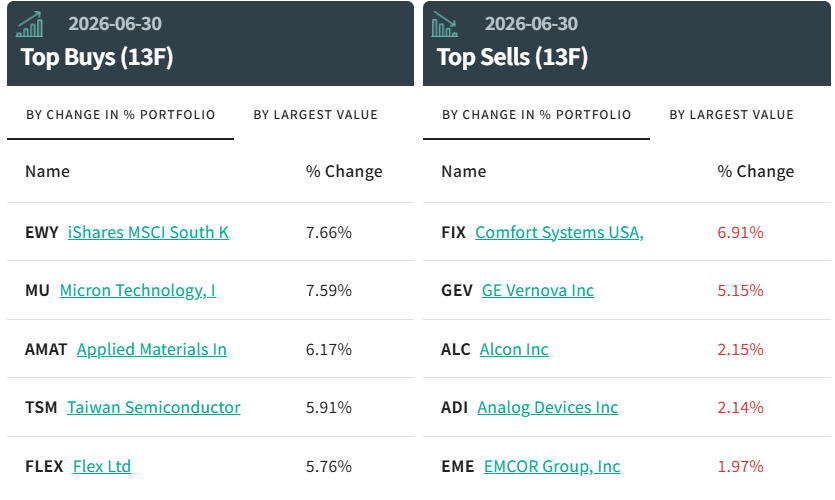
Soros Capital's first five sales targets in the second quarter, led by Soros's eldest son were: data center HVAC and mechatronic engineering giant Comfort Systems USA (FIX.US), data center power equipment giant GE Vernova (GEV.US), ophthalmic medical equipment company ALC.US (ALC.US), analog chip giant ADI.US (ADI.US), and electromechanical engineering contractor EMCOR Group (EME.US). Corresponding portfolio weights declined by 6.91, 5.15, 2.14, and 1.97 percentage points, respectively, further underscoring that it is making profit settlements for AI power, HVAC, and engineering construction beneficiaries with high early valuations and stock price increases, while reducing medical and traditional analog chip positions to accelerate the rotation of capital from “second-tier beneficiaries of AI data center construction” to storage, foundry, and semiconductor equipment, the core AI computing power bottleneck asset more directly linked to AI capital expenditure; this is not a bearish on AI, but rather a bottleneck asset in the AI computing power industry ratio Reorder.