
- PRICING
- LIVE QUOTES
- LEARN
- HELP


EN
Bank of America investigation reveals “no landing” carnival is approaching the limit of positions Wall Street smart money is shifting to “compound cash flow+misplaced valuation”
The Zhitong Finance App learned that the latest August global fund manager survey released by Wall Street financial giant Bank of America shows that investors' sentiment about the stock market is still fanatical and bullish. A record 56% of respondents expect the US economy to “not land” in the next 12 months. However, while market optimism overflowed, the risk signals from fund managers became more and more clear: “disorderly upward trend in bond yields” rose to the second largest tail risk at a rate of 27%, second only to the “AI bubble” panic (32%), which had been at the top for two consecutive months.
Bank of America analysts, including Michael Hartnett and Anya Sherekhin, said in a research report that the August fund manager survey was the third-highest bullish survey since 2022. A total of 203 fund managers were interviewed in this survey, with assets under management totaling US$581 billion. The survey was conducted from August 7 to August 13.
Bank of America's cash rules triggered a reverse “sell” signal at the same time as the Bull and Bear Index, which rose to 9.3. Combined with the recent surge in bond market yields and the resurgence of pessimism about the AI bubble, it means that “no recession, no interest rate hikes, no reduction in AI capital expenditure, and continued high profit growth” has almost all been included in the market pricing system.
The picture drawn by Bank of America's August global fund managers survey is not “investor sentiment has turned cautious and pessimistic,” but rather a paradox where institutional risk perception has risen sharply, real positions are still extremely risky, and AI positions are crowded: a record 56% of respondents bet that the US economy will “not land” in the next 12 months, net 37% expect corporate profits to achieve double-digit growth, and 72% believe that the Federal Reserve will not raise interest rates before the midterm elections; in response, the net overallocation of global stocks rose to 56%, the highest since November 2021, and the cash ratio fell to the sixth lowest in history. Net low bonds Allocation increased to 39%.
During the preparation of the fund manager survey, another Bank of America research report showed that at a time when the AI theme faced a storm of deleveraging and extreme overcrowded bullish positions, and the risk of inflation posed a challenge to traditional portfolios, value stocks, biotechnology, regional banks, some credit types, and commodities all provided attractive investment opportunities. Furthermore, international small-cap value stocks were already more attractive than US large-cap growth stocks, and the profitability of Japanese companies had risen to historical record levels. The agency also sees listed private equity management companies as a reverse investment opportunity and favors high-quality high-yield bonds over investment-grade bonds.
Wall Street financial institutions, including Bank of America, have not recently been bearish on the AI theme, but have emphasized a very clear asset allocation upgrade: from highly concentrated AI/US growth stock transactions to “retaining structured AI longs+increasing low-correlation, high cash flow, and undervalued assets” portfolio proliferation. As AI moves from a scarcity narrative to a trillion-dollar capital expenditure payment period, the determinants of excess earnings will shift from “whether there is AI exposure” to “whether valuation, free cash flow, ROIC and congestion match.”
“Don't land” became the main theme on Wall Street! Bank of America survey shows that stock overallocation rose to the highest level in nearly five years
A team led by Bank of America senior strategist Michael Hartnett (Michael Hartnett), who has the title of “Wall Street's Most Prospective Strategist,” released a research report saying that under the “no landing” scenario, even though benchmark interest rates and inflation remain historically high, the economy will continue to grow, and employment will remain strong. A total of 34% of fund managers surveyed expect the economy to achieve a “soft landing,” while another 4% expect a “hard landing.”
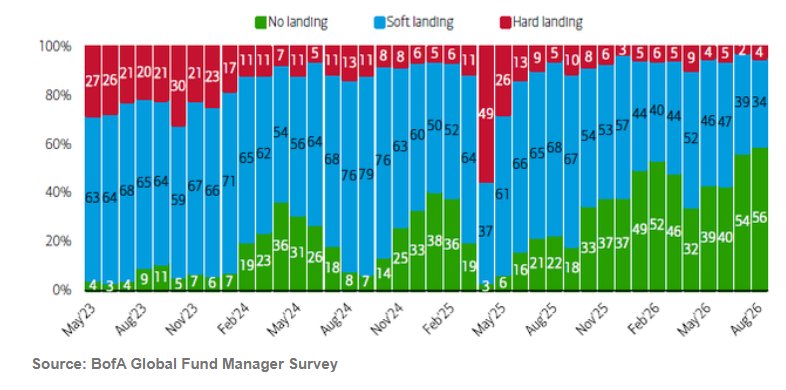
About 72% of respondents expect the Federal Reserve will not raise interest rates before the midterm elections. Furthermore, 53% of respondents expect the tone of Federal Reserve Chairman Kevin Walsh's upcoming major speech at Jackson Hole to remain generally neutral.
As for the midterm elections, 47% of respondents believe that the most likely outcome is a two-party check and balance pattern where the Democratic Party controls the House of Representatives and the Republican Party controls the Senate.
Net 56% of respondents are still “overvalued” stock assets, the highest level since November 2021. August was also the 14th month in a row that institutional investors oversold stocks.
Net 37% of investors expect strong double-digit growth in corporate profits over the next 12 months.
From the perspective of position structure, the most crowded transaction was “going long on semiconductors”. 53% of respondents held this view, although it was a sharp drop from the previous month's historical peak of 82%. The second most crowded transaction was “shorting the yen” (12%), and the third was “going long on Magnificent 7", or going long for the Big Seven (11%). Reverse trading suggestions given by Bank of America strategists include: going long on bonds/commodities, going long on essential consumer goods/shorting technology stocks, and going long on UK stocks/shorting US stocks.
Bank of America's cash rules and the latest survey showed that the Bank of America's exclusive bullbear index rose to 9.3. In addition, the most crowded transaction, “going long on semiconductors,” highlights that positions related to AI computing power seem to be getting more crowded. It can also be described as triggering the opposite of the “sell” signal indicator compiled by the agency. To a large extent, “no recession, no interest rate hikes, no reduction in AI capital expenditure, and continued high profit growth” has almost all been included in the price.
The AI bubble hits the yield curve, and extremely low cash positions raise the alarm for overcrowded transactions
The so-called “bond market falls into ICU and stock market frenzy” essentially means that the bond market is repricing inflation, finance, and capital scarcity, while stock investors are still offsetting valuation pressure with profit growth.
AI is simultaneously acting on both ends of the stock valuation formula: on the one hand, it supports the “molecule” of profit, and on the other hand, it pushes the “denominator” numerical trajectory of risk-free benchmark yield (anchoring 10-year US Treasury yield) through huge capital expenditure and debt financing — from a theoretical perspective, the 10-year US Treasury yield is equivalent to the risk-free interest rate indicator r on the denominator side of the DCF valuation model, an important valuation model in the stock market.
The “AI bubble” continued to be the biggest tail risk at 32%, followed by a “disorderly rise in bond yields” from 14% to 27%. Meanwhile, 71% of fund managers still believe that hyperscale cloud service providers will not cut capital expenses in 2026, while 38% see this as the most likely source of systemic credit incidents, and a net 19% believe corporate balance sheet leverage is too high. Since 2026, large technology companies have issued close to 220 billion US dollars in debt, compounding the government's fiscal deficit to compete for long-term long-term capital pools, driving the US 30-year real yield close to 3%.
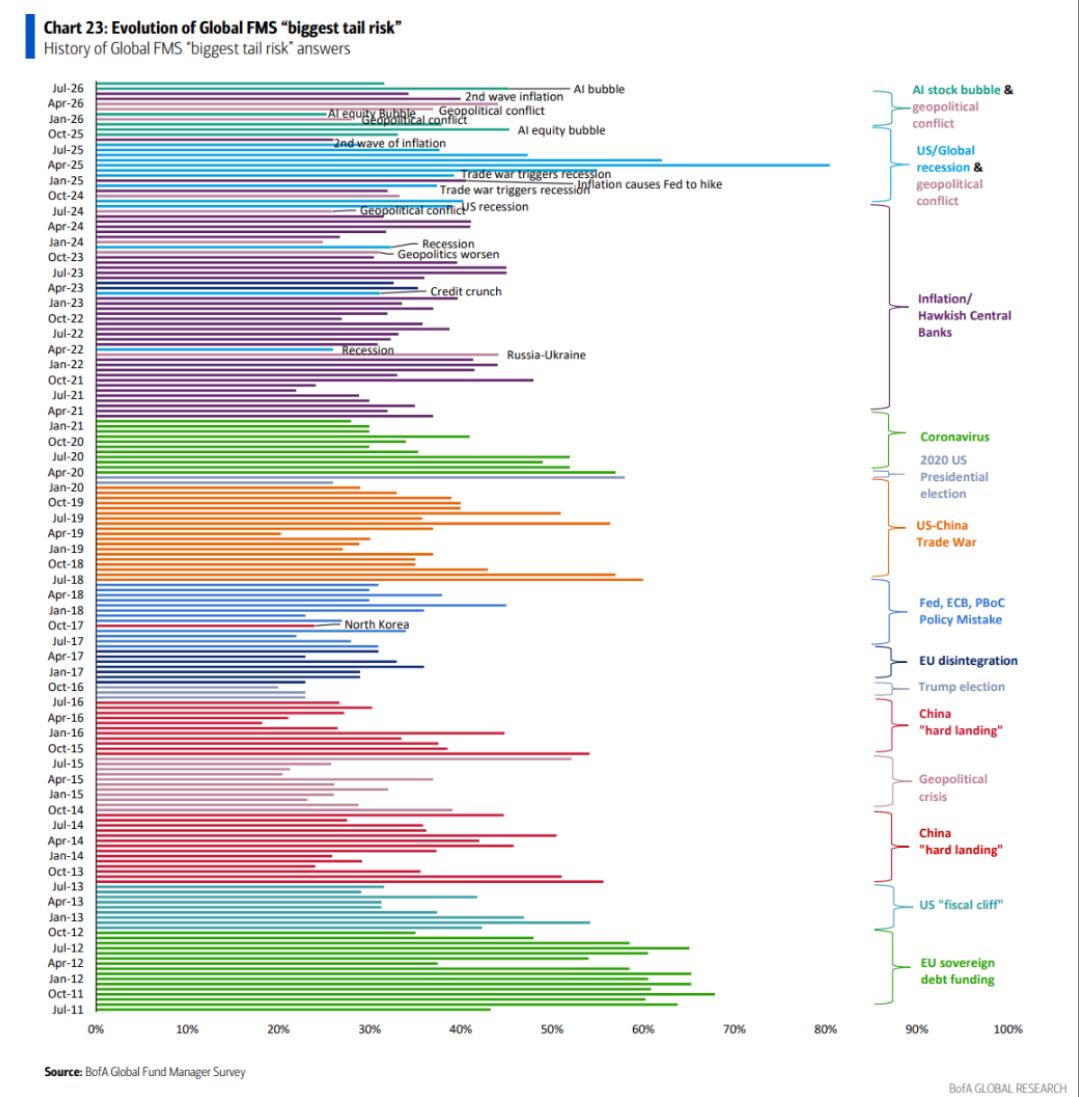
Therefore, the real risk brought about by the AI bubble and the continued surge in bond market yields is not that demand for computing power disappears out of thin air; rather, there is a mismatch between upfront investment, long-term debt, and deferred monetization — once the 10-year US bond yield approaches 5% and financing costs continue to be higher than the return on AI projects, the market will rapidly shift from rewarding capital expenditure to questioning how much free cash flow and AI inference revenue can be generated per dollar invested.
Stock investors are likely to be more cautious, but this is first reflected in the internal rotation of risky assets and the tightening of stock selection standards, rather than immediately leaving the stock market. This is why Wall Street's latest investment layout highlights the beginning of a shift in investment focus to high-cash flow compound assets, that is, from leveraged positions to historically extreme AI computing power themes and high beta momentum transactions with extremely high position congestion to “high quality cash flow compounding+valuation misalignment” alpha transactions.
Bank of America's team of strategists is urging investors to move beyond the overcrowded topic of artificial intelligence trading. The agency believes that at a time when the AI theme is facing a deleveraging storm, forced clearance of extremely crowded positions, and inflation risks are challenging traditional portfolios, value stocks, biotechnology, regional banks, some credit products, and commodities all provide attractive investment opportunities.
After the AI bull market entered the “high valuation+high congestion+high capital consumption” stage, Bank of America advocated shifting marginal capital from the most expensive AI computing power beta to “cheaper profit growth, real cash flow, and anti-inflation assets” — this is a rebalance from a single technology main line to the spread of profits and high-quality cash flow sectors across the market, not the end of the AI bull market. For example, Pershing Square, founded by billionaire and hedge fund legend Bill Ackman himself at the helm, switched to an investment framework of “buying high-quality fundamental stocks at misplaced prices/collapse prices” — opening new positions, the digital payment and bank card network giants Visa (V.US) and Mastercard (MA.US), as well as four other companies with low concentration of positions and high cash flow quality for a long time.