
- PRICING
- LIVE QUOTES
- LEARN
- HELP


EN
The underrated robot brain leader: inflection point and doubling logic in the Xiangong Intelligence (06106) report
For Xiangong Intelligence (06106), which only landed on the Hong Kong Stock Exchange on June 24, the significance of the first interim report card is not only that it handed over a set of high growth data, but that the company is moving from a period of technology and business model verification to a new stage of gradual release of scale effects.
The Zhitong Finance App learned that in the first half of 2026, Xiangong Intelligence achieved revenue of 264 million yuan, an increase of 67.5% year on year; gross profit of 123 million yuan, up 71.7% year on year; and overall gross margin rose to 46.6% from 45.4% in the same period last year. The loss attributable to equity shareholders of the company narrowed 25.1% year over year to 37.89 million yuan, while the adjusted net loss narrowed by 50.1% year on year to 10.97 million yuan.
However, compared to a single revenue growth rate, what is more noteworthy is the overall resonance of business indicators: in the first half of 2026, more than 8,000 “robot brains” were shipped, up more than 80% year on year; new orders exceeded 467 million yuan, up more than 60% year on year; more than 400 new customers were added, up about 65% year on year, and the repurchase rate of existing customers exceeded 60%.
The five indicators of revenue, shipment, order, customer, and repurchase rate confirm each other, which means that the growth of Xiangong Intelligence does not come from a single large order or phased demand, but is based on the joint drive of customer expansion, stock repurchase, and industry penetration.
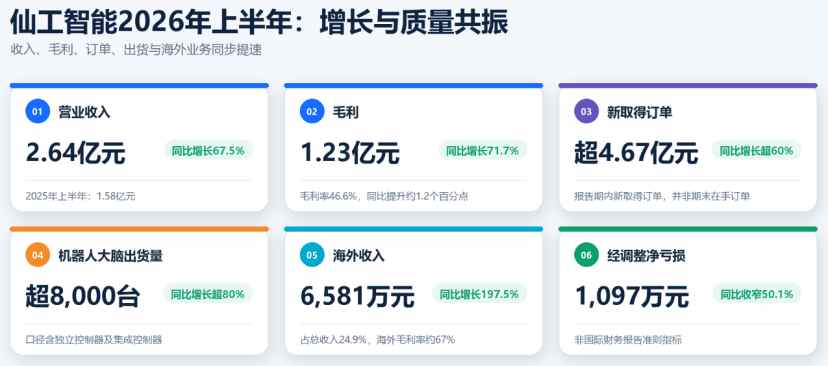
(Data source: Xiangong Intelligent Interim Results Report; Cartography: Zhitong Finance App)
Improving “brain” capacity is the underlying logic of overall machine growth
Judging from the product classification in financial statements, in the first half of 2026, Xiangong Intelligence achieved revenue of intelligent robots of 185 million yuan, an increase of 70% over the previous year, accounting for about 70% of total revenue; the “robot brain” revenue was 59.02 million yuan, an increase of 56.1% over the previous year, accounting for about 22%.
But these two types of revenue are not separate businesses. The essence of Xiangong Intelligence is an intelligent platform company with a “robot brain” as the core, and the underlying capabilities are biased towards software and algorithms. The robot brain of Xiangong Intelligence is not a single control hardware, nor is it an independent model ability. It is a “model+cerebelline+nerve” three-in-one architecture: the model layer is responsible for environmental understanding, task reasoning and decision planning, and is the core of robot cognitive ability; the cerebellar layer undertakes motion control and execution scheduling to transform decisions into accurate and stable robot actions; the neural layer connects multi-modal perception with the whole machine hardware to achieve real-time collection of sensor data and efficient distribution of instructions. The three work together in a closed loop to form a complete intelligent link for robots from perception to action. Intelligent robots are an important vehicle for the brain's ability to enter the physical world and complete scene delivery. The increase in revenue is ostensibly reflected in the expansion of sales of complete machines. The core driving force behind it is the continuous improvement of the “brain” in terms of perceptual understanding, decision planning, motion control, cluster scheduling, cross-configuration adaptation, and complex task execution.
As the brain becomes smarter and more stable, robots can move further from being “able to run” to “being able to complete tasks” and achieve large-scale deployment in more customers and industry scenarios. As a result, intelligent robot revenue increased 70% year over year, which not only indicates that the whole machine product has received higher market recognition, but also reflects that the company's underlying algorithms, models, and software platforms are being rapidly transformed into deliverable and replicable commercial results.
The commercial value of the company's “brain” ability can be realized in two ways: one is to directly deliver it to customers in the form of a “brain” (integrating the model, cerebellum, and nerves into one hardware), corresponding to revenue of 59.02 million yuan during the reporting period; the other is to embed the “brain” into complete machine products such as humanoid robots, self-contained forklifts, composite robots, and delivery robots to form intelligent robot revenue through software and hardware integration. Judging from this, the 22% share of “brain” revenue in financial statements does not fully reflect the actual contribution of the “brain” to the company's overall revenue and product competitiveness.
The company revealed in the announcement that the gross margin of the “robot brain” is about 80%, and its high added value does not only come from controller hardware, but is based on unified control architectures, algorithms, software interfaces, and development tools. The same set of underlying capabilities can adapt to different robot forms, component combinations and application scenarios to help customers lower the threshold for robot development, adaptation and delivery. Sales of intelligent robots have increased, and the scope of installation and application of the “brain” has been further expanded, so that algorithms, tool chains and platform capabilities can be reused among more products and customers.
The growth logic that differentiates Xiangong Intelligence from traditional robot hardware companies is this set of growth logic that enhances product competitiveness while expanding the deployment of complete machines and further broadens the scope of platform reuse.
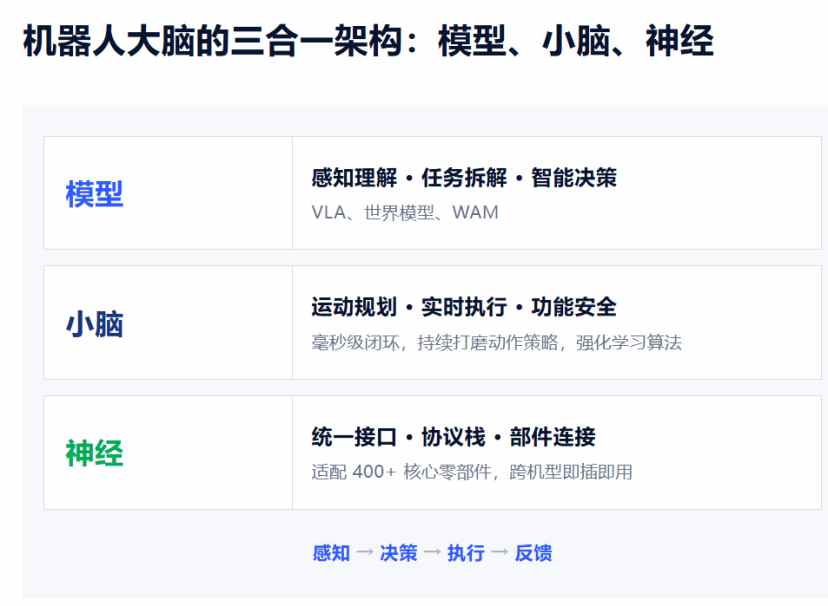
(The model is responsible for decision-making, the cerebellum is responsible for execution, and nerves are responsible for connections — three layers in one is a complete robot brain. (Screenshot source: WeChat Official Account “Xiangong Intelligent AGI”)
In the first half of 2026, the company's gross profit increased by 51.41 million yuan over the same period last year, exceeding the year-on-year increase of about 46.05 million yuan in sales, administration and R&D expenses. As “brain” capabilities continue to be transformed into machine sales, customer coverage, and scenario replication, the company's business model with a soft bottom layer and high platform reuse rate is beginning to penetrate revenue growth and be reflected in operating efficiency.
Overseas revenue, orders, and customers accelerate at the same time
If the domestic business has verified the commercialization capabilities of Xiangong Intelligence, the overseas business has begun to verify the replicability of its platform.
In the first half of 2026, the company's overseas revenue reached 65.81 million yuan, up 197.5% year on year, and the revenue share rose from 14.0% to 24.9%; new overseas orders exceeded 124 million yuan, up more than 550% year on year; and the gross margin of overseas business remained at a high level of about 67%.
By the end of June, the company's customers had covered 43 countries and regions, and the number of new overseas customers increased by more than 150% year-on-year in the first half of 2026. Overseas revenue, orders, and customers are growing at the same time, indicating that the company's internationalization is shifting from the channel construction stage to the actual revenue contribution stage.
More importantly, overseas business not only increases revenue, but may also improve the company's profit structure. Overseas gross margin is significantly higher than the overall level of the Group. With the gradual improvement of local sales, service and channel systems, overseas business is expected to become a dual driving force for revenue growth and increased profitability.
It is important to note that as projects progress, delivery, and acceptance of new overseas orders, confirmed revenue will be reflected in the next few reporting periods.
“Platform Company Basic Issue+General Brain Options”
Another important feature of Xiangong Intelligence is that it does not rely on a single robot form.
According to insight consulting data quoted in the company announcement, Xiangong Intelligence ranked first in the world in sales of intelligent robot brains for three consecutive years from 2023 to 2025, with a global market share of about 25%; in terms of sales, the company's ranking in the global industrial intelligent robot market rose from third in 2024 to second in 2025.
SPDB International pointed out in the robot industry report released on August 6, 2026, that industrial robots have entered a period of large-scale maturity, and the growth mainly comes from domestic substitution, manufacturing automation, and exports; humanoid robots are still in the early stages of mass production, and the technology route and competitive pattern have not yet been defined. The two are not an alternative relationship in the short term. Instead, industrial robots take on standardized, high-precision tasks, and humanoid robots complement flexible and unstructured links.
According to the industry report released by CMB International on August 14, the basic motion control of humanoid robots is currently progressing rapidly, but “brain” generalization ability and real machine data are still the main bottlenecks in large-scale commercial use. The report quoted IDC data as saying that in 2025, scenarios such as commercial demonstrations, scientific research, and data collection accounted for 78.4% of humanoid robot shipments, and truly economical industrial applications are still being verified.
This means that Xiangong Intelligence's existing business can provide revenue and basic scenarios. After further breakthroughs in brain capabilities, it will empower humanoid robots, robot dogs, self-contained forklifts, and AI delivery robots to provide new growth space. Compared to betting on a certain ontology manufacturer or a certain technical route, cross-configuration platforms can share the development dividends of various robot forms and spread risks when the ontology pattern has not yet been determined.
CMB International also estimated using Tesla Optimus as an example. As the cost of mechanical components is reduced on a large scale, the hardware cost of the whole machine may drop by nearly 70% in the medium to long term, while the relative cost share of domain controllers and chips may increase. The estimate is an institutional scenario and is not an industry or company guideline, but it reveals a trend: the more standardized and less costly robot hardware, the more likely it is that the relative value of controls, models, and software in the industrial chain will increase.
Tens of thousands of real machines have been deployed to establish a lower-level starting point for a closed loop of data and models
The core of the long-term competitiveness of an intelligent enterprise is not limited to the size of the data stock, but also whether the data comes from actual production tasks, whether a continuous return mechanism can be formed, and whether it can actually drive forward iteration of model capabilities and product experience.
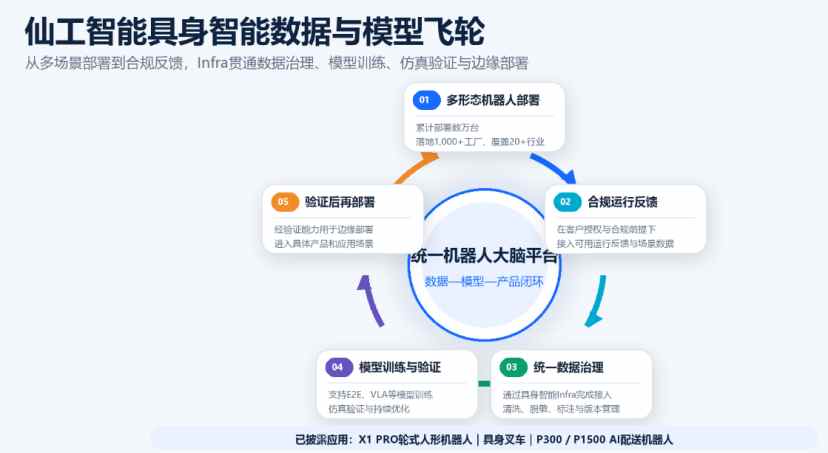
By the end of June 2026, robots equipped with the “robot brain” of Xiangong Intelligence had accumulated tens of thousands of deployments and landed at more than 2,500 customers, covering a wide range of more than 20 industry segments such as 3C electronics, automobile manufacturing, new energy, semiconductors, biomedicine, retail, etc., and had accumulated a diverse and solid real scene base for a closed loop of data.
Based on large-scale scenario implementation, the company has built a full-link embedded intelligent infrastructure (Infra) to run through the entire process of data access, cleaning and desensitization, data labeling, model training, simulation evaluation, model release, and end-side data return. Currently, the company's self-developed end-to-end (E2E), visual language motion (VLA) models have been applied to X1 PRO wheeled humanoid robots, smart forklifts, and P300 and P1500 AI delivery robots, and have been deployed in batches in leading global companies in the semiconductor, automotive, and 3C industries.
This system forms a sustainable positive growth flywheel: the robot runs in real scenarios to produce first-line operation data, and the data flows back to feed back the model for continuous iteration; after improving model capabilities, it can further reduce subsequent scenario adaptation and project deployment costs, thereby driving more product shipments and data accumulation, and achieving a self-driving cycle of “deployment — data — model — growth”.
According to Tianfeng Power's new research notes, the company currently operates about 50,000 robots, with a data return rate of about 20%. It has accumulated 500,000 hours of actual machine operation data across configurations. The data has the core characteristics of authenticity, scene diversity, standard consistency and sustainable iteration. Among them, the company's vertical VLA model has successfully landed at Nvidia's Houston plant. Based on the current shipping growth rate, Tianfeng Securities expects the company's actual machine operating data volume to exceed 1 million hours in 2027.
Tianfeng Securities pointed out that at present, general robot brains are not fully mature, and industrial scenarios are highly structured and there are few extreme scenarios, and implementation requirements can be met through VLA models and real machine data training. As a highly standardized product, Xiangong Intelligent's controller can rapidly release data in industrial scenarios, simultaneously recover real machine data for model training, and form a stable data flywheel; it can also train a large base model on this basis, and eventually evolve into the long-term goal of a general-purpose robot brain.
Revaluing Xiangong Intelligence: There is room for the stock price to double
The listing has significantly enhanced the company's financial security cushion and strategic investment capacity. As of the end of June 2026, the company's cash and cash equivalents were about $1,012 million, bank loans were about $92.1 million, and the net cash volume was about $920 million; the net capital raised from the global sale was about HK$995 million unspent as of the end of the period. Adequate capital reserves will provide a solid guarantee for the company's continued investment in the fields of intelligent infrastructure, world models, computing power resources, new product development, and global service network construction.
Looking forward to the future, Xiangong Intelligence will continue to improve the embedded intelligent Infra, pass through data backflow, model training, simulation evaluation and model recharge, and promote spatial intelligence, world model and WAM research and development, and enhance the robot's ability to sense, predict, plan, and generalize across scenarios. Based on this, the company will accelerate technology commercialization, iterate on multi-morphed humanoid robots and robot dogs, and launch a new generation of “robot brain” controllers to lower development and application thresholds with a unified platform and open up more industrial and commercial scenarios.
Judging from the essence of investment, the layout of Xiangong Intelligence is not betting on the success or failure of a certain humanoid robot, but rather on the long-term need for a unified “brain”, a general control platform, and a closed loop of real scene data after the robot forms continue to diversify. This is the difference in core value between a platform-based enterprise and a single machine manufacturer.
At the valuation level, SPDB International's research data as of August 4 shows that the average predicted market sales rate (“PS”) of the four types of industrial, mobile, service, and humanoid robot companies in 2026 was about 7.9 times, while the average predicted market sales rate of core components and upstream suppliers during the same period was about 14.3 times. Upstream platform models enjoyed significant valuation premiums.
Estimates from various agencies also confirm the cost performance ratio of current valuations. According to some agency estimates, the company's current market value is only about half of the basic market valuation (105-14 billion yuan), corresponding to less than 10 times PS in 2026 (see Cognex still enjoying 10 times PS during the single-digit growth phase); compared with the domestic primary market's valuation starting at 20 billion yuan and the valuation level of overseas target companies of 10-30 billion US dollars, the value of the company's intelligent “brain” options is almost free.
Tianfeng Securities also regards the company as a scarce target for the domestic robot brain circuit. The company's 2026/2027 revenue is estimated to be about 7.2/1.12 billion yuan, respectively, which is only 9.7/6.3 times PS. It believes that the company's business model is closer to Momenta, and they are all “asset-light + software development” models; considering that the smart track ceiling is higher, and the company's compound growth rate can reach 50% or more in the future, giving a 15-fold PS valuation, there is still room for a 138% increase in the corresponding stock price, maintaining a “recommended” rating.
Overall, revenue, orders, customer base, deployment scale, and global layout are only the starting points for Xiangong's intelligent growth. In the future, whether these stock advantages can continue to be transformed into higher growth quality, stronger cash generation capacity, and more stable platform-based barriers will be the core that determines its long-term shareholder value and valuation center.