
- PRICING
- LIVE QUOTES
- LEARN
- HELP


EN
Resilience in home improvement spending has borne the downturn in the property market! Home Depot (HD.US) Q2 results exceeded expectations and maintained full-year sales guidance, but warned that the outlook is still uncertain
The Zhitong Finance App learned that the second-quarter results announced by US home building materials retail giant Home Depot (HD.US) exceeded market expectations, indicating that despite high borrowing costs and housing costs, consumer spending on home improvement projects remains resilient. As of press release, Home Depot's US stock rose more than 2% before the market on Tuesday.
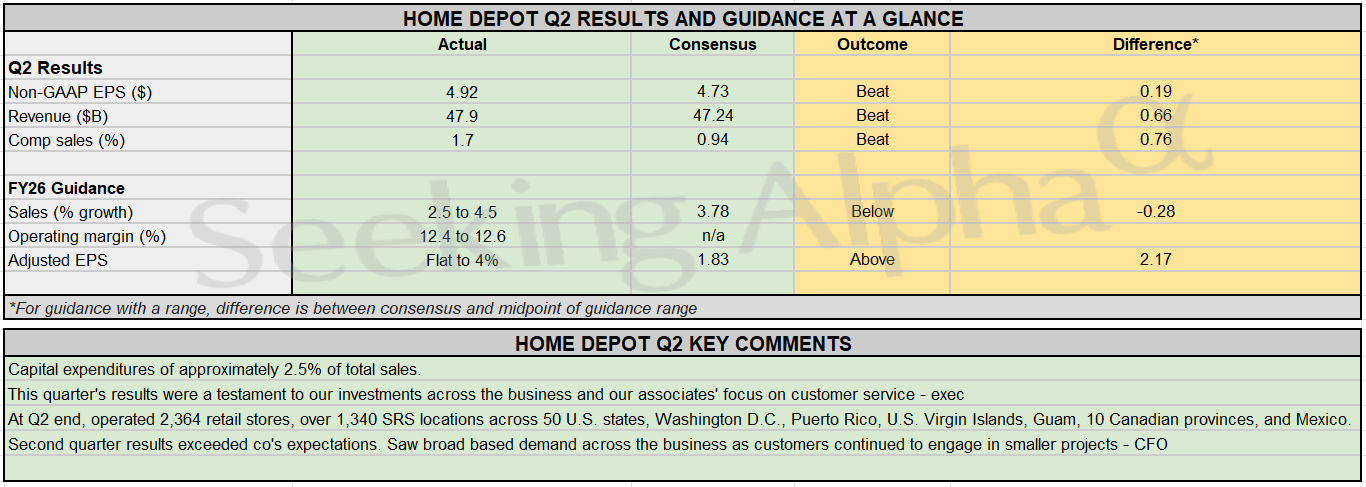
Financial reports show that in the second quarter ending August 2, Home Depot's sales increased 5.7% year over year to US$47.86 billion, better than analysts' average expectations of US$47.24 billion; same-store sales increased 1.7%, the highest growth rate since the end of 2022, far exceeding the average analysts' expectations of 0.94%. Adjusted operating profit was $7.017 billion, up 4.8% year over year; adjusted earnings per share were $4.92, better than analysts' average expectations of $4.73.
This better-than-expected performance shows that a series of measures taken by Home Depot have helped the company mitigate the impact of the downturn in the US real estate market. Currently, high housing prices and high interest rates continue to drag down the real estate market. In response, Home Depot's strategy includes expanding its rapidly growing specialty contractor business and further developing its e-commerce business. At the same time, Home Depot is also appealing to consumers who are undertaking small home improvement projects, such as repainting a room or adding new plants to the garden, rather than undergoing major renovations.
Home Depot Chief Financial Officer Richard McPhail said that in the second quarter, the company maintained healthy demand across all regions and product divisions in the US. Portable power tools are particularly popular. Everyday consumers are in high demand for live plants, garden products, and grills, while specialty contractors are in strong demand for plumbing and electrical supplies and hand tools. The July heatwave boosted sales of air conditioners and fans.
While American households continue to buy necessities, many consumers are cutting back on non-essential and big-ticket items. The war in the Middle East further intensified the pressure on consumers, raised concerns about a new round of inflation, and pushed mortgage interest rates to their highest level in more than a year. At the same time, supply shortages and higher material costs are also driving up housing prices.
McPhail said the broader real estate market has yet to recover due to concerns about housing affordability, borrowing costs, and consumer uncertainty, and the outlook remains uncertain. He added that large-scale home improvement projects are still “frozen.” He said, “Our customers have always been consistent in their message to us. What they see is the reality of growing uncertainty and growing concerns about inflation and fuel costs.”
It is worth mentioning that in the face of these challenges, Home Depot CEO Ted Decker will be temporarily on leave for the next few months due to illness, and McPhail and Senior Executive Vice President Ann-Marie Campbell will temporarily assume Decker's responsibilities.
Home Depot executives have previously said that unless mortgage interest rates fall and income levels rise more significantly, the real estate market is not expected to improve significantly in the short term. However, they are still optimistic about the company's long-term growth prospects because there is a large suppressed consumer demand for housing upgrades.
Looking ahead, Home Depot maintained its full-year performance guidelines and stated that tariff refunds are expected to partially offset “unplanned fuel, energy, and other product input costs” this fiscal year. The company currently expects sales to grow by 2.5%-4.5% in the 2026 fiscal year, and the median forecast range of 3.5% is lower than the average analysts' average forecast of 3.78%; the adjusted earnings per share for the 2026 fiscal year are expected to increase by 0%-4%, and the median forecast range of 2% is higher than the analysts' average forecast of 1.83%.