
- PRICING
- LIVE QUOTES
- LEARN
- HELP


EN
After the European stock market surged, Xiaomo strategist suggested a shift to a “selective layout”: the financial and industrial sectors became the first choice
The Zhitong Finance App learned that while the continued rise in US Treasury yields was putting pressure on the rise in the global AI-driven stock market, J.P. Morgan Global Investment Strategist Madison Faller sent the latest asset allocation signal: Under the premise that the US is still the “core of the investment portfolio,” the European market is entering a new stage requiring “careful selection”, and the financial and industrial sector is becoming the most attractive value depression in her eyes.
Faller's latest statement reveals a key shift taking place in the European market: profit growth for European companies is catching up with the US, but the market is not fully pricing the structural opportunities behind this trend. In the context of Europe's second-quarter earnings season handing over its three-year strongest report card, the division between sectors is creating a new investment window.
Europe's Profits “Catching Up with America”: Reshaping the Market Narrative in the Three-Year Strongest Earnings Season
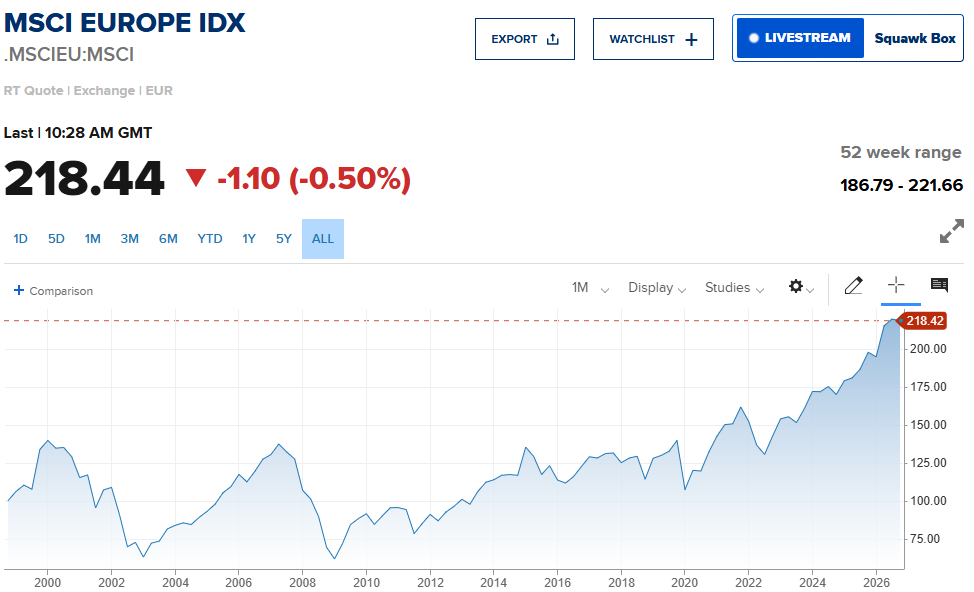
European businesses have just finished a landmark earnings season. According to LSEG I/B/E/S data, the second-quarter earnings of STOXX 600 index constituents are expected to increase 22.4% year-on-year, the strongest growth rate since the third quarter of 2022. According to the data, the profit of the MSCI Europe Index increased by 14%, and the performance of more than half of the constituent stocks exceeded expectations. Both indicators were the highest levels since the beginning of 2023.
The driving force behind this round of profit rebound showed clear structural characteristics: the energy sector led the way at a growth rate of 135.8%, while the basic materials sector (including chemicals, steel and mining) grew by 57.6%. What is more noteworthy, however, is the spread of growth drivers — from raw materials, industry to technology, the entire AI and infrastructure industry chain has achieved rapid growth, and the financial sector has also played an additional role in boosting.
The revised trend in earnings also sends positive signals. The J.P. Morgan strategist team pointed out that the revised earnings per share data in the Eurozone has continued to rise in the past few weeks and has completely turned positive. The gap with US profit growth is narrowing, and is close to being completely closed for the first time since the beginning of 2025. According to Citi data, the European profit forecast for the second quarter was raised from 11% to 15%, and the growth forecast for the third quarter reached 18%.
From “fully configured” to “carefully selected”: Faller's new European investment framework
In this context, Faller proposed a clear European investment framework. She said, “We have indeed seen an improvement in European equity earnings over the past few quarters. I think valuations have kept up with this trend, so the key is where you should focus your investments in Europe.”
Faller's core strategy logic includes several layers:
The US remains the “ballast stone”; given America's economic growth and innovation potential, economic resilience, and high corporate profit margins, the US “remains the core of the investment portfolio.” Europe is moving towards “selective allocation”; “For Europe, we will adopt a more selective investment strategy in the industries we are optimistic about.”
Finance and industry are priority options. Faller is clearly optimistic about the financial and industrial sectors, believing that these sectors will benefit from a more favorable economic environment. She also specifically mentioned companies that have physical assets that are difficult to replace and are less affected by artificial intelligence.
In seizing AI investment opportunities, Faller also emphasizes a “whole industry chain” perspective. She pointed out that investors should look not only at tech giants, but at the entire artificial intelligence industry chain — “The story of artificial intelligence is not limited to a single industry; we are really focusing on assets that are capital-intensive and difficult to replace,” she specifically mentioned the semiconductors, infrastructure, utilities, and industrial sectors.
A “catalyst” for finance and industry: Fundamental improvements and AI infrastructure dividends
Faller's optimism about the financial and industrial sectors is based on solid fundamental improvements. The European banking sector is experiencing multiple positive resonances. Faller pointed out that given the improved fundamentals of the European banking sector and the continued increase in dividends and share repurchases, bank stocks in the region are worth watching. The J.P. Morgan Chase Strategy Team further stated that the banking sector is expected to be one of the key contributors to second-quarter earnings and is expected to exceed expectations. Productivity gains brought about by the application of AI help control costs, and loan loss preparations calculated in the first quarter are unlikely to be repeated — shocks such as the collapse of Market Financial Solutions are more reflected in individual events rather than systemic risks.
The second quarter of the European banking sector is expected to benefit from a full three-month operating environment with high interest rates, and net interest spreads remain at a favorable level. Stock buybacks and dividend growth provided additional support to the valuation.
The industrial sector, on the other hand, stands on the structural cusp of AI infrastructure construction. Faller clearly mentioned that “capital-intensive and difficult to replace assets” in the AI industry chain are the focus of her attention. From gas turbine manufacturers (such as Siemens Energy), which are indispensable for data center construction, to power equipment suppliers (such as Schneider Electric), the expansion of the entire AI infrastructure industry chain is creating continuous incremental demand for the European industrial sector.
Judging from sector performance, the STOXX 600 industrial sector achieved 16% EPS growth and 9% sales growth in the second quarter. FactSet data shows that the industrial, energy and materials sectors reacted most positively to exceeding expectations.
Market sentiment and risk tips
According to the Bank of America's latest survey, 53% of net fund managers expect the European stock market to rise in the next one to three months, reflecting the market's broad confidence in the recovery of European profits.
However, the risks must not be ignored either. On August 18, the yield on US 30-year Treasury bonds soared to 5.326%, a record high since 2007, triggering sharp fluctuations in Asian technology stocks. If US bond yields continue to rise, it may put systemic pressure on global risk asset valuations. Furthermore, analysts' intensive increase in profit expectations has raised the European performance threshold — the current valuation has climbed to about 15 times the future price-earnings ratio, 13 times higher than the 20-year average.
Conclusions
J.P. Morgan strategist Faller's latest statement provides a clear framework for European asset allocation: the US is still the core, Europe needs to be carefully selected, and finance and industry are currently the most attractive sectors. This strategic logic is being verified by the market against the backdrop of European companies handing over the three-year strongest profit report card and the profit correction trend continues to improve.
According to Goldman Sachs data, with the exception of basic resources and non-essential consumer goods, profit forecasts for other industries were raised in July. Among them, the technology and energy industry saw the biggest improvement. As Faller said, the AI story isn't just about a single industry — sectors with irreplaceable physical assets, are capital-intensive, and benefit from the expansion of AI infrastructure are becoming the core battlegrounds for the next phase of the European market.