
- PRICING
- LIVE QUOTES
- LEARN
- HELP


EN
Omdia: Global industrial display panel shipments in 2026 are estimated to be 302 million, down about 10% from last year
The Zhitong Finance App learned that according to Omdia's “Industrial and Public Display & OEM Market Tracker”, global industrial display panel (Industrial Display) shipments in 2026 are estimated to be 302 million pieces, down about 10% from 2025. Some industrial control applications are mainly affected by tight supply of DDR, CPU and other key components. However, the market has not lost growth momentum due to a decrease in shipments. The overall market output value can still be maintained at more than 3.1 billion US dollars in 2026. Although it is down from the record high of 3.5 billion US dollars in 2025, it is still higher than the level of 2023 and 2024. Industrial control shows that the market is gradually shifting from pursuing shipments to a growth model centered on high-value-added products.
From the supply side, AUO Display Plus (AUO Display Plus), BOE (BOE), Innolux (Innolux), Tianma (Tianma), and Truly (Truly) are still major global industrial display panel (Industrial Display) suppliers, continuing to promote cost optimization and integration with supply chain layout, high-value application markets, emerging display technologies, and open architecture display panels and systems.
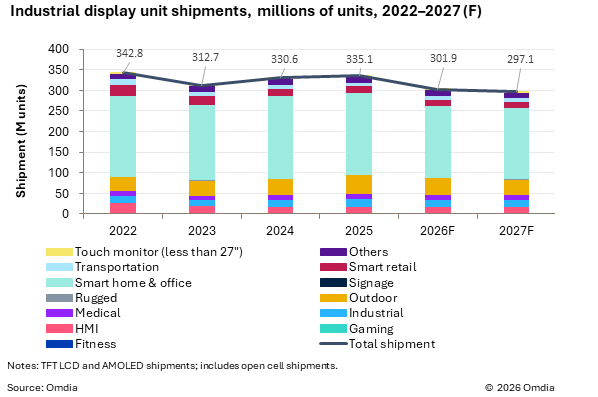
Looking at various industrial control market segments
POS market: Shipments slow, but display values continue to rise
Omdia expects mobile POS display shipments to drop to about 11.7 million units in 2026, while Standalone POS will remain at around 3.2 million units. The slowdown in demand was mainly affected by retailers' cuts in capital expenditure, extended equipment replacement cycles, and the spread of mobile payments.
Although the growth in POS display panel shipments has slowed, its stand-alone carrying value continues to rise. With the gradual integration of functions such as touch modules, covers, optical bonding, and NFC, the display has changed from a simple information display interface to an integrated module with operation, payment, and interaction functions, driving up product specifications and average unit prices.
At the same time, DDR and SSD costs continue to rise, driving up x86 POS hardware costs, and the existing retail market extends the equipment update cycle; on the other hand, the adoption rate of ARM-architecture Android POS continues to increase in new construction projects, and growth is even more remarkable, especially in the hospitality (hospitality) market. At the same time, with the spread of touch screen payments (tap-to-pay) and digital payments, the introduction of SoftPOS software has accelerated, helping retail and catering businesses achieve mobile payments and flexible deployment at a lower cost.
Marine display panels are becoming more advanced, and Mini LED backlighting and AI navigation have become new highlights
The marine display (Marine Display) market also continues to evolve towards high-end products. During the pandemic, market demand was mainly focused on handheld fish finders (Fish Finder), but in recent years, it has gradually switched to multi-function displays (MFDs) that integrate navigation, radar, automatic identification systems (AIS), and sonar functions.
Omdia pointed out that at present, 9 inches has become the mainstream size in the market, and Tianma continues to maintain its leading position. The market share is about 48% in 2025, and it is estimated that it will further increase to 49% in 2026.
On the other hand, high-end marine display panels are rapidly introducing Mini LED backlighting, 4K ultra-high resolution, and AI intelligent navigation assistance functions, reflecting that intelligent navigation and high-reliability displays have become important trends in the future market, and overall panel specifications and technical developments will increasingly be consistent with in-vehicle displays.
Geopolitics drive supply chain restructuring, and OEMs pay more attention to supply chain resilience
In addition to product upgrades, supply chain strategy has also become one of the topics OEMs are most concerned about.
Affected by geopolitics, export controls, and supply chain risks, OEMs will begin evaluating management mechanisms such as Dual Sourcing (Dual Sourcing), Multi-source Procurement (Multi-sourcing), and supply chain traceability.
In the future, supply chain competition will no longer be just price competition, but full competition for supply stability, traceability, and risk management capabilities.
Conclusions
The industrial display panel market is gradually shifting from volume-driven (volume-driven) to value-driven (value-driven). At the same time, supply chain resilience and diversified procurement strategies will also be an important basis for OEMs to select partners.