
- PRICING
- LIVE QUOTES
- LEARN
- HELP


EN
Dear Wetour Robotics Stock Fans, Mark Your Calendars for August 24
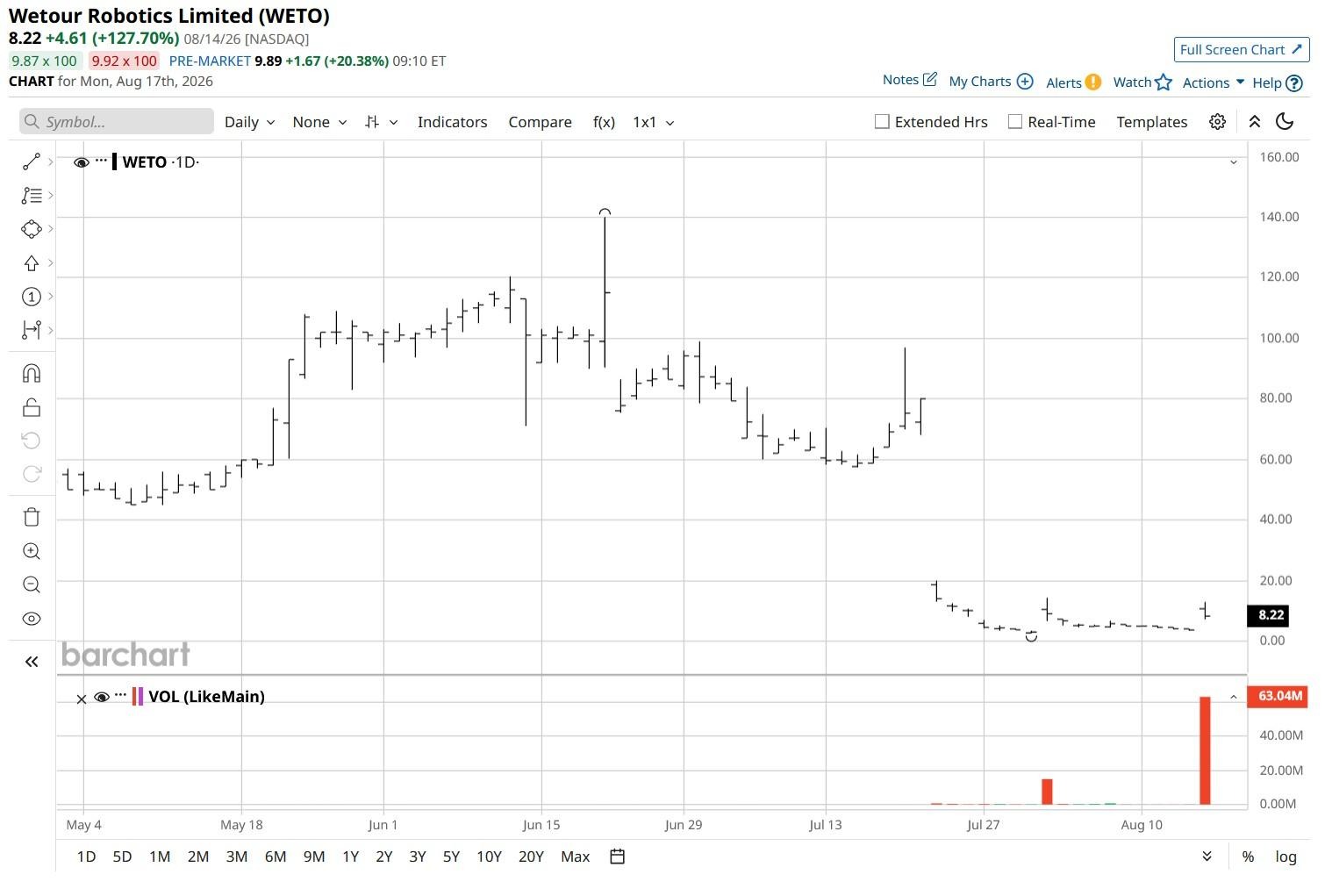
Wetour Robotics (WETO) shares have soared as speculative momentum takes hold of the physical artificial intelligence (AI) and wearable robotics company.
However, investors are advised to exercise caution as WETO is scheduled for an extraordinary general meeting (EGM) on Aug. 24, where shareholders will vote on a 100-for-1 reverse stock split.
Note that Wetour stock has already been a huge disappointment in 2026, currently trading at only a fraction of its price at the start of this year.
What the Reverse Split Means for Wetour Stock
A reverse stock split is structurally a defensive maneuver, not a sign of fundamental health.
For Wetour, proposing a 100-for-1 split on Aug. 24 comes hot on the heels of another 1-for-100 consolidation implemented earlier this month. Companies typically execute reverse splits to artificially inflate their share price to satisfy Nasdaq’s $1 minimum bid requirements and avoid delisting.
Plus, the company's latest proposal of a reverse stock split is paired with an expansion of authorized share capital, which signals impending shareholder dilution.
Rather than creating intrinsic value, repeating reverse splits often invites immediate short-selling pressure as market participants anticipate new equity raises into an artificially consolidated float.
Why WETO Shares Are Unattractive to Own
Beyond structural mechanics, WETO’s underlying fundamentals also present significant red flags.
Micro-cap physical AI and wearable robotics companies face immense commercialization hurdles, high cash burn rates, and ferocious competition from established tech giants.
The recent price rally is largely an artifact of an ultra-thin public float, reduced to roughly 820,000 post-split shares, which enables low-volume speculative order flow to trigger violent, temporary price spikes.
All in all, lacking sustained institutional backing, stable cash flow, or a clear path to profitability, Wetour shares carry severe downside risk.
Expecting long-term gains from a business reliant on repeated reverse splits and equity financing is often a dangerous gamble.
Why Else Is Wetour Robotics Not Worth Owning
Another major red flag on Wetour Robotics is the complete absence of Wall Street coverage.
This means investors have little independent analysis to rely on, making it significantly harder to validate WETO stock’s growth prospects, valuation, and long-term investment case.
On the date of publication, Wajeeh Khan did not have (either directly or indirectly) positions in any of the securities mentioned in this article. All information and data in this article is solely for informational purposes. For more information please view the Barchart Disclosure Policy here.