
- PRICING
- LIVE QUOTES
- LEARN
- HELP


EN
End of 14 quarters of net sales! Berkshire Q2 “throw money to buy stocks”: Google (GOOGL.US) jumped to the third largest position, and Delta Air Lines (DAL.US) and real estate stocks received heavy attention
The Zhitong Finance App learned that according to the US Securities and Exchange Commission (SEC) disclosure, Berkshire Hathaway submitted a position report (13F) for the second quarter ending June 30, 2026.
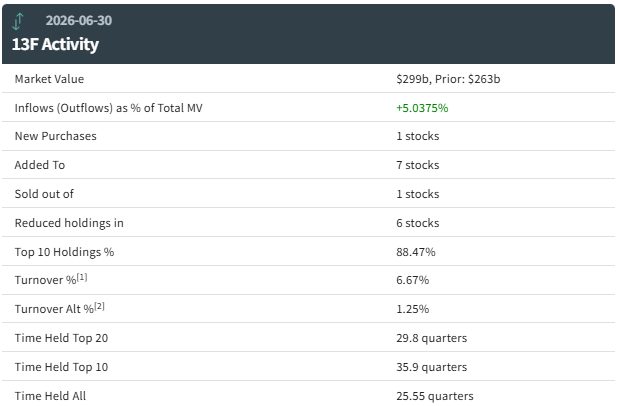
According to statistics, the total market value of Berkshire Hathaway's positions in the second quarter was 299 billion US dollars, and the total market value of the previous quarter was 263 billion US dollars. Berkshire Hathaway added 1 new share to its portfolio in the second quarter and increased its holdings by 7 shares. Meanwhile, Berkshire Hathaway reduced its holdings by 6 stocks and cleared 1 stock. Among them, Berkshire Hathaway's top ten holdings account for 88.47% of the total market value.
Changes in positions
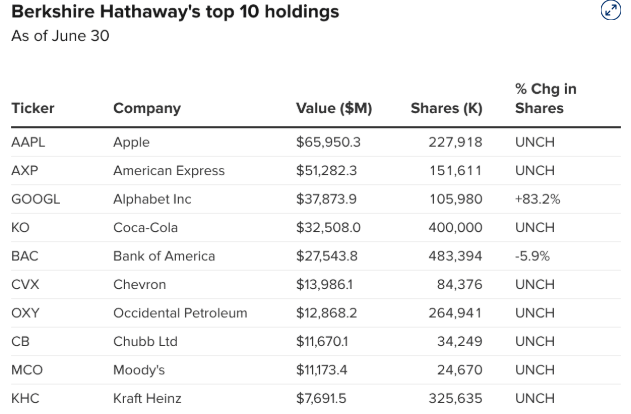
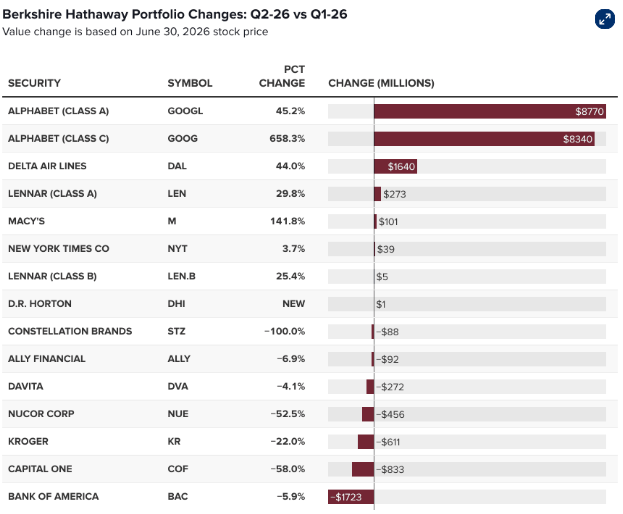
This is the second full quarter since Abel succeeded Warren Buffett as CEO. Berkshire Hathaway increased its holdings of Delta Air Lines (DAL.US) shares by 17.5 million. By the end of June, its holding value reached 5.37 billion US dollars. Furthermore, Abell increased its holdings of Alphabet (GOOGL.US) shares by 48.1 million. Alphabet has now become the third-largest shareholding of Berkshire Hathaway, with a value of 37.8 billion US dollars as of mid-year.
Big increase in Alphabet
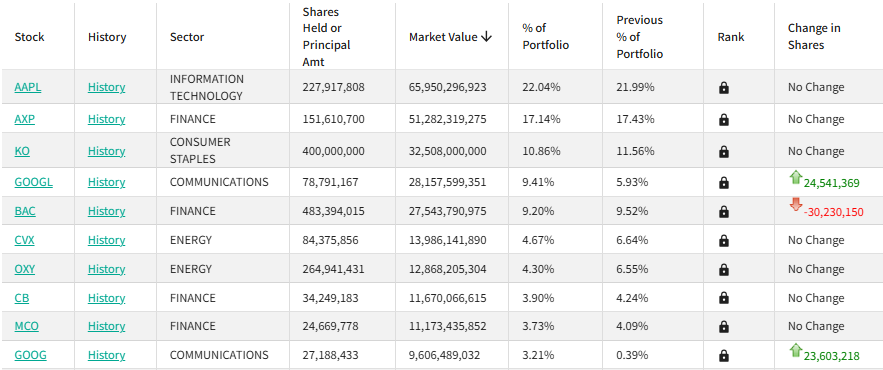
By the end of June, Berkshire Hathaway (current CEO is Greg Abell) held approximately 106 million Alphabet shares (Class A+C) worth US$37.9 billion. The holding increased by 83% in the second quarter, making Alphabet the Omaha-based company's third-largest holdings (by market capitalization), surpassing Coca Cola (KO.US), behind Apple (AAPL.US), and American Express (AXP.US), which accounted for 22.04% and 17.14% of the portfolio, respectively.
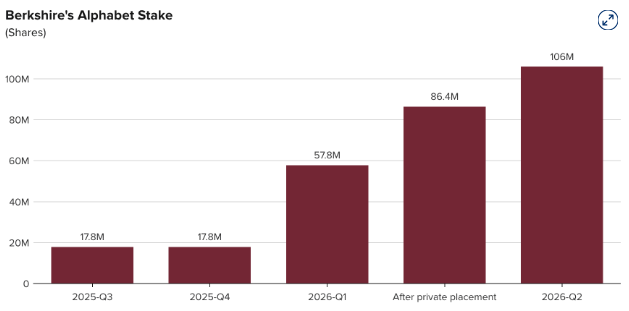
This increase in holdings is mainly due to the $10 billion private equity acquisition announced in early June, when Alphabet sought new capital to fund its huge artificial intelligence infrastructure. This meant that Berkshire bought approximately $70 billion worth of Alphabet shares on the open market. Warren Buffett, the current chairman of Berkshire Hathaway, told the media that he has always been optimistic about Alphabet and has received support from Abell.
Betting on aviation and real estate
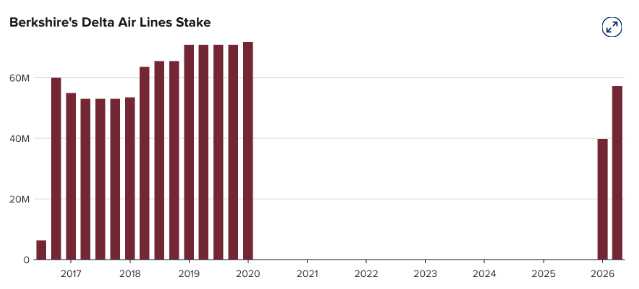
Second, Berkshire Hathaway continues to increase its investment in the aviation industry, which has always been Buffett's favorite. The company's holdings of Delta Air Lines increased 44% during the quarter to reach 57.3 million shares worth approximately $5.4 billion by the end of June. Previously, in the first quarter of 2020, air travel was drastically reduced due to the raging COVID-19 pandemic. Buffett sold shares of Delta Airlines and three other airlines at a loss in the early days of the pandemic, but did not buy Delta again until soon.
In addition, housing is another cyclical industry where Berkshire Hathaway increased its holdings. The company increased its holdings of LEN.US (LEN.US) Class A shares by nearly 30% to 13.1 million shares, worth about US$1.19 billion; at the same time, its Class B holdings also increased 25% to about 298,000 shares. Berkshire Hathaway also revealed its small new position in Houghton Houses (DHI.US), which held 3,600 shares worth about $580,000 as of the end of June.
Berkshire Hathaway completed the $6.8 billion acquisition of Scottsdale, Arizona-based homebuilder Taylor Morrison (TMHC.US) during the quarter.
In terms of other new holdings, Berkshire Hathaway's Macy's (M.US) shares increased by 142%, but due to its relatively small size, the actual increase in holdings was only about $100 million.
Continued reduction in financial stock holdings
Berkshire Hathaway has been reducing its financial holdings in recent quarters, and this trend continues. The company reduced its holdings in Ally Financial (ALLY.US) by 7% and reduced its holdings in Capital One (COF.US) by 58%.
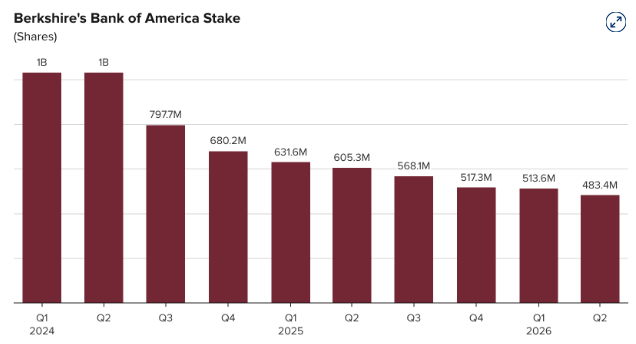
Bank of America (BAC.US)'s holdings were reduced by a small margin of 5.9%, but due to the large size of its holdings, this reduction reduced its value by about 1.7 billion US dollars, the largest single reduction in holdings this quarter. After eight consecutive quarters of reducing its holdings, Berkshire Hathaway has reduced its Bank of America holdings by 53%.
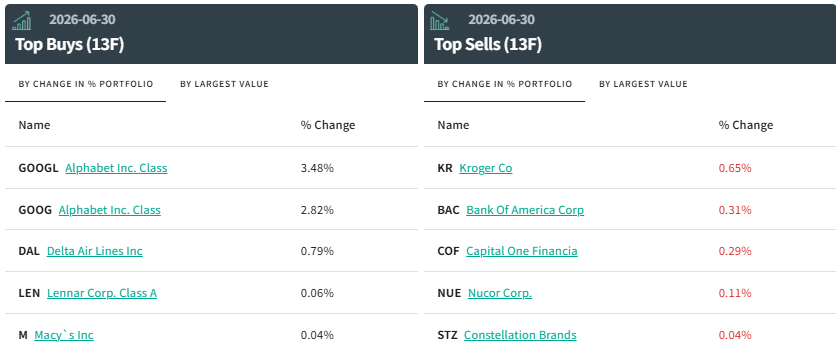
In addition, judging from changes in holding ratios, Berkshire also drastically reduced its holdings of Kroger (KR.US), NUE.US (NUE.US), and Devitt (DVA.US) in the second quarter, and cleared the Constellation brand (STZ.US).
Berkshire ends net sale of shares, big bears dissatisfied with declining cash reserves
Berkshire Hathaway ended a long period of net stock sales and became a stock buyer in the second quarter, making a net purchase of nearly $20 billion. Prior to the last three months, Berkshire Hathaway had 14 consecutive quarters of net stock sales. By the end of June, the conglomerate's cash reserves fell from a record of $397.4 billion three months earlier to $365.5 billion as Berkshire Hathaway began putting more capital into operation through investments and share buybacks.
When announcing its second-quarter results, Berkshire Hathaway said that the company spent about 4.5 billion US dollars to buy back its own shares during this period, while also increasing its holdings of other stocks by a net increase of nearly 20 billion US dollars.
During Buffett's time in charge, trading activity was relatively sluggish, and Buffett often complained that the market was overvalued. And Abel dominated many multi-billion dollar deals during this period.
Michael Burry, the prototype for the movie “The Big Short,” was unhappy with Berkshire Hathaway CEO Greg Abell's practice of cutting the company's huge cash reserves in the second quarter. Bury posted on Substack on Sunday that his “biggest concern” is that Warren Buffett's successor won't be as patient as Buffett to wait for the “best hitting point.”
Now, he writes, “I believe my concerns have come true. As a result, I don't think the future of Berkshire Hathaway is an attractive investment.”
Burry acknowledged that “cash reserves have not been used up much yet,” and that the remaining approximately 360 billion US dollars is still a huge amount of money. But he was concerned that Abel's “first step looked more like framework building than investment.” Burry clarified that he is not recommending that anyone short Berkshire Hathaway.
Over the years, the key to Buffett's investment strategy was to maintain sufficient self-discipline and wait for excellent investment opportunities, just as baseball legend Ted Williams would wait for a “big ball” he could easily hit.