
- PRICING
- LIVE QUOTES
- LEARN
- HELP


EN
Expectations of interest rate hikes and fiscal concerns topped Japan's 10-year treasury bond yield to a 30-year high
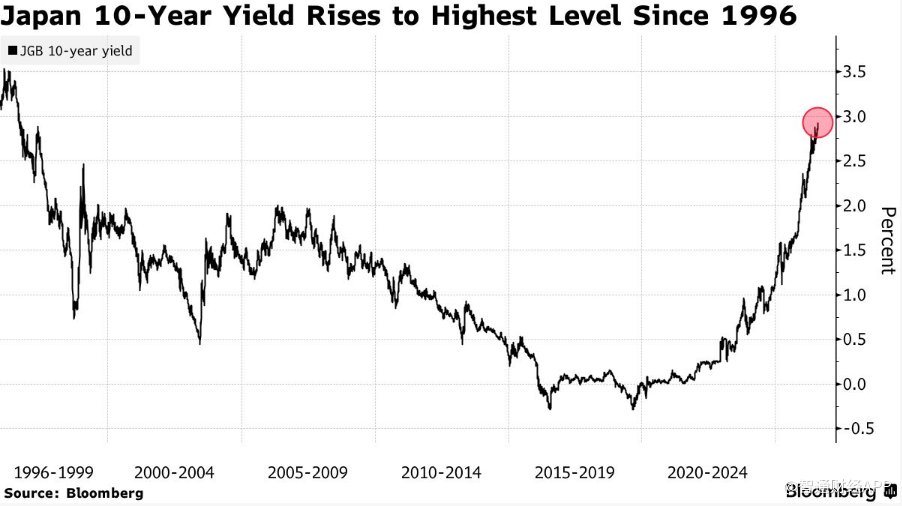
The Zhitong Finance App learned that due to fiscal concerns and rising market expectations for future interest rate hikes by the Bank of Japan, the price of Japanese bonds fell on Monday, and the yield on Japanese 10-year treasury bonds rose 5.5 basis points to 2.93%, the highest level since 1996; at the same time, the yield on 30-year treasury bonds also rose to 4.06%, close to the record high hit in May.
People familiar with the matter revealed last week that the government led by Japanese Prime Minister Sanae Takaichi supports the Bank of Japan's recent interest rate hike, and the next rate hike may be in September or October. Furthermore, since the Japanese government has yet to determine how to fund a two-year food consumption tax relief program, fiscal concerns are also putting pressure on Japan's debt.
Ryutaro Kimura, a senior bond strategist at BNP Paribas Asset Management, said, “As investors return to the market after the holidays and market liquidity improves, the bond market is once again beginning to absorb expectations that the Bank of Japan will accelerate interest rate hikes. Unless the Takaichi government abandons expansionary fiscal policies, any decline in yield is likely to be gradual, which means investors don't need to worry about missing out on buying opportunities.”
The yield on Japan's 10-year treasury bonds rose to the highest level since 1996
Global market expectations for further monetary policy tightening are growing, which poses a threat to the bond market. Major central banks are facing multiple pressures, including rising oil prices due to the war in Iran, a sharp increase in government spending, and a boom in artificial intelligence investment driving economic growth.
Meanwhile, data released on Monday showed that in the second quarter, Japan's real gross domestic product (GDP) grew 0.3% month-on-month and 1.1% on an annualized basis, far below market expectations. This result may complicate policy communication between the Bank of Japan when weighing the timing of the next rate hike.
Still, these data are unlikely to take the Bank of Japan off the path of rate hikes. Overnight swap market pricing shows that traders think it is 80% likely that the Bank of Japan will raise interest rates at the next policy meeting on September 18.
After Japan's GDP data was released, the yen strengthened slightly, rising from about 159.21 yen to 1 US dollar before the release to 159.04 yen to 1 US dollar. Since the US and Japan jointly intervened in the foreign exchange market at the end of July, the yen's rise has narrowed, and is still significantly below its 10-year average exchange rate of 126.09.
Naoki Hattori, chief Japanese economist at the Mizuho Research Institute, said, “Following the coordinated intervention of the US and Japan in July, I think the external environment is also putting pressure on the Bank of Japan to raise interest rates. With all these factors in mind, I think the September rate hike is still the main scenario.”