
- PRICING
- LIVE QUOTES
- LEARN
- HELP


EN
Not afraid to fall, just afraid to go short! The S&P 500 reached a new high, and “FOMO Insurance” set off a bullish options buying frenzy
The Zhitong Finance App learned that as US stocks continue to rise to record highs, investors' growing concerns are not that the market may suddenly fall, but rather that they are shorting the market.
By Thursday's close, the S&P 500 had risen 0.7% to a record high, with a cumulative increase of about 23% since the end of March. Falling oil prices and signs of easing inflationary pressure in the US prompted traders to lower their bets on further interest rate hikes by the Federal Reserve to provide support for the stock market. Meanwhile, US companies have just announced their strongest quarterly profit growth since the 2021 pandemic. Traders began betting on continued gains, and long-term bullies and strategist Ed Yardeni also raised their S&P 500 targets.
This sentiment is echoed in the options market—investors are reducing their downward-protected positions and concentrating on buying contracts that can profit as the market continues to rise.
According to Citadel Securities statistics, demand for bullish options for at least 170 constituent stocks in the S&P 500 index has already surpassed demand for flat value options, and the deviation is the biggest since at least 2016. This is a break with previous trading norms.
Scott Rubner, head of equity and derivatives strategy at Citadel Securities, wrote in the client report: “Demand for upside options has accelerated to near record levels.”
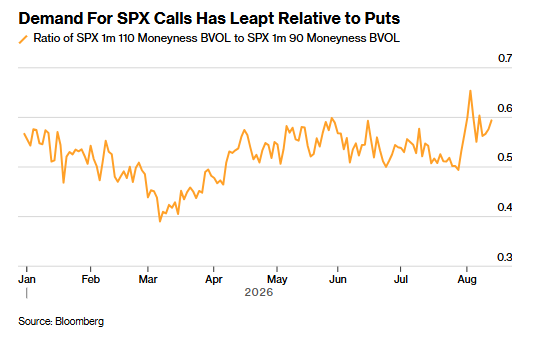
Interactive Brokers chief strategist Steve Sosnick called this phenomenon “fear of missing out (FOMO) insurance.” He explained that institutional investors may think that some popular stocks are overvalued, have excessive momentum, and are unwilling to directly catch up, but they don't want to miss out on gains, so they are motivated to buy bullish options and gain upward exposure with a smaller capital footprint.
However, there are also opinions that this still sends a signal that the stock market may continue to rise. Christopher Jacobson, co-head of derivatives strategy at Susquehanna International Group, believes that the push up of call options is not pure speculation; “Fluctuations achieved at the individual stock and index levels are providing a reason for this kind of demand.”
The risk is not gone away, and complacency raises alarm
While demand for call options heats up, overall volatility indicators are unusually calm. Wall Street's “panic indicator” has fallen to its lowest level since January as investors fully pour into this FOMO-driven upward trend.
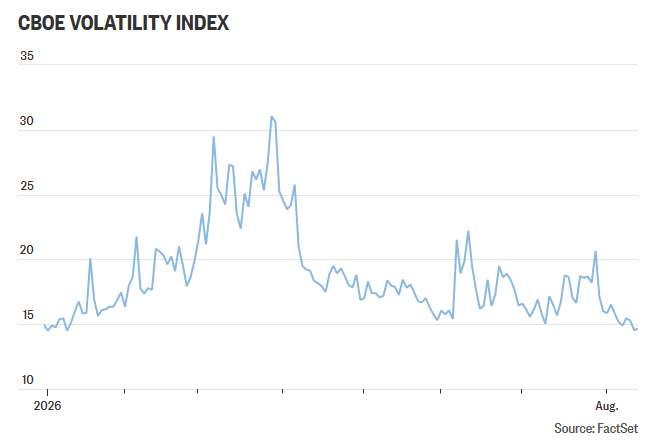
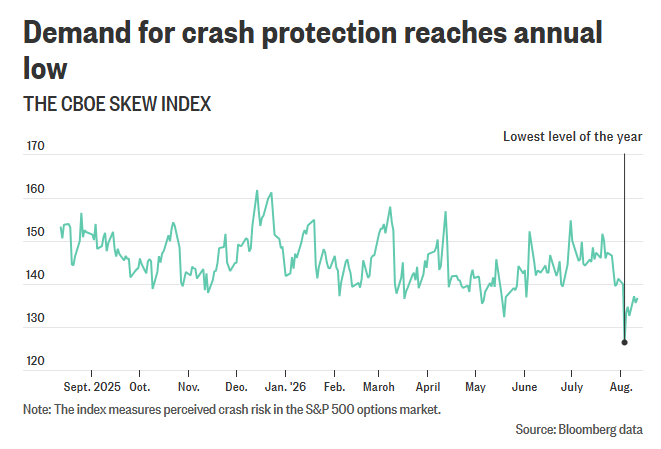
On Thursday, although the Cboe Volatility Index (VIX) rose slightly, forming a rare combination with the record high of the S&P 500 index (this extraordinary dynamic suggests that the current round of rapid rise in the stock market may have been excessive), the previous day, the index fell to a low of 14.39, the lowest since the beginning of January. The VIX Equivalence Index is also at its lowest level since March 17. The Cboe Skew Index, which measures investors' demand for “collapse insurance,” hit its lowest level during the year on August 4. These indicators all indicate that the current cost of hedging stock falls is relatively low.
The calm even spread overseas. Korea's Kospi 200 Volatility Index fell more than 34% this month to its lowest level since April 30.
On the face of it, the market has reason to be optimistic. After all, Wall Street has just experienced another bright earnings season, and analysts' profit expectations for the rest of 2026 and beyond have continued to improve. FactSet data shows that the rate of increase in profit expectations has even surpassed the exponential increase in stock prices.
However, risk factors have not disappeared as a result. The conflict with Iran continues to drag down global economic prospects; concerns about the independence of the Federal Reserve and whether large-scale AI investments can bring expected returns remain unabated. Michael Kramer, portfolio manager at Mott Capital Management, also pointed out that the recent rise in global bond yields has also increased risk in the stock market.
Kramer added that some technical indicators also suggest that volatility may soon rise again. As the stock market has risen over the past two weeks, the gap between actual volatility and implied volatility has narrowed to a recent low. “Actual volatility and implied volatility are very close, and there may not be much room left for further narrowing.”
The seasonal factor cannot be ignored either. According to an analysis by Dow Jones Market Data, September has historically been the weakest month for the S&P 500 index throughout the year.
The Cboe Skew Index recently rebounded from an August low, indicating that some investors may have begun to change their attitudes. SentimenTrader's analysis indicates that when VIX falls below 15 and is at the bottom of the 126-day range, sharp fluctuations usually don't come immediately, but this is not a risk-free state; rather, the risk may be delayed, and the worst case scenario may become more serious after the buffer period.
“Risk warnings may be triggered first, and price instability often comes later,” wrote SentimenTrader.
This situation has prompted some of the funds to take advantage of the opportunity to hedge at the end. On Thursday, an institutional investor spent $23.4 million to buy a series of put options. If the S&P 500 index falls 38% by December 18, these contracts will bring huge returns. Sosnick of Interactive Brokers commented: “If you're in a dry period, no one really wants to buy an umbrella. But it's probably the best time to buy an umbrella.”