
- PRICING
- LIVE QUOTES
- LEARN
- HELP


EN
Bank of America gives “midterm election trading guide”: if the Republican Party holds the Senate, semiconductors will go all the way to “bubble 2027”
The Zhitong Finance App learned that a team led by Bank of America senior strategist Michael Hartnett (Michael Hartnett), who has the title of “Wall Street's Most Accurate Strategist,” released a research report saying that if the Republican Party led by Trump achieves great success in the midterm elections and the Texas gubernatorial election, the US stock market, especially the semiconductor sector closely linked to AI computing power, is expected to usher in further strong gains.
The research team led by Hartnett wrote that if US President Donald Trump's Republican Party performs strongly on November 3, and Trump's core political ally and staunch supporter Greg Abbott is successfully re-elected governor of Texas, this will be particularly beneficial to global semiconductor stock trading related to artificial intelligence. The midterm elections have long been viewed by Wall Street as a major risk event affecting the bullish trajectory and bullish sentiment of the US stock market and the global stock market. From a historical perspective, market volatility often rises sharply in the months before the election.
From the “AI Liquidation Storm” to the “Bubble 2027” AI Super Bull Market Expectations, it seems like it will only take three weeks! Yes, Wall Street's attitude towards future market expectations is changing so fast.
According to Wall Street strategists, the most important change in the semiconductor sector of the global stock market is that the July “AI congestion transaction settlement” is becoming more and more like an extreme leverage and speculative position clearing, rather than a trend reversal in the fundamentals of the AI computing power industry chain. According to the latest market data, the Philadelphia Semiconductor Index (SOX) once plummeted nearly 29% from a historical high on June 22 to a low on July 29, but then rebounded about 20% in just three weeks, which can be described as re-entering a technical bull market in a short period of time.
In the recent US semiconductor market, Coherent, which best represents the AI optical interconnection theme, rebounded about 57% from the July 29 low, while investors in the US NAND storage giant SanDisk (SanDisk) rose 13.7% in a single day on August 13, and the stock price of another US storage giant Micron rose nearly 5% in response, indicating that the core of the global AI computing power counterattack is spreading from simple GPUs to a wide range of AI computing infrastructure topics such as NAND/DRAM/HBM storage+high-speed optical communication+network interconnection.
South Korea, which has the title of “AI computing power weather vane,” magnified this “fundamentals are not broken, AI leverage first” semiconductor counterattack market to the extreme: the benchmark index KOSPI rose 11.5% this week, ending a seven-week decline. Samsung Electronics and SK Hynix rose 19% and 16% each week, respectively; based on the closing of 5,593.56 points on July 30, the benchmark KOSPI had rebounded by about 24.75% at 6,977.94 points on August 14. More importantly, South Korea's single-share leveraged ETF assets plummeted from about 50 billion US dollars to 17 billion US dollars. J.P. Morgan predicted that hedge fund deleveraging had been completed by about 90%, compounded by a net foreign purchase of about 3 trillion won on August 14 — this means that the global semiconductor market is shifting from “forced sales” to “hedge funds and other institutions take risks again.” If the financial strength of low semiconductor positions continues to catch up, it is expected to form positive feedback on a “rise — fill up — push back up — rise again.”
The “Mid-Term Election Deal” is heating up all over! Bank of America: Republican Party Holds Senator+Texas, AI Bull Market May Drive All the Way to “Bubble 2027”
The Bank of America team led by Hartnett said in the research report: “If Trump can hold the Senate and Abbott can hold Texas, then it is expected that the stock market — especially AI-related semiconductor stocks — will soar all the way up and push the market towards 2027, which may be full of bubbles (Hartnett cites “bubbly 2027”).” However, if the Democratic Party takes the Senate and defeats Abbott at the same time, then US stocks will face a “sharp drop” of at least 10%. At the same time, the US dollar and bond yields will also fall sharply before the end of the year.
According to Bank of America strategists, the Texas gubernatorial election between Abbott and Democratic challenger Gina Hinojosa is a “referendum” on “affordability of living and AI data centers.” Texas currently has 335 data centers, and another 247 data centers are in the planning and proposal stage. They believe that Abbott's announcement, which has always worshipped pro-businessism, actually temporarily suspends data center expansion reflects “election anxiety” surrounding Americans' energy costs and the growing risk of rising grid electricity prices.
This month, the technology stock market, which is dominated by a strong rebound in semiconductors, pushed the S&P 500 index to a record high, mainly because investors have been actively buying semiconductors and other popular technology stocks related to AI computing power topics since late July. Combined with the overall corporate profit data of the S&P 500 Index for the second quarter, it exceeded the already high expectations of market analysts.
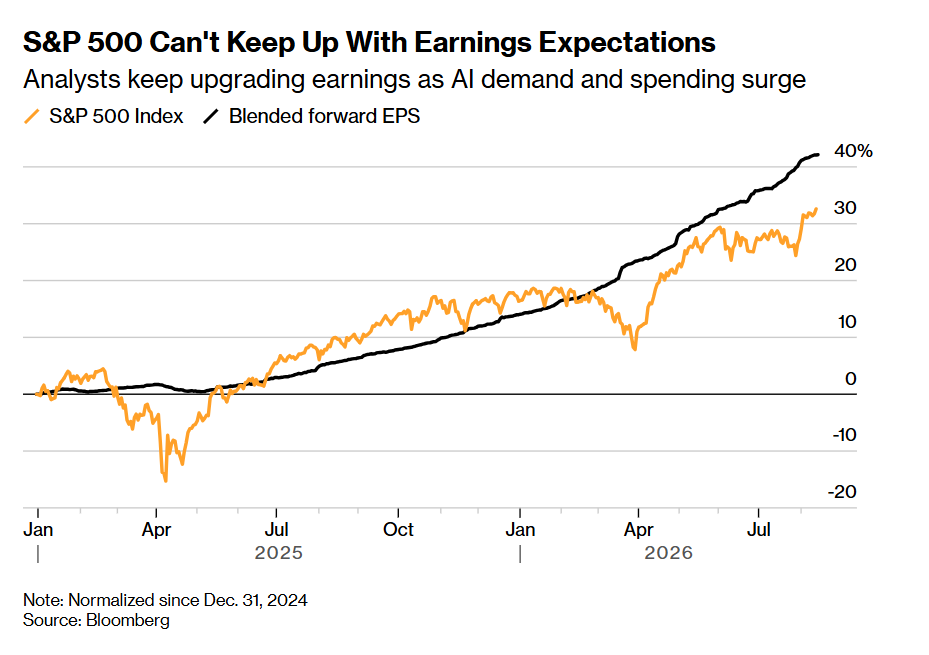
As shown in the chart above, the S&P 500 index couldn't keep up with analysts' profit expectations rising — as AI computing power demand and data center construction-related expenses surged, analysts continued to raise profit forecasts. Note: Standardized processing will commence on December 31, 2024.
According to Bloomberg Intelligence's long-term tracking data, the overall profit growth rate of the S&P 500 index constituents in the second quarter is currently expected to reach 32%, which is a significant increase from the 23% forecast before the start of the second quarter earnings season. At the same time, 93% of technology company-type constituent stocks have exceeded market expectations.
Hartnett and his team believe that “the door is completely open for the bulls to further push up risky assets,” based on continued surging profits, an increase of 10 trillion US dollars in total wealth in 2026, and analysts agree that capital expenditure associated with AI computing power infrastructure will exceed 1 trillion US dollars in 2027. They said, “The only limiting factors are bonds (yield soaring), voters (rising socialist power), and the fact that almost all investors have made significant positions for the rise in the market.”
Chris Caso, a strategist from Wolfe Research, a top Wall Street investment agency, pointed out that the Philadelphia Semiconductor Index (SOXX) doubled in the previous three months and then fell about 25% from its high. The recent weakness is more like a reset of expectations after a sharp rise. Caso anticipates that demand for artificial intelligence chips will still exceed supply until at least 2028. He believes that the market's previously feared slowdown in capital expenditure for hyperscale cloud computing has not actually occurred, and that the competitive trend surrounding AI agents has instead left hyperscale cloud vendors “no choice not to invest.”
According to a recent research report led by Brian Nowak, a senior analyst at Morgan Stanley, the 2027/2028 capital expenditure forecasts for the five largest hyperscale cloud computing and vendors (Meta, Amazon, Microsoft, Google, SpaceX) in the global market (Meta, Amazon, Microsoft, Google, SpaceX) have been significantly raised again, reaching approximately $1.2 trillion and $1.4 trillion, respectively. The agency's capital expenditure forecast for major US tech giants in 2026 was drastically raised from 433 billion US dollars a year ago to 805 billion US dollars.
AI bull market reignited after deleveraging in July! Will semiconductors “boom” until 2027?
The midterm elections are more like a “valuation and risk premium switch” for the global semiconductor super-bull market than the engine that determines AI demand itself. Hartnett and his team's strategy and investment logic are very clear: if the Republican Party holds the Senate and Greg Abbott holds Texas, the market will interpret it as continuing to favor the AI data center, energy infrastructure, tax and commercial regulatory environment. Especially when Texas already has 335 data centers and 247 planned projects, this is equivalent to reducing the market's risk of “electricity prices, grid pressure, and voter backlash ultimately forcing AI CapEx (AI capital expenditure) to be politically constrained.”
Conversely, if the Democratic Party seizes the Senate and takes the Texas governor, Bank of America believes that US stocks may fall by more than 10%. However, from the perspective of AI engineering and the semiconductor industry chain, the primary variables that actually determine whether 2027 can continue the semiconductor supercycle are still the capital expenses of Hyperscalers (cloud computing giants such as Microsoft and Amazon), the actual deployment volume of AI GPU/ASIC clusters, HBM and enterprise-grade NAND supply and demand, the expansion and deployment scale of high-speed optical interconnect/laser/switching networks in data centers, and the actual demand for AI inference tokens.
Needless to say, a series of recent hard-core evidence from the AI computing power industry chain shows that the prospects for AI fundamental growth are becoming more and more strong. Bank of America has seen the capital expenditure of hyperscale cloud vendors reach about 1.2 trillion US dollars in 2027, and J.P. Morgan Chase also used the growing backlog of cloud orders and improved return on AI investment as an important basis for raising S&P's goals. In other words, the Republican Party's victory did not create an AI supercycle; rather, it could further push the existing AI capital expenditure supercycle from a “fundamental bull market” to an AI bubble phase of “record expansion in valuation+emptying positions.”
The recent explosion performance and strong performance outlook of the two most important upstream AI computing power industry chains, Asmack and TSMC, as well as the strong performance and outlook recently announced by CoreWeave and Hon Hai, are actually sending an important signal to the global stock market: the AI computing power industry chain has gradually moved from the “AI capital expenditure supercycle of training AI big models” to a new stage of “exponential expansion of AI inference computing power demand driven by large-scale applications of intelligent devices”. These latest signals can be described as hitting the recent AI computing power theme, particularly the AI semiconductor sector. The pessimistic argument of “excess computing power” of a sharp decline.
Ed Yardeni, a senior Wall Street analyst with the title of “Wall Street Prophet” and founder of Yardeni Research, recently raised the S&P 500 target at the end of 2026 from 8,250 to 8,400 points, while also drastically raising the 2026/2027 EPS forecast from $330/375 to $375/415; from a long-term perspective, he still believes that S&P 500 is expected to reach 10,000 points by the end of 2029, that is, around the beginning of the 2030s, and may even be achieved ahead of schedule. Changes in human productivity brought about by technology and the S&P 500 EPS continued to exceed expectations. Conversely, once election shocks are compounded by long-term bond yields out of control or AI capital expenditure returns fall far short of expectations, the same extreme market structure with high beta and crowded positions will once again become a liquidation amplifier.