
- PRICING
- LIVE QUOTES
- LEARN
- HELP


EN
Wall Street laughs at the “intervention dividend”: every time the Japanese government bailouts the market, it is an excellent shorting window for Japanese yen bears
The Zhitong Finance App notes that every intervention involving the Japanese yen itself is also creating a new round of opportunities for short selling yen.
Just two weeks ago, the unprecedented joint intervention of the US and Japan almost failed to reverse the fundamental force that suppressed the yen — the yen is falling back to the 160 line against the US dollar, and is moving towards the worst week of performance against the US dollar since mid-May. The key is the huge interest rate gap between Japan and other economies. Investors can borrow low-yield yen and then invest their capital in high-yield assets — this strategy is known as “arbitrage trading.”
This means that when intervention pushes up the yen, investors can instead get a better price to sell it. Market observers such as J.P. Morgan Chase Private Bank and State Street Bank and Trust Company indicated that as of August 4, hedge funds had cut their bearish yen bets in half, but some investors are beginning to return to arbitrage trading funded in yen.
Goldman Sachs strategist Karen Reichgort Fishman wrote in the report, “The Japanese yen's arbitrage position is 'reduced, but far from over. '”
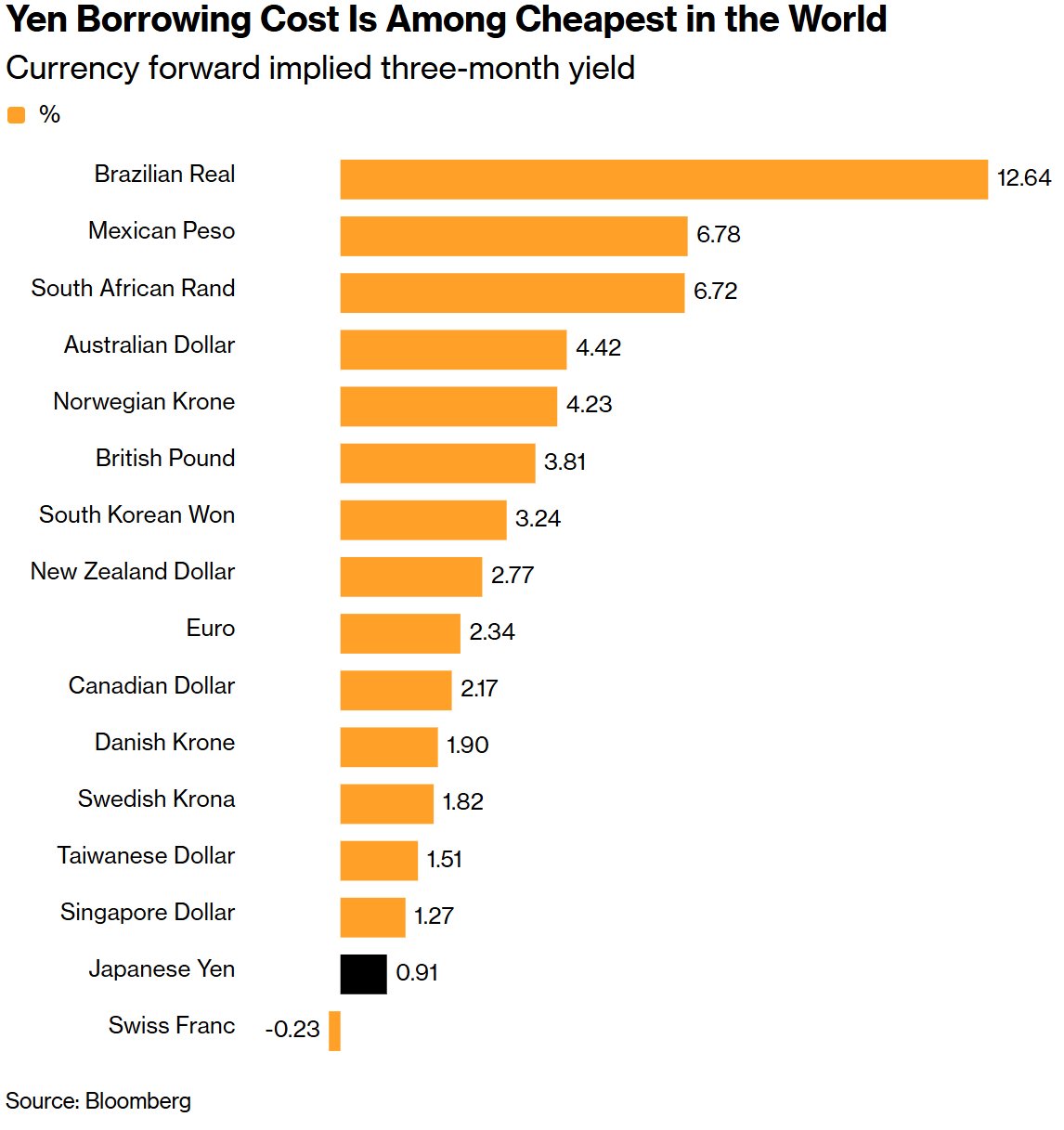
The cost of borrowing in yen is among the lowest in the world
Ashwin Binwani, founder of private equity firm Alpha Binwani Capital, bought USD/JPY around 157. This position will profit as the yen weakens. In the London session on Friday, the pair was reported at 159.16.
Bingwanee said, “The intervention is an excellent opportunity to sell yen at a higher price,” and “we won't be deterred by their actions. The arbitrage deal is so tempting and not to be missed.”
This is an opportunity that comes with great risk. As investors rebuild their short positions, they have also raised the possibility that regulators will step in again.
However, the fundamental forces that suppress the yen remain. Japan's 1% policy interest rate is lower than most advanced economies, and fiscal concerns are compounded. The yen has taken back half of the gains brought about by the intervention, and has depreciated against almost all of its major rival currencies over the past week.
Since this year, borrowing yen, shorting yen, and buying high-yield Colombian pesos, Turkish lira, and Norwegian krone has been able to bring returns of more than 10% per transaction.
Strategist Mark Cranfield said that the rise in the one-year yen forward price should sound a wake-up call in Tokyo. This trend is usually linked to direct dollar buying, and suggests that foreign exchange traders are using the yen's rebound after the intervention to reload arbitrage trading and prepare for another long period of weakness.
Bart Wakabayashi, manager of the Tokyo branch of State Street Bank and Trust Company, said that the company's proprietary data shows that real money accounts are still arranging arbitrage transactions, selling yen and buying a range of Group of Ten (Group-of-10) currencies.
He said the biggest interest was against the Australian dollar, followed by the euro, the US dollar, the Canadian dollar, and the British pound.
Yuxuan Tang, Asia's head of interest rate and foreign exchange strategy at J.P. Morgan Chase Private Bank, said, “Unless we see a meaningful downward turn in the dollar and US bond yields, arbitrage traders may push the pair to retest 162,” she added. The market also recognizes that repeated intervention is becoming increasingly costly for Japan.
Based on an analysis of central bank accounts, Tokyo may have spent about 34 billion US dollars on July 31 to intervene in the foreign exchange market to support the yen. An estimated $53 billion was invested the day before. If confirmed, this would be the largest single-day intervention on record.
US Treasury Secretary Scott Bessent reiterated America's support for stabilizing the yen, saying that the weak yen could trigger a wider risk of depreciation throughout Asia, and that Washington would support Japan “at any cost.”
Hedge funds aren't limited to getting involved in this deal. According to preliminary data released by Japan's Ministry of Finance on Friday, Japanese investors bought the largest overseas asset in more than two years last week, taking advantage of the brief rebound of the yen after the intervention.
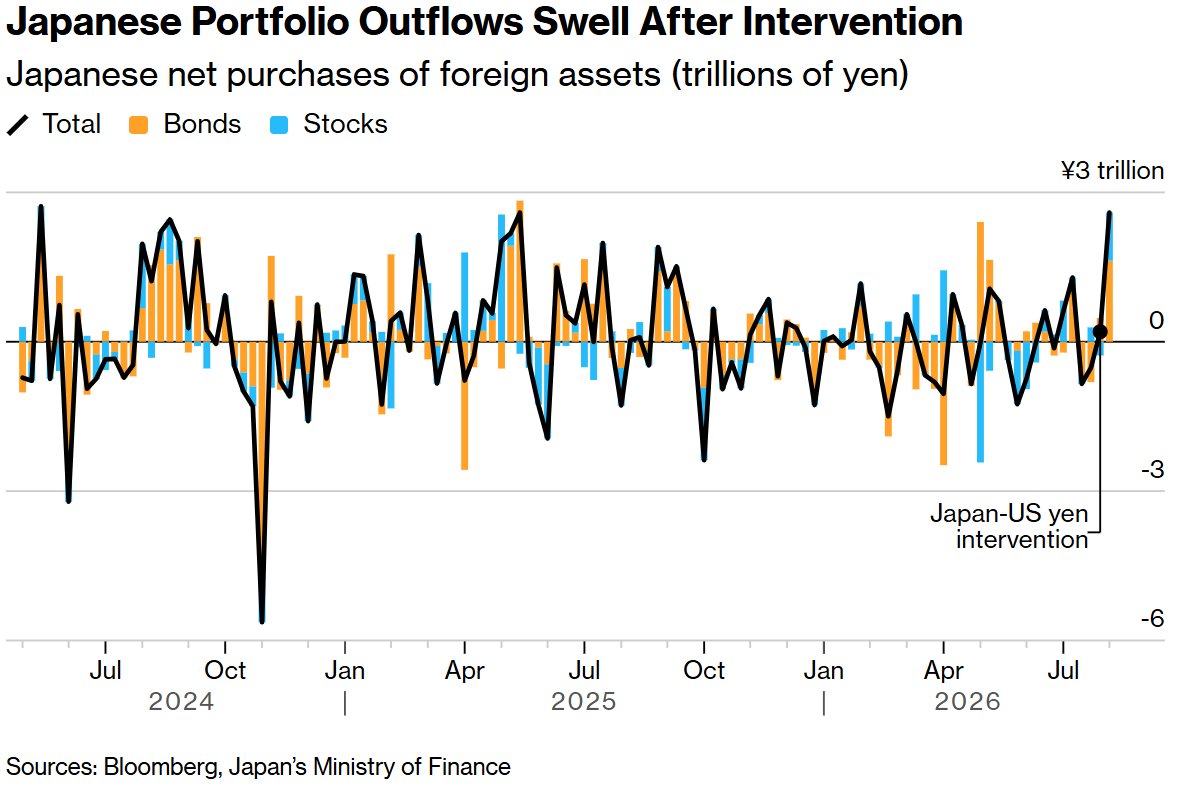
Japan's portfolio outflows surged after intervention
The attractiveness of the yen as a financing currency is likely to decline if traders anticipate further intervention or follow-up from the Bank of Japan. Any action may trigger phased fluctuations, forcing investors to quickly close positions and amplifying price fluctuations across markets.
According to people familiar with the matter, as a sign of growing concern about the weakening yen, Prime Minister Takaichi Sanae's government supports the Bank of Japan's recent interest rate hike, and the next step is likely to fall in September or October.
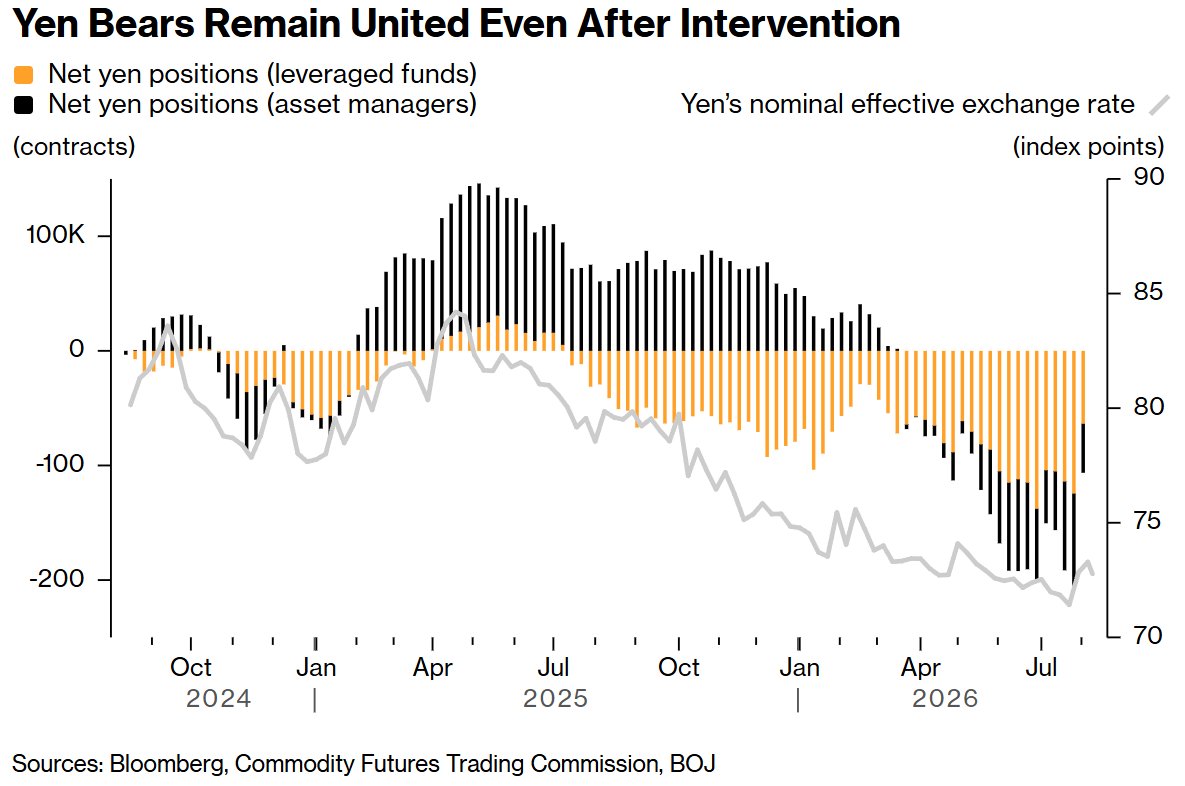
The yen bears remain united even after the intervention
Carol Lye, portfolio manager and senior research analyst at Brandywine Global Investment Management in Singapore, said. If the intervention succeeds in stopping further depreciation, the yen should not break through the 162 level,” she added, adding that arbitrage transactions can instead be financed through other relatively low-yield currencies such as the euro or the Swiss franc.
Investors such as Damien Loh, chief investment officer of Singapore's Ericsenz Capital, did not retreat as a result. He restarted buying USD/JPY at around 157 levels after the last round of intervention. He said that in addition to earning positive arbitrage returns, the deal can also provide a hedge against other short dollar positions elsewhere in the portfolio.
“I'm optimistic about going long on gold or Australian dollars because the dollar depreciation narrative is coming back in full,” Damien Loh said. “If I don't want to be exposed to too much dollar, I can buy the dollar directly against the yen. That way you have hedging, and it also gives you positive arbitrage returns — perfect day.”
The overnight index swap shows that traders are betting that the Bank of Japan will raise interest rates by 25 basis points by October, although this will do little to narrow the spread with the US. Although moderate US inflation data has lowered market expectations that the Federal Reserve is about to raise interest rates, the central bank is likely to tighten policy this year.
George Efstathopoulos, portfolio manager at Fidelity International, believes that demand for arbitrage bets will continue, but fluctuations will also increase under US endorsement.
“As long as the Bank of Japan lags behind the curve, then arbitrage transactions funded in yen can continue to flourish,” he said.