
- PRICING
- LIVE QUOTES
- LEARN
- HELP


EN
“Tesla in the Grocery Industry” staged a 45% Jedi counterattack! South Korea's new warehouse ignites valuation repair Ocado ushered in a key window of “reversal of the predicament”
Once a superstar in the retail sector of the stock market, Ocado Group Plc has once again shown a revival in its stock price trend and basic outlook after experiencing a difficult period of extremely severe stock price declines. According to the latest estimates, the stock price of this British online grocery delivery and warehousing technology service company has been soaring recently, with a cumulative sharp rise of 45% over the past month, and surged 18% this week alone.
This was a rare bright spot for the retail company, once known as the “Tesla of the grocery world,” but its business model has been questioned ever since. The stock is still down more than 90% from its all-time high during the pandemic. The core reason is that changes in consumer shopping habits during the pandemic ultimately proved to be only a temporary phenomenon, and Ocado has been struggling to convince investors that its technology business model is viable.
Ocado is essentially not an ordinary British “online supermarket,” but a technology company that uses online retail as an important testing ground and sells automated retail fulfillment infrastructure to retailers around the world. Its core asset is the Ocado Smart Platform (OSP): it integrates AI/software, warehouse robots, automatic sorting, inventory and order management, and last-mile logistics into an end-to-end online B-end retail system, and exports IT technology to global retailers such as Lotte, Aeon, and Kroger (Kroger) through large-scale customer fulfillment centers (Customer Fulfilment Centres, also known as “CFCs”) and store automation solutions.
In the UK, it also operates the OCADO.com online grocery business through Ocado Retail, a joint venture with Marks & Spencer. Ocado itself defines the company as a global technology company that is reshaping e-commerce, fulfillment, and logistics, while analysts have clearly described it as “an important supplier of automated distribution center technology+British online grocery joint venture operator.”
“Tesla in the grocery world” Ocado is back to life. Can the new South Korean warehouse leverage valuation repair?
Earlier this month, the first fulfillment center built by Ocado in collaboration with Korean retailer Lotte Shopping Co. officially opened, which mitigated market concerns to a certain extent. After its largest customer and well-known US grocery retailer Kroger Co. reduced the scale of cooperation, Ocado also announced layoffs and sought to reduce the cost of deploying its products.
Chris Beauchamp, IG's chief market analyst, said, “It's still too early to say that Ocado has come out of trouble, but the glimmer of hope for business recovery brought by a new warehouse fulfillment center in South Korea has at least reversed the recent round of decline. After such huge losses in stock prices, especially when the market began to think that Ocado may have reached the edge of exiting the stage, this (bottoming out) is probably natural; but now it is clear that the market still has some hope, and believes that there may be more new orders surrounding its technology in the future.”
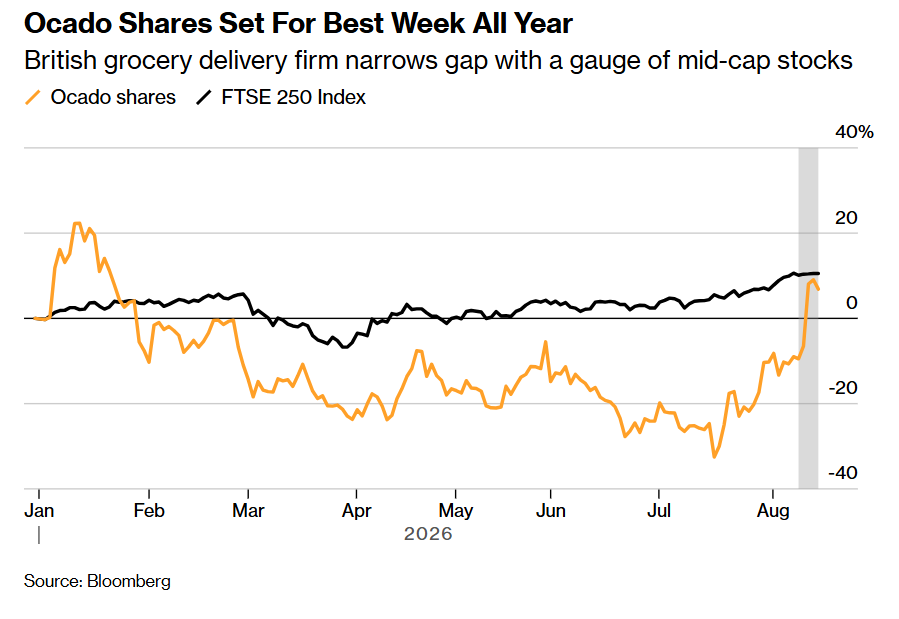
As shown in the chart above, Ocado shares are expected to have the best weekly performance of the year — the UK grocery delivery company is closing the performance gap with the UK stock market's mid-cap benchmark index.
At its peak, Ocado's market capitalization reached an astonishing £22 billion (about US$30 billion) in September 2020, surpassing Tesco Plc. At the time, demand for online grocery shopping continued to surge due to the COVID-19 pandemic.
Since then, however, Ocado has been dealing with an increasingly obvious trend: more and more grocery retailers are choosing to process more online orders directly within physical stores. This has also sparked market calls for Ocado to move away from its previous business model, which relied heavily on large, capital-intensive distribution centers.
Ocado experienced a major setback in November of last year, when Kroger said that the financial performance of its automated warehousing network fell short of expectations and would close 3 large fulfillment centers led by Ocado. In January of this year, Canadian partner Sobeys Inc. said it would close a warehouse in Calgary. Last month, the company also announced that CEO Tim Steiner will step down at the beginning of its 2028 fiscal year.
This week's rise has already propelled Ocado shares into the overbought region — and recent similar rebounds have all finally subsided before. Beauchamp from IG pointed out that the round of rising prices that began in December last year began to show signs of “cooling off” in January of this year. “To maintain the current upward momentum, we need more contracts, or at least negotiations on new warehouse projects,” he said.
As of Wednesday, the number of shares of Ocado loaned — an indicator that can be used to measure overall short positions — represented approximately 9.4% of the company's freely tradable shares, according to data from S&P Global Market Intelligence. This ratio is lower than 17.8%, which was a relative high of 17.8% in late April this year.
Marcus Diebel, a senior analyst at J.P. Morgan Chase, said that the current stock price does not reflect the value of the contract that Ocado has signed. According to the brokerage firm's estimates, the current stock price also means that the market is pricing that in the future, more key sites will be shut down rather than new sites being put into operation. Diebel wrote in a report released on Wednesday that although the current risk-reward ratio is “extremely attractive,” stock price fluctuations are likely to continue.
This volatility is also reflected in huge differences in analysts' target prices. Some analysts are still choosing to wait and see.
UBS Group analyst Sreedhar Mahamkali said in a report last week: “Although Ocado is rapidly readjusting its business plan, we still don't see a clear enough growth path.”
Ocado robot warehouses have regained orders, and soft landing transactions have begun to move from consumption to automated capital expenditure?
What Ocado really needs to be re-valued by the market is not sales data for a retail supermarket or a certain site, but closer to the valuation reshaping of a “retail automated cloud platform+robotic warehousing infrastructure provider”.
The recent 45% stock price rebound is first and foremost that Ocado's own business model has received an important “viability test” rather than just a macro beta. The company previously faced serious questions due to Kroger's closure of three robot fulfillment centers and Sobeys's reduction of cooperation. However, in mid-July, the stock price even fell to a 13-year low; however, ocado then obtained a new CFC contract from a major European retailer, and the stock price rose by more than 12% on the same day. In August, it also officially launched the first highly automated CFC in Busan, South Korea, covering about 4 million households, and deploying automated freezers, robotic systems, and morning delivery capabilities for the first time.
These developments mean that the market is beginning to believe again: large centralized automated warehouses have not been completely eliminated by traditional store compliance, and that Ocado's technology may still generate economic value in a market with high population density and high online penetration. But it's still a typical turnaround (turnaround) + short recovery deal — its North American partner's previous retreat has proven that not all regions are suitable for capital-intensive CFC models, so the current rise is more like “expectations of exiting the historical stage being corrected” rather than the business model having won out all.
From the perspective of a global “soft landing (soft landing)”, the Ocado rebound is a microsignal with a positive direction but very low weight. To a certain extent, Ocado's strong rebound of 45% can be viewed as an example of “a soft landing environment conducive to repricing troubled growth stocks.” The signs of Ocado's stock price and fundamental recovery confirm that consumer demand is still resilient, retailers are once again willing to automate long-term capital spending, and the market is beginning to revalue high-growth assets. If the economy enters a deep recession, retailers usually delay large-scale warehousing investments first; on the contrary, companies such as Lotte continue to deploy automated infrastructure, which is consistent with the typical soft landing trajectory of “demand has not collapsed+companies are still willing to invest in improving efficiency.”