
- PRICING
- LIVE QUOTES
- LEARN
- HELP


EN
It not only guarantees the prosperity of AI computing power, but also prevents crowded transaction settlement! UBS Q2 overbought Micron and NASDAQ Call, increased holdings on Lilai Call and Index Put
The Zhitong Finance App learned that according to the US Securities and Exchange Commission (SEC) disclosure, international financial giant UBS GROUP AG (UBS GROUP AG) submitted the US stock market position report (13F) for the second quarter ending June 30, 2026.
According to statistics, the total market value of UBS's holdings in the second quarter was 790 billion US dollars, and the total market value in the previous quarter was 670 billion US dollars, which meant that UBS US stock holdings, which were close to the trillion-dollar level, increased sharply by 18% month-on-month during the second quarter when the stock market settled profits and selling pressure heated up. The financial giant added 1281 new holdings to its portfolio in the second quarter, increased its holdings by 4,272 shares, reduced its holdings by 4,416 shares, and cleared 1,282 shares. Among them, the top ten holdings account for about 13% of the total market value.
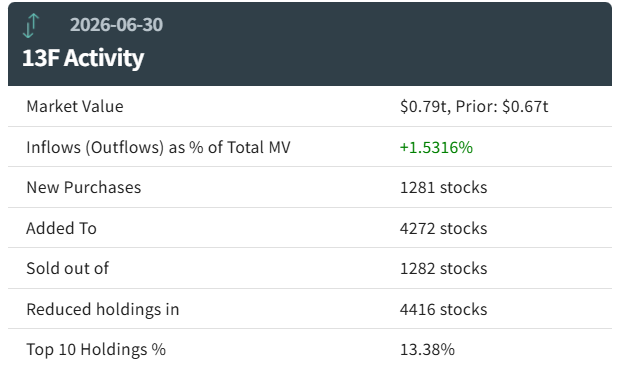
The 13F recently disclosed by UBS can be described as a “textbook” barbell (Barbell) combination of “continuing to increase the structural prosperity of AI computing+actively managing the rear risk of congestion”, rather than UBS frantically chasing the AI computing infrastructure investment frenzy surrounding Nvidia and AMD in one direction. UBS aims to move from a single high-beta AI chip giant to betting on storage+cloud computing superplatform stocks+index calls to jointly capture upward factors, while reducing tail risk with medical growth stocks and index puts. Nvidia is still in first place. Microsoft gained a significant 8.62% increase, Broadcom increased 2.01%, Google increased 4.84%, and QQQ Call increased by 90.40%, indicating that it still retains a strong upward exposure to major US technology and AI computing power; but on the other hand, SPY Put surged 155.10%, which combined with Lilly Call surged 4571.11%, which clearly strengthened the index's downward convexity protection+high-quality non-technology growth.
UBS increased its holdings of Microsoft by 8.62%, Alphabet by about 3.8% to 4.8%, and Broadcom 2.01% in the second quarter. Micron common stock still held about 6.09 million shares and ranked the eleventh position. At the same time, the number of declarations and disclosures corresponding to Micron Call (that is, Micron call options) surged 174.94% to an equivalent scale of about 4.21 million shares, and QQQ Call (that is, the bullish option positions of NASDAQ 100 ETFs) increased sharply by 90.40% to about 9.69 million shares.
But on the other hand, UBS cut some spot stock exposures for Nvidia, TSMC, and Meta, while SPY Put (put options tracking the S&P 500 ETF) increased sharply by about 155% and QQQ Put by about 10%. Therefore, the real signal for UBS to hold positions is not to “withdraw from technology,” but rather to spread from a single, highly crowded AI computing power leader to storage giants+cloud computing giants+broader AI beta-themed stocks, and at the same time buy a convex risk exposure to the downward trend in the index. Regarding bullish options positions+SPY/QQQ PUT, this shows that UBS clearly did not ignore the risk of AI leverage liquidation, trying to buy Micron bullish options in a big way to prosper AI structurally, while using medical growth stocks plus index puts to reduce tail risk.
Among them, the bet on American memory chip supergiant Micron is the clearest “AI computing power fundamental bet” in UBS's portfolio, while QQQ Call is closer to “the continuation of the upward trend in buying AI with limited capital.” UBS's drastic increase in Micron Call is more like betting that “after GPUs, storage will inevitably become the second scarce bottleneck in the AI system”; QQQ Call allows the combination to obtain beta and gamma where the entire AI ecosystem, such as Microsoft, Nvidia, Broadcom, and Meta, continues to rise without having to put all capital back on the most crowded single stock such as NVDA (NVDA).
It is worth noting that Q2 itself cannot simply be called an AI bear market, but it showed a clear pullback trajectory before the sharp semiconductor deleveraging sell-off in July: semiconductors did fall sharply on June 5 and June 23. On the latter dates, SOX (Philadelphia Semiconductor Index) fell 7.9% in a single day and Micron fell about 13%, but in the end, the NASDAQ still recorded one of the best quarterly performances since 2020.
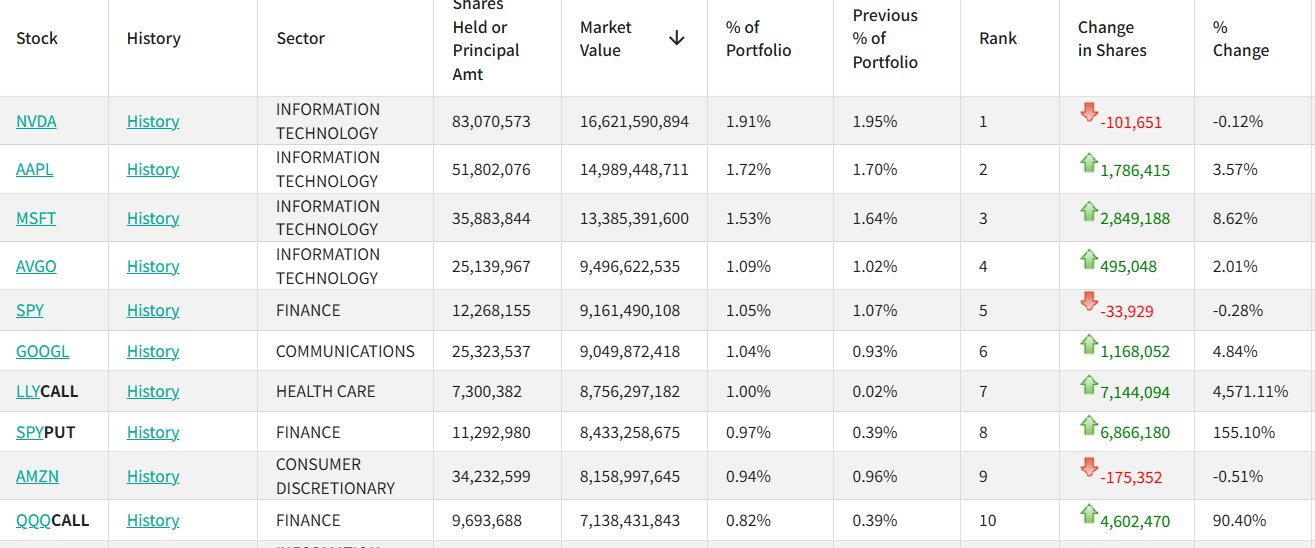
Specifically, the “AI chip hegemon” Nvidia (NVDA.US) was still UBS's largest holding target in the second quarter, holding about 83.07 million shares, with an overall market value of about US$16.622 billion, accounting for 1.91% of the portfolio, a slight decrease of 0.12% from the number of positions held in the previous quarter.
Apple (AAPL.US) is the second-largest holding, holding about 51.8 million shares, with a market value of about US$14.989 billion, accounting for 1.72% of the portfolio. The number of holdings increased by 3.57% over the previous quarter.
AI technology giant Microsoft (MSFT.US) is the third-largest holding, holding about 35.88 million shares, with a market value of about US$13.385 billion, accounting for 1.53% of the portfolio, a significant increase of 8.62% over the previous quarter.
Broadcom (AVGO.US), a giant of AI ASIC custom chips and Ethernet switch chips, ranked fourth, holding about 25.14 million shares, with a market value of about US$9.497 billion, accounting for 1.09% of the portfolio, and the number of holdings increased by 2.01%.
The S&P 500 ETF (SPY.US) ranked fifth, holding about 12.27 million shares, with a market value of about US$9.161 billion, accounting for 1.05% of the portfolio, a slight decrease of 0.28% from the previous quarter.
Among the top ten largest positions, UBS ranked 6-10 as of the end of the second quarter: Google Class A Shares (GOOGL.US), Lilly Bullish Options (LLY.US, CALL), S&P 500 ETF put options (SPY.US, PUT), Amazon (AMZN.US), and NASDAQ 100 ETF call options (QQQ.US, CALL). Overall, the top ten positions highlighted UBS's Q2 13F did not reflect “escaping AI,” but instead showed a very clear textbook barbell configuration of “continuing to bet on AI's main upsurance+increasing tail risk protection”.
Among them, UBS held about 25.32 million Google Class A shares, with a market value of about 9.050 billion US dollars, accounting for 1.04%, an increase of 4.84% over the previous quarter; Eli Lilly's bullish options jumped to the 7th largest position, corresponding to the equivalent number of about 7.3 million shares, with a declared market value of about US$8.756 billion, accounting for 1.00%. The number of positions surged 4571.11% from the previous quarter; SPY had the eighth largest bearish position, corresponding to about 1.12 million shares, accounting for about US$8.433 billion. 0.97%, up to 155.10% increase in holdings; Amazon holds about 34.23 million shares, with a market capitalization of about US$8.159 billion, accounting for a slight decrease of 0.51% from the previous quarter; at the same time, QQQ bullish options increased by 90.40%, corresponding to about 9.69 million shares and declared market value of about US$7.138 billion, accounting for 0.82% of the portfolio, making it one of UBS's top ten positions.
Judging from changes in position ratios, UBS Group's top five buying targets in the second quarter were: Lilly's call options (LLY.US, CALL), S&P 500 ETF put options (SPY.US, PUT), Micron Technology (MU.US), Micron Technology (MU.US, CALL), and Nasdaq 100 ETF bullish options (QQQ.US, CALL).
The configuration structure of the top five buying targets is enough to highlight that UBS did not withdraw from the AI main line in the context of repeated deleveraging of AI and semiconductor high volatility and crowded transactions in the second quarter, but instead adopted a more “barbell” asset allocation logic — on the one hand, it also added current Micron shares and Call, and increased QQQ Call to reinforce HBM/DRAM/NAND storage requirements and the upward flexibility of large technology stocks in the AI reasoning era; on the other hand, it greatly increased SPY Put and introduced Call and AI through Lilly Healthcare growth assets with less correlation between capital expenditure cycles and more certainty of fundamental growth to hedge against technological congestion and the risk of systemic retracement.
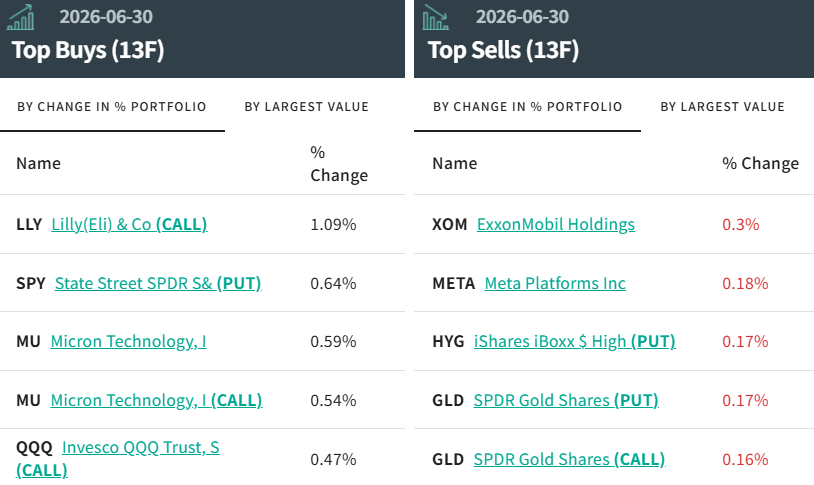
UBS Group's top five sales targets in the second quarter were: ExxonMobil (XOM.US), Meta Platforms (META.US), high-yield corporate bond ETF put options (HYG.US, PUT), gold ETF put options (GLD.US, PUT), and gold ETF call options (GLD.US, CALL). UBS did not simply shift to comprehensive defense. While cutting back some of its traditional energy and meta exposure, it also simultaneously lowered downside protection for high-yield bonds and options positions on both sides of gold. It was more like actively cleaning up tactical positions previously used for macro tail risk and commodity fluctuation trading, and refocusing position allocation into a more directional combination of “AI storage+large-scale technology upward convexity+index downward protection+high-quality medical growth hedging AI computing power sell-off”.