
- PRICING
- LIVE QUOTES
- LEARN
- HELP


EN
The British bond market cast a “vote of confidence” ahead of schedule: interest spreads on asset swaps are stable, and making long British bonds outperform swaps has become a popular transaction. Burnham's first budget will face critical verification
The Zhitong Finance App learned that in the British treasury bond market, a popular trading strategy shows that investors are confident that the new Prime Minister Andy Burnham (Andy Burnham) will keep his promise to control government loans.
Less than three months have passed since the new government's first budget, and asset swap spreads — widely regarded as an indicator of bond supply anxiety — have remained stable. J.P. Morgan Chase, as one of the main market makers in the UK interest rate market, pointed out that this shows that investors are betting that Burnham will match his words and actions.
Julian Baker (Julian Baker), co-head of linear interest rate trading at J.P. Morgan Chase in Europe, the Middle East and Africa, said that betting on British treasury bonds performed better than swaps over the same period and has become a “highly sought after trading strategy.” Strategists from Bank of America, Morgan Stanley, and Royal Bank of Canada have also mentioned the popularity of the deal in interviews and research reports in recent weeks.
Beck said, “The government is now sending a signal of responsible finance, and the market will expect them to deliver on their rhetoric with practical actions.”
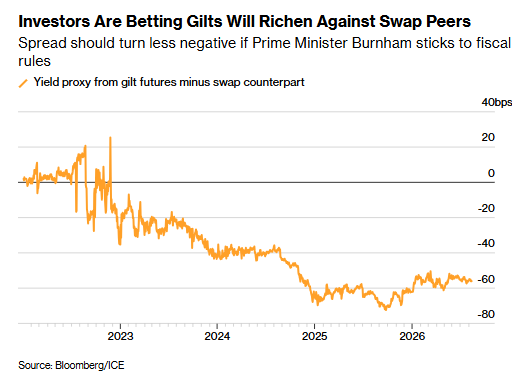
Asset swaps essentially measure the difference between bond interest rates and swap interest rates, and are very attractive to investors who want to get involved in treasury bonds but don't want to take too many risks in the bond market. Interest spreads are currently negative because bond prices are lower than swap interest rates; however, if the government can introduce a responsible budget to avoid a drastic increase in debt issuance to boost treasury bond prices, interest spreads are expected to fall to zero.
Fabio Bassanin (Fabio Bassanin), a British strategist at Morgan Stanley, said: “The deal should still be an attractive way to maintain a long-term view of the UK's exposure.”
Up to now, Burnham's policy proposals have been relatively moderate, and he has promised to abide by the government's fiscal rules, which to a certain extent has allayed market concerns about a surge in large-scale bond issuance. Plans include further decentralization, the establishment of a branch of the Prime Minister's Office in Manchester, implementation of a bus fare cap, and a reduction of around £45 (about $61) of VAT on electricity bills for each household in the winter.
Fiscal concerns remain
At the same time, however, there is still uncertainty about how the Prime Minister will raise funds for an ambitious administration agenda spanning ten years, whether to raise taxes or expand borrowing.
Once the October budget disappoints, this popular asset swap could trigger a massive withdrawal of capital, impacting banks, hedge funds, and institutional investors.
James Lynch (James Lynch), portfolio manager at Aegon Asset Management, said, “These types of deals are indeed often popular before and after financial events.” However, he is not currently involved in the asset swap transaction, adding, “I want to see the market level before Burnham's first budget is introduced before making a decision.”
Market tension was already evident at the end of July. At the time, although Burnham insisted that he would abide by the government's own borrowing and spending restrictions, he also mentioned that he wanted to seek “fiscal flexibility” within the rules, which once triggered a brief sell-off of British treasury bonds. The yield on 30-year treasury bonds hit 5.8%, the highest level since mid-May.
This scene is reminiscent of how yields soared after former Prime Minister Liz Truss (Liz Truss) announced an unfunded tax cut plan in 2022.
Currently, the UK's 30-year swap spread is still hovering in the middle of the range since this year, which is comparable to the year-to-date average.
Megum Muhic (Megum Muhic), UK interest rate strategist at the Royal Bank of Canada, pointed out that although caution is necessary, asset swap strategies are “quite popular recently” given the level of interest spreads offered by the deal. She said that the October 28 budget announcement date “will undoubtedly be an important independent catalyst for the treasury bond market.”