
- PRICING
- LIVE QUOTES
- LEARN
- HELP


EN
Everything from memory to operating systems is rising! Microsoft (MSFT.US) Windows license fees increased by 7%-10%, and global PC shipments may now decline for the first time in nearly a year
The Zhitong Finance App learned that in a context where the rush to buy memory chips in AI data centers has already triggered “chip inflation,” Microsoft (MSFT.US)'s Windows license fee has added another spark to the PC industry. According to related reports, PC industry executives were quoted as saying that Microsoft has raised Windows license fees for some OEMs by 7% to 10% since July, an increase significantly higher than in previous years. Asus and Acer have confirmed another price increase of about 5% this season, although research institutes expect global PC shipments to fall year on year for the first time since early 2025.
The report said that Microsoft has raised Windows OEM licensing fees for some PC manufacturers, with an increase of 7% to 10%, effective from July. Microsoft does not set a uniform price for OEMs, but rather refers to factors such as CPU grade; models with i7 or higher processors usually have higher licensing fees than i3 or i5 models. As a result, different brands and product lines are also affected differently.
For PC manufacturers, Windows licensing fees are a rigid cost that cannot be circumvented. Industry executives said that Microsoft raises licensing fees slightly every year, but this year the amount is significantly larger. PC manufacturers are already dealing with price increases for components such as memory, display panels, and batteries. The increase in Windows licensing fees means another expense during pricing. Low-end PCs have thin profit margins, and manufacturers can only choose between increasing prices, reducing configurations, or accepting thinner margins, and higher licensing fees make every option more difficult.
Despite this, it may be difficult for consumers to detect this cost alone. The brand said that parts prices are rising too fast, and the rise in licensing fees is drowning in the overall noise of price increases. Microsoft's own Surface products are already showing cost pressure: the latest Surface Pro and Surface Laptop are about 400 to 500 dollars higher than the previous generation; the price of the Apple (AAPL.US) Mac series has also increased by hundreds of dollars due to rising parts costs. However, the difference is that Windows camp vendors also have to bear additional operating system licensing fees.
PC price increases: May rise another 5% this season, with some products up nearly 30% from the end of last year
The PC industry has faced memory shortages over the past year, driving up notebook and desktop manufacturing costs. Mainstream PCs that originally cost between $600 and $800 are already close to $1,000; some of the original high-end Windows notebooks that cost between $1,200 and $1,500 are close to $2,000. Notebooks are likely to be affected the most because manufacturers need to balance multiple costs such as memory, display panels, batteries, processors, and thin and light design at the same time.
Both Asus and Acer have confirmed that they will launch another round of price increases this quarter, by about 5%. Asus also revealed that compared with the fourth quarter of last year, the current price of some of its products has increased by nearly 30%. In mainstream markets, price increases are particularly difficult for manufacturers: lower-cost models are more difficult to absorb additional costs, and manufacturers can only raise prices, reduce distribution, or sacrifice profit margins.
Counterpoint Research predicts that global PC shipments in the second quarter of 2026 will be about 65 million units, a year-on-year decrease of 4%, the first year-on-year decline since the beginning of 2025. The AI PC and Windows migration cycle is still driving some demand for switching, but rising prices are dampening demand.
“Chip inflation” spreads from data centers to consumers
In fact, the deep background behind the rise in PC prices stems from the imbalance between supply and demand for memory chips. Morgan Stanley calls it “chipflation” (chip inflation): memory chips are no longer falling in price over time, but are becoming more expensive and harder to buy.
This isn't the first time that chips are under pressure. During the pandemic, chip shortages caused automobile production lines to stop production and doubled the secondary market prices of consumer goods such as the Sony (SONY.US) PS5, revealing the fragility of the semiconductor supply chain.
The world produces more than 1 trillion memory chips every year, which are used in mobile phones, automobiles, medical devices, and defense systems. Currently, there are no alternatives in the field of mass production computing, but demand for memory such as DRAM in AI data centers has surged.
The top five AI companies in the US are expected to spend more than 650 billion US dollars this year, mainly for data centers, which is nearly double that of 2025. Chipmakers prioritize the production of more profitable AI chips, leading to a squeeze on the supply of chips used in mobile phones, notebooks, and automobiles; it takes several years to build a new fab. Coupled with geopolitical tension, export restrictions, and supply chain fragmentation, supply bottlenecks are difficult to ease in the short term.
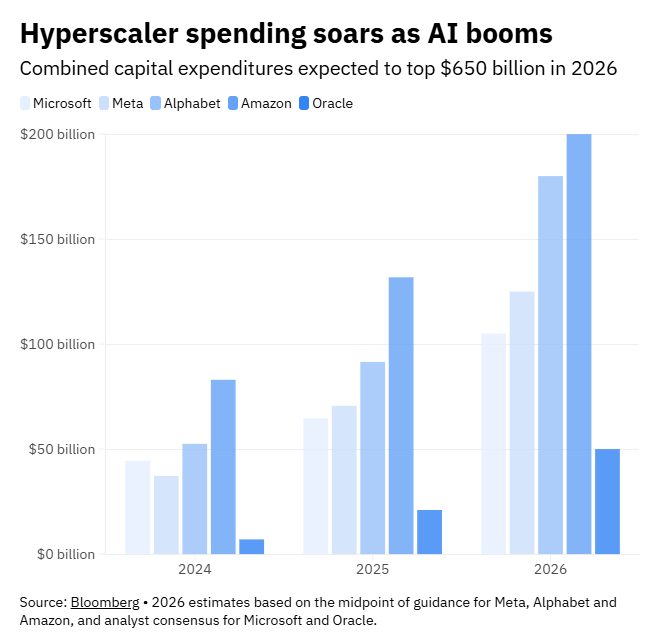
Morgan Stanley estimates that memory prices have increased about six times in the past year. Apple CEO Tim Cook called this sharp rise in memory costs a “once-in-a-century flood,” adding that he had never seen it in the business for 40 years. Well-known tech journalist Mark Gurman commented, “The bills of the AI era have officially fallen to Apple users.”
Analysts expect that supply chains will continue to be tight until the second half of the 2020s, and AI servers will continue to absorb large amounts of memory production capacity. Meanwhile, research institutes expect that global PC and smartphone shipments will shrink markedly this year, and high prices will curb demand and lengthen the switching cycle.
BlackRock believes that chips are becoming a key strategic asset in the AI economy era. Governments and businesses compete not only with each other, but with the wider economy for equally scarce resources. The test facing the AI revolution is whether it is possible to build stronger model infrastructure without directly or indirectly transferring costs to the overall economy.
The report released by the World Economic Forum in collaboration with Accenture also reminds that AI is driving a new round of innovation and growth. But to fully unlock its potential, the key is to build and manage AI systems to maximize benefits while minimising risks to humans, society, and the environment.