
- PRICING
- LIVE QUOTES
- LEARN
- HELP


EN
The market appetite has been propped up to the ceiling! Applied Materials (AMAT.US) is also unable to escape the “selling facts” curse: demand for AI devices is strong, and the Q3 earnings report overall exceeded expectations
The Zhitong Finance App learned that after the market on Thursday, the stock price fell by about 5% after the market, applied materials (AMAT.US), the largest chip equipment manufacturer in the US, handed over a questionnaire that “completely exceeded expectations.” This trend of “good performance, bad stock prices” reflects that after the AI equipment sector experienced a year-long surge, the market is reviewing every financial report with unprecedented stringent standards.
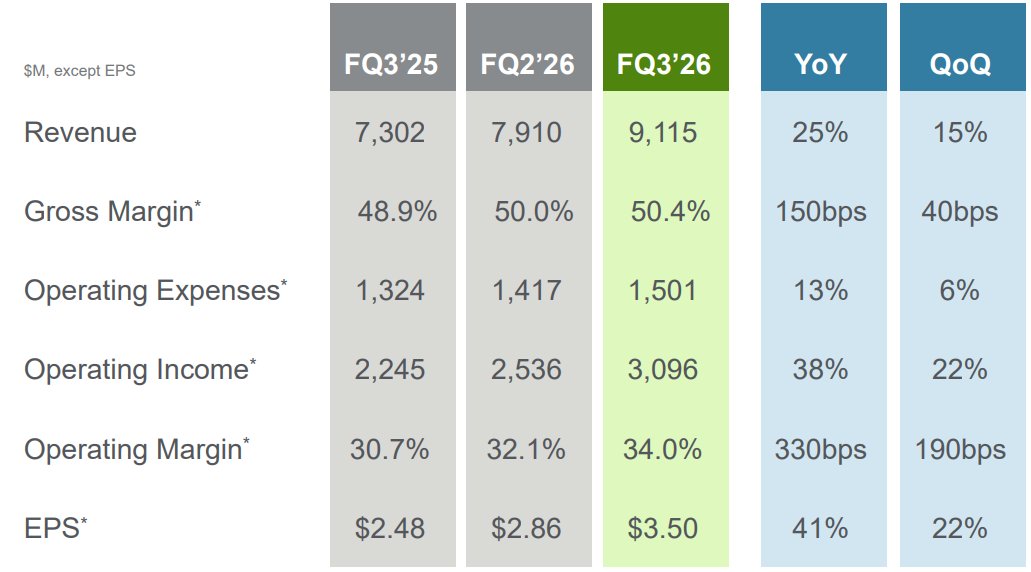
Q3 Performance Overview: Revenue and profit both set records, 13 consecutive quarters of gross margin expansion
Revenue of $9.12 billion not only exceeded analysts' expectations of $9 billion, but also hit a record high for the company. Adjusted earnings of $3.50 per share also set a new record. GAAP gross margin reached 50.3%, up 1.5 percentage points year on year. This is the 13th consecutive quarter of year-on-year improvement.
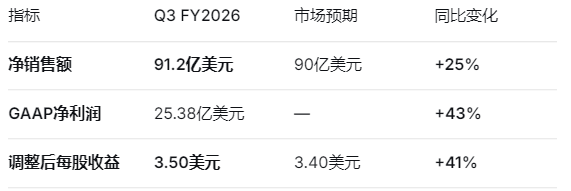
Looking at the business structure, the Semiconductor Systems (Semiconductor Systems) business was the core engine of growth this quarter — revenue of US$7.04 billion, up 30% year over year, with Foundry/Logic and other businesses accounting for 67%, DRAM for 26%, and Flash for 7%. The gross margin of the semiconductor systems business reached 55.3%, an increase of 1.9 percentage points over the previous year, and the operating profit margin increased from 33.0% to 37.7%. Global service business revenue was US$1.78 billion, up 11% year over year.
Q4 guidance: median revenue and earnings per share both exceeded expectations, but “not surprising enough”
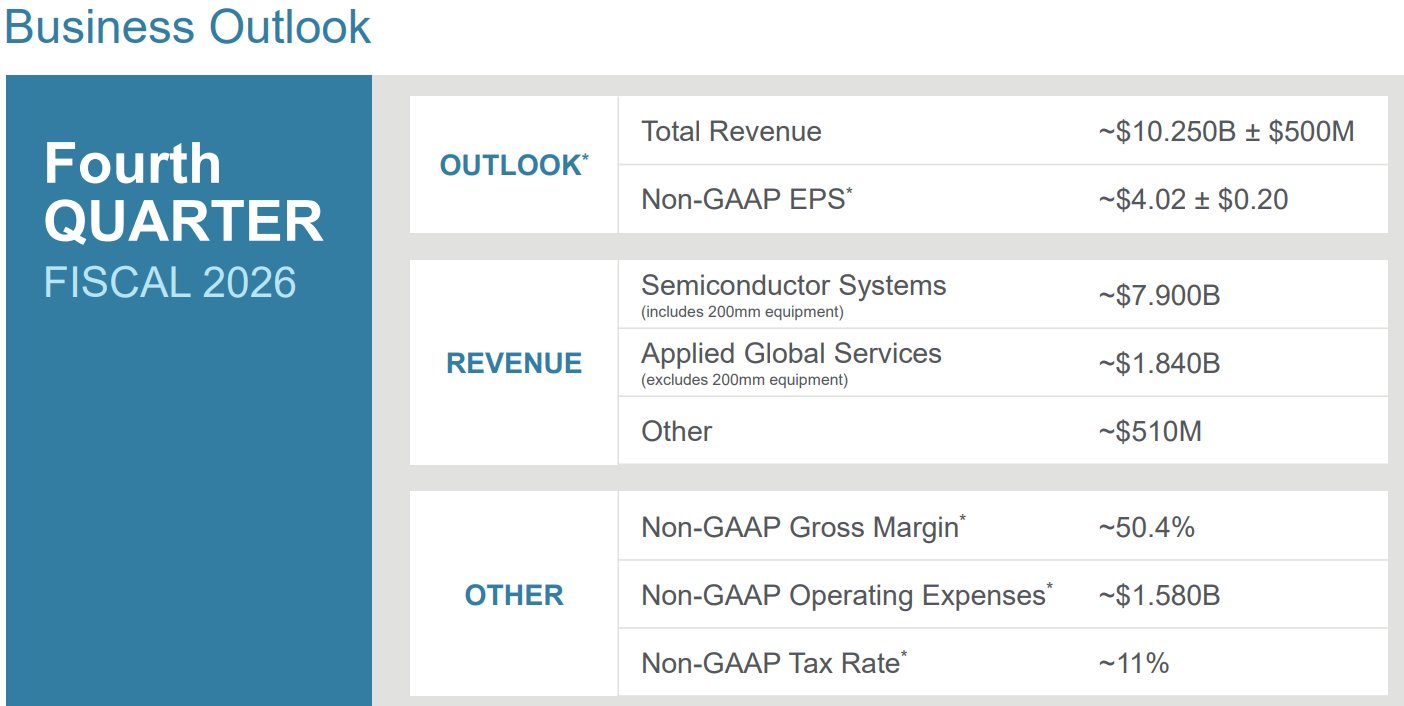
According to the median calculation, Q4 revenue was approximately US$10.25 billion, about 7% higher than analysts' average expectations; adjusted earnings per share of US$4.02 also exceeded market expectations. The adjusted gross margin is expected to be 50.4%, the same as in Q3. This guideline means that Applied Materials is expected to grow its semiconductor equipment business by more than 30% and its packaging business revenue by more than 70% in the 2026 calendar year (higher than the previous forecast of more than 50%).
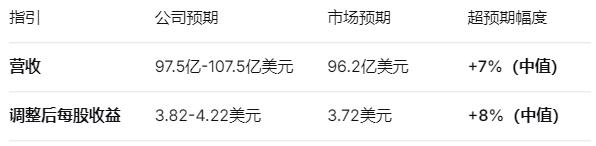
CFO Bryce Hill said during the earnings call that the company expects continued strong revenue growth in the second half of the year, particularly in the fields of DRAM, advanced process logic and foundry, and advanced packaging.
AI demand is “unprecedented”: customer order visibility extended to 2030
CEO Gary Dixon painted a picture of AI-driven long-term growth during the earnings call:
“With the rapid spread of AI around the world, demand for materials engineering solutions has reached an unprecedented level. Based on the growing visibility of demand from customers, we expect another year of strong growth for applied materials in 2027.”
Key signal 1: Customers are requesting applied materials to increase production capacity. Dixon said that chipmaker customers are even urging the company to speed up equipment delivery in order to obtain manufacturing tools more quickly, and his multi-quarter predictions from customers convinced him that 2027 will be another year of strong growth.
Key signal 2: Order visibility has been extended to 2030. CFO Hill revealed during the call: “Customers have given us more visibility than ever before, and some conversations have even extended to 2030.” Major customers generally give rolling demand forecasts for eight consecutive quarters.
Key Signal 3: Packaging revenue growth is expected to rise in 2026. Applied Materials expects overall packaging revenue to grow by more than 70% in 2026, higher than the previous forecast of more than 50%. “Our customers are creative; they're looking for more cleanroom space, so they're speeding up the need for tool delivery,” Dixon said.
The triple logic of the “selling facts” market
Despite both performance and guidance exceeding expectations, the stock price fell about 3% after the market. There is a triple logic behind this phenomenon:
First, expectations have been fully priced. The stock price of Applied Materials has accumulated a cumulative increase of 108% since this year, with an increase of 194% over the past year. If it continues to rise, it will be the best annual performance since 1999. In the face of such a huge increase, “exceeding expectations” alone is not enough to push stock prices to continue to rise — what the market needs is to “significantly exceed expectations.”
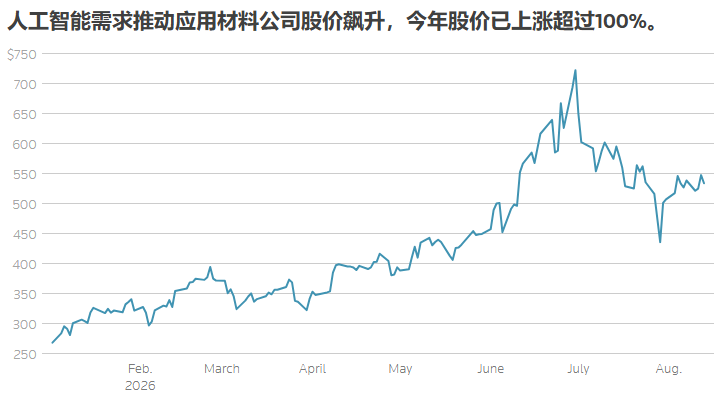
Second, sector rotation comes to an end with profit. Recently, the semiconductor equipment sector has seen a correction due to concerns about the sustainability of AI capital expenditure. Applied Materials shares have entered a six-week consolidation period since reaching a record high on June 30. The sell-off after the earnings report was released was partly due to the systematic settlement of the profit market in the previous period.
Third, “lessons from the past” of peers' financial reports. Last month, KLAC.US (KLAC.US) shares also fell after announcing results in line with expectations — lower free cash flow than expected raised market concerns. After Lam Research released its earnings report, the market's expectations for chip equipment manufacturers also soared. Although Applied Materials handed over a more beautiful report card, it did not break this pattern.
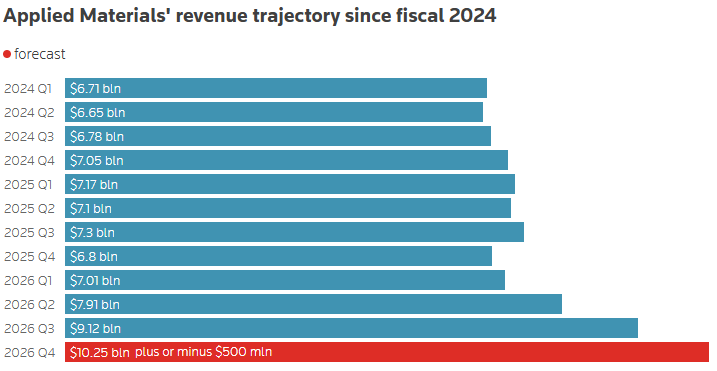
When a company handed over financial reports that “simply exceeded expectations” after such a huge increase, the market already viewed “exceeding expectations” itself as a “benchmark situation” rather than a surprise. CFRA analyst Brooks Idlett pointed out, “Performance and forecasts are not enough to impress Wall Street, but overall performance remains steady, and the growth momentum continues to increase markedly. If the recent strong momentum continues, the market's general expectation is that there is still room for growth in 2027.
This financial report from Applied Materials reflects the core contradictions of current AI hardware investment: when a company is at the core of the AI wave, when performance continuously exceeds expectations is the norm, and when the stock price doubles within a year — the appetite of the market has been fed to an almost unsatisfied level.
Revenue growth of 25%, EPS growth of 41%, gross margin improvement for 13 consecutive quarters, Q4 guidelines crushing expectations, and extended visibility of customer orders to 2030 — figures that could be enough to ignite stock prices in any other industry were simply exchanged for “success without falling too much” in Applied Materials.
This is not a deterioration in fundamentals, but rather expected inflation. At a time when AI infrastructure construction is moving from an “arms race” to “structural growth,” Applied Materials' earnings report proves one thing: demand is still strong, and growth is still certain — yet the market's patience is being exhausted by rising expectations.