
- PRICING
- LIVE QUOTES
- LEARN
- HELP


EN
3 Fertilizer Stocks Retail Investors Are Watching After Black Sea Grain Risk
Geopolitical risk around Russia’s Black Sea grain routes has pushed food security back into the spotlight, and that ripples straight into fertilizer demand, trade flows and pricing power. When supply chains look fragile, capital often shifts quickly toward businesses that sit closer to essential production. This article walks through 3 fertilizer stocks from our Global Fertilizer Producers and Distributors screener that appear most exposed to this news, and explains why that may matter for your portfolio decisions.
The 3 stocks in this article are just a starting sample from this fertilizer theme, and the full screen surfaces 46 more companies that carry equally compelling narratives around crop nutrient exposure, balance sheet quality and risk profile that are not covered here. If you want to move beyond headlines and identify which producers and distributors line up with your own thesis, head straight into the Global Fertilizer Producers and Distributors screener to filter and analyze the list for your highest conviction ideas.
OCI (ENXTAM:OCI)
Overview: OCI is a Netherlands based producer and distributor of hydrogen based and natural gas based products, supplying nitrogen fertilizers and related chemicals to agricultural, transportation and industrial customers worldwide. Its portfolio spans ammonia, urea, nitrate based fertilizers, melamine, carbon dioxide and diesel exhaust fluid, supported by storage and export infrastructure at the port of Rotterdam.
Operations: OCI currently reports $1.1b in revenue from its Nitrogen EU segment, with most sales generated in Europe.
Market Cap: €854.4 million
Investors looking at fertilizer exposure tied to food security themes may find OCI interesting because it sits at the heart of European nitrogen supply, while geopolitical shocks are pushing grain and input markets into focus again. The company is reshaping itself after major divestments, with key ammonia projects and terminal capacity in Rotterdam that could become more relevant as trade routes adjust and regional supply remains tight. At the same time, OCI is working through profitability challenges, a short cash runway and governance questions during an ongoing buyout proposal from NNS Holding. That combination of potential margin recovery, asset optionality and balance sheet risk creates a setup where headlines rarely tell the full story.
OCI’s ammonia and nitrogen assets could be masking a different story around balance sheet pressure and buyout uncertainty. Review the 2 key rewards and 2 important warning signs to see how the potential upside and the key risk twist might really look

Build your own fertilizer opportunity shortlist
OCI and the two other fertilizer stocks in this piece all came out of a single screen, but the real edge comes from shaping your own filters. Use our customizable Screener to mix metrics like valuation, growth, balance sheet strength, risks and dividends, or jump straight into our curated Investing Ideas.
Coromandel International (NSEI:COROMANDEL)
Overview: Coromandel International is an India based agriculture solutions company that supplies fertilizers, crop nutrients, crop protection chemicals and bio products, supported by services such as drone spraying, soil and leaf testing, crop diagnostics and an advisory led e commerce platform for farmers.
Operations: Coromandel International generates most of its revenue from the Nutrient and Other Allied Business segment at about ₹283.3b, with a smaller contribution of about ₹44.9b from Crop Protection and an inter segment offset of ₹2.2b.
Market Cap: ₹610.6b
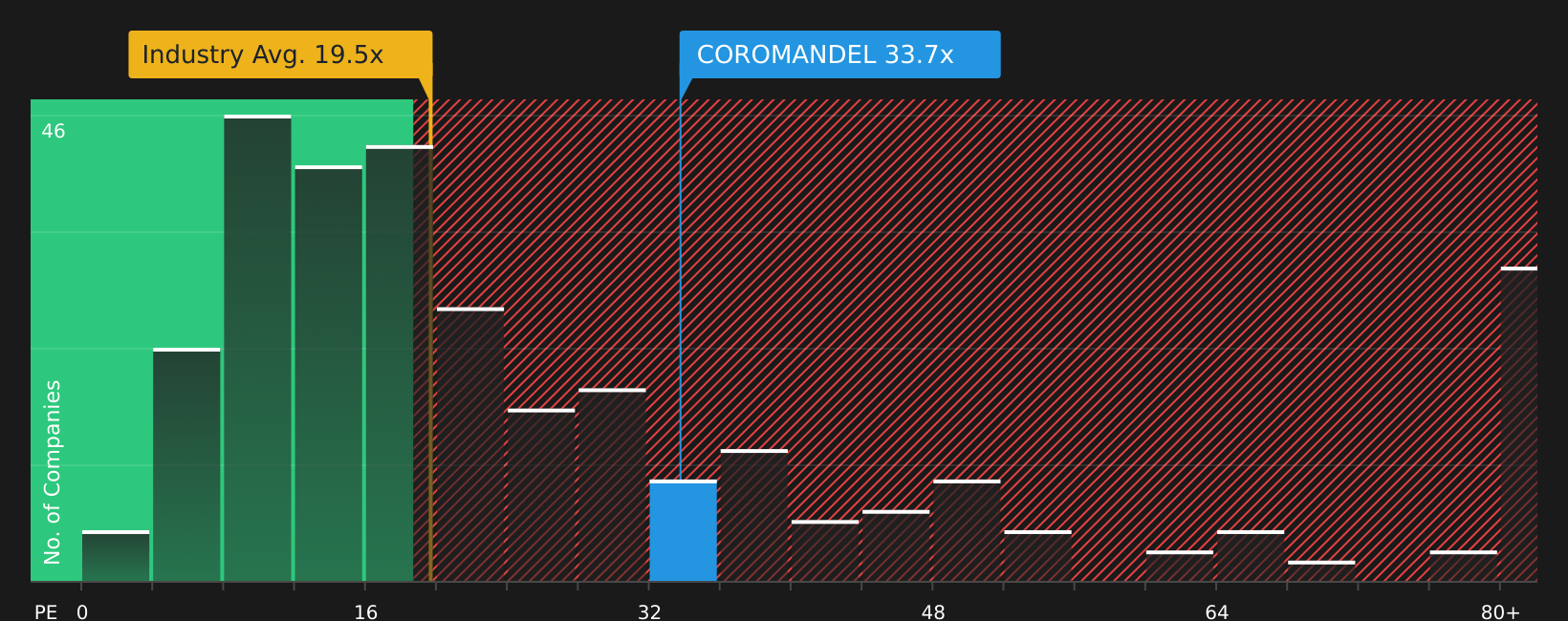
Coromandel International sits at the heart of India’s fertilizer and crop protection supply chain at a time when higher global grain prices and ongoing geopolitical risk are keeping food security in focus. The company is focusing on higher margin areas such as specialty nutrients, bio products and drones. It is also expanding further into Central and Northern India through retail and e commerce, which could change its earnings mix over time. At the same time, heavy reliance on government fertilizer subsidies and imported raw materials, together with a rich P/E multiple and weaker recent profit margins, leaves limited flexibility if policy or input costs move against it. That combination of opportunity and policy exposure is one reason many investors are watching the next few quarters closely.
Coromandel International is pushing into specialty nutrients, bio products and drones while carrying a rich P/E and subsidy dependence that many investors may be underestimating. See how the 1 key reward and 2 important warning signs could shift that risk reward picture
China XLX Fertiliser (SEHK:1866)
Overview: China XLX Fertiliser is a long established Chinese producer of urea based fertilizers and a range of related chemicals, selling into Mainland China and overseas markets. Alongside fertilizers, it produces methanol, liquid ammonia, melamine and other industrial products, and also has coal mining, power distribution and various ancillary services.
Operations: China XLX Fertiliser generates most of its revenue from fertilizers and chemicals, including about CN¥9.7b from urea, CN¥8.5b from compound fertilizers, CN¥6.8b from methanol and CN¥2.6b from liquid ammonia, with additional smaller contributions from melamine and other products.
Market Cap: HK$14.0b
China XLX Fertiliser provides direct exposure to nitrogen fertilizer demand at a time when higher grain prices and tighter global supply chains are in focus. Analysts anticipate earnings growth, with revenue forecast to rise faster than the broader Hong Kong market, while the stock trades at a P/E that is broadly in line with its estimated fair multiple. At the same time, net margins are thin, debt levels are high and the dividend is not well covered by free cash flow, so balance sheet risk may be a consideration. The company also has an inexperienced management team alongside a long tenured board. Overall, it is a business where potential for improving profits exists, but outcomes remain uncertain.
China XLX Fertiliser sits at the crossroads of thin margins, high debt and nitrogen exposure that many investors only half see. Read the 3 key rewards and 3 important warning signs and find out what might be hiding behind the dividend story.

Seeking Fresh Alternatives Before They Fly
Markets move fast and the best ideas rarely stay quiet for long. Spot fresh momentum stories and under the radar opportunities before the crowd catches up and consider acting sooner rather than later.
- Spot high yielding compounders that could support future income streams by screening for potential 441 dividend fortresses while valuations and payout profiles still look reasonable enough for long term holders.
- Track where AI spending might flow next and scan 55 AI infrastructure stocks while many infrastructure focused stocks remain under the radar for now.
- Hunt for stronger balance sheets before conditions tighten further by filtering through the list of solid balance sheet and fundamentals (428 results) and seeing which companies look built to handle tougher cycles.
This article by Simply Wall St is general in nature. We provide commentary based on historical data and analyst forecasts only using an unbiased methodology and our articles are not intended to be financial advice. It does not constitute a recommendation to buy or sell any stock, and does not take account of your objectives, or your financial situation. We aim to bring you long-term focused analysis driven by fundamental data. Note that our analysis may not factor in the latest price-sensitive company announcements or qualitative material. Simply Wall St has no position in any stocks mentioned.
Have feedback on this article? Concerned about the content? Get in touch with us directly. Alternatively, email editorial-team@simplywallst.com