
- PRICING
- LIVE QUOTES
- LEARN
- HELP


EN
IDC: Shipments in the Chinese tablet market in the second quarter were 7.96 million units, down 4.4% year on year
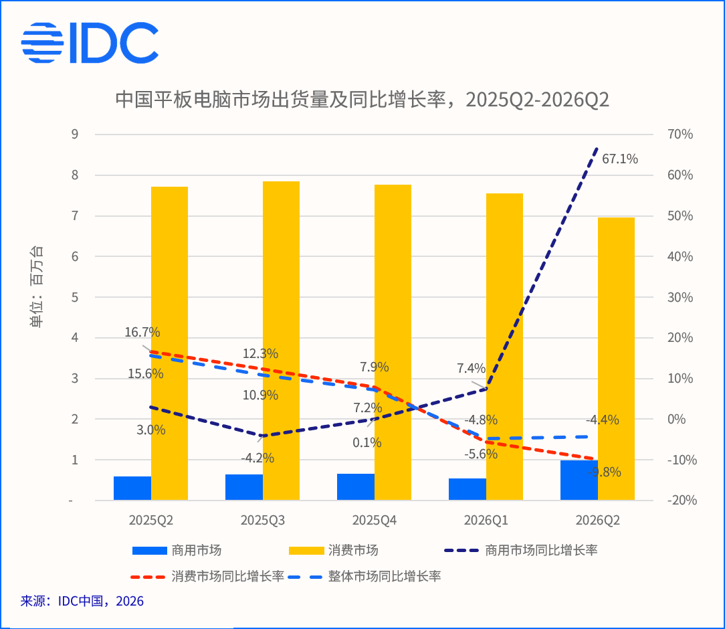
The Zhitong Finance App learned that the International Data Corporation (IDC) released a quarterly tracking report on the Chinese tablet market for the second quarter of 2026. According to the data, in the second quarter of 2026, the Chinese tablet market shipped 7.96 million units, down 4.4% year on year, and the decline was slightly narrower than in the first quarter. However, judging from market performance, market pressure has not abated; on the contrary, it has further increased. The sharp increase in the commercial market was mainly due to pre-demand in anticipation of price increases, while the consumer market declined 9.8% year over year due to factors such as rising costs and early release of demand. On the face of it, the market decline has narrowed; in fact, rising costs are being transmitted to the demand side at an accelerated pace.
Behind the high growth in the commercial market, the pre-demand characteristics are obvious
Commercial tablet market shipments increased 67.1% year-on-year in the second quarter of 2026, becoming an important force supporting the overall market. However, this round of growth is due more to early procurement in anticipation of delays in price increases by manufacturers and continued price increases. Enterprise customers and channel vendors concentrated on preparing goods, which boosted single-quarter shipments in the second quarter. As the commercial market starts to increase overall prices in July, subsequent channel inventory and delivery pace will be an important variable affecting market performance in the third quarter.
“618” is difficult to offset the impact of rising prices, and the consumer market has entered a period of adjustment
Shipments in the consumer tablet market fell 9.8% year on year in the second quarter of 2026. Although manufacturers and channels are actively deploying the “618 Promotion” to stimulate demand through new products and promotions, the impact of price increases has clearly exceeded the impetus brought about by promotions. At the same time, last year, the national supplement promoted the early release of demand, and the stark contrast between low prices and price increases further curtailed consumers' willingness to buy.
Rising costs have accelerated the differentiation of leading manufacturers, and there have been new changes in the market pattern
Along with the gradual consumption of low-priced materials, the impact of rising costs on manufacturers is further evident. There are differences in product layout, channel capabilities, and pace of dealing with price increases among different manufacturers, and there have also been some changes in market rankings and performance this quarter.
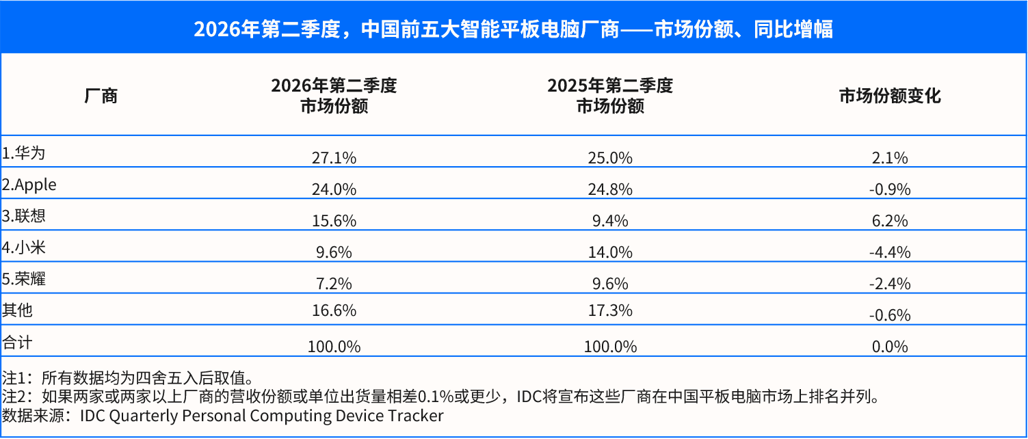
Huawei continues to rank first in the Chinese tablet market in terms of shipment volume, and its overall performance is relatively steady. The consumer side perfected the high-end product layout and deepened cooperation in learning scenarios through the MatePad Pro Max; the commercial side benefited from the channel's advance preparation and achieved a relatively rapid increase in shipment volume.
Apple is second in the market. The main sales period in the second quarter still maintained the original price, forming a certain price advantage before the price increase, but due to the gradual transmission of cost pressure, Apple raised the sales price of its tablet products at the end of June, and subsequent market challenges will increase.
Lenovo's shipment volume rose to third place in the market, and it is the manufacturer with obvious ranking changes among the leading manufacturers this quarter. The new products in the Savior and Xiaoxin series promoted the upgrading of their consumer product structure. The commercial side also maintained relatively rapid growth due to market accumulation and demand forecasting from major customers, which together led to an increase in overall shipments.
Xiaomi ranked fourth in the market. Although tablet shipments declined year-on-year under cost pressure, the decline narrowed somewhat. During the “618 Promotion” period, the Xiaomi Tablet 7 Series and 8 Series promotions received good sales feedback. At the same time, the two new Redmi K Pad 2 and Redmi Pad 2 SE products covered different price ranges, which stimulated the market to a certain extent.
Honor ranked fifth in the market. The low-end consumer tablet market has been impacted by rising costs, and shipments have shrunk markedly; at the same time, early stocking in education industry channels has driven its commercial tablet to continue to grow rapidly, which has become an important support for its tablet market performance during the season.
Overall, competition among leading manufacturers in the second quarter was no longer solely based on products and prices. In an environment of rising prices, the layout structure, channel capabilities, and operational efficiency of manufacturers are becoming important factors affecting changes in market share.
Follow-up outlook: Cost increases continue, and manufacturers seek price upgrades and demand balance
The impact of rising costs on the tablet market is expected to be further evident in the second half of this year and continue until next year. Price increases will extend the consumer switching cycle to a certain extent, and manufacturers may also cope with cost pressure by adjusting the pace of new product launches and product structure. Changes in both supply and demand in the market will jointly affect the overall scale. In the context of continuing cost pressure, consolidating the competitiveness of products in the mainstream price range of 2000-3000 yuan is the foundation for stabilizing the market size. Although the cost forces tablet prices to continue to rise, the value position of many consumers for tablets is still anchored in the 2000-3000 yuan range. The layout and increase in this range is the key to stabilizing the scale of shipments. Guiding demand to upgrade to the high-end price range of 3,000-5,000 yuan will become an important direction for manufacturers to improve product structures and ease cost pressure. Compared with simple price increases, manufacturers need to create more sufficient premium space for mid-range and high-end products through performance upgrades, expansion of usage scenarios, and enhanced AI capabilities. In the long run, rising costs may become a constant variable in the tablet market, and manufacturers need to find a new balance between cost transmission, product upgrades, and consumption affordability. Future market trends depend not only on whether manufacturers can support higher prices through product innovation, but also on whether consumers are willing to pay more for higher-end products and new usage scenarios.
Liu Yun, research manager at IDC China, said that in the second quarter of 2026, the year-on-year decline in shipments in the Chinese tablet market narrowed, but the actual market pressure due to rising costs further increased. The high growth in the commercial market is more reflected in demand ahead, while the consumer market has clearly been affected by rising prices. In the future, cost pressure will drive the upgrading of the market structure, and whether manufacturers can guide consumption upgrading through product innovation and scenario expansion will be the key to achieving a balance of scale and efficiency.