
- PRICING
- LIVE QUOTES
- LEARN
- HELP


EN
eToro (ETOR) Stock Looks Reasonable On Earnings While Shares Stay Weak
eToro Group stock has fallen sharply over the past year, yet the current market price still screens as cheap against both an intrinsic value estimate from the Excess Returns model and traditional valuation multiples. That combination puts the recent share price weakness and the current valuation message at odds for investors trying to assess what the stock is really pricing in.
- Over the past 12 months, eToro Group shares are down about 40.7%, which means recent buyers have faced a steep drawdown even as valuation indicators lean positive.
- The planned TradeZero acquisition and the roll out of eToro Work can support expectations for a broader US presence and product set. However, the additional share issuance to fund the deal may weigh on how much value ultimately accrues to existing shareholders.
- eToro Group currently passes 5 of 6 valuation checks. This suggests the broader assessment leans toward the stock looking inexpensive on Simply Wall St's 5 out of 6 value score.
The issue now is whether the current discount to intrinsic value reflects an opportunity for patient investors or a market view that the risks around execution and capital allocation are higher than they first appear.
Find out why eToro Group's -40.7% return over the last year is lagging behind its peers.
Is eToro Group Still Cheap on Excess Returns?
The Excess Returns model for eToro Group looks at how much profit the company can earn over and above its cost of equity and then capitalises that stream into a per share value. For eToro Group, the inputs point to a business that is expected to earn returns on equity above its required rate while growing its capital base moderately over time.
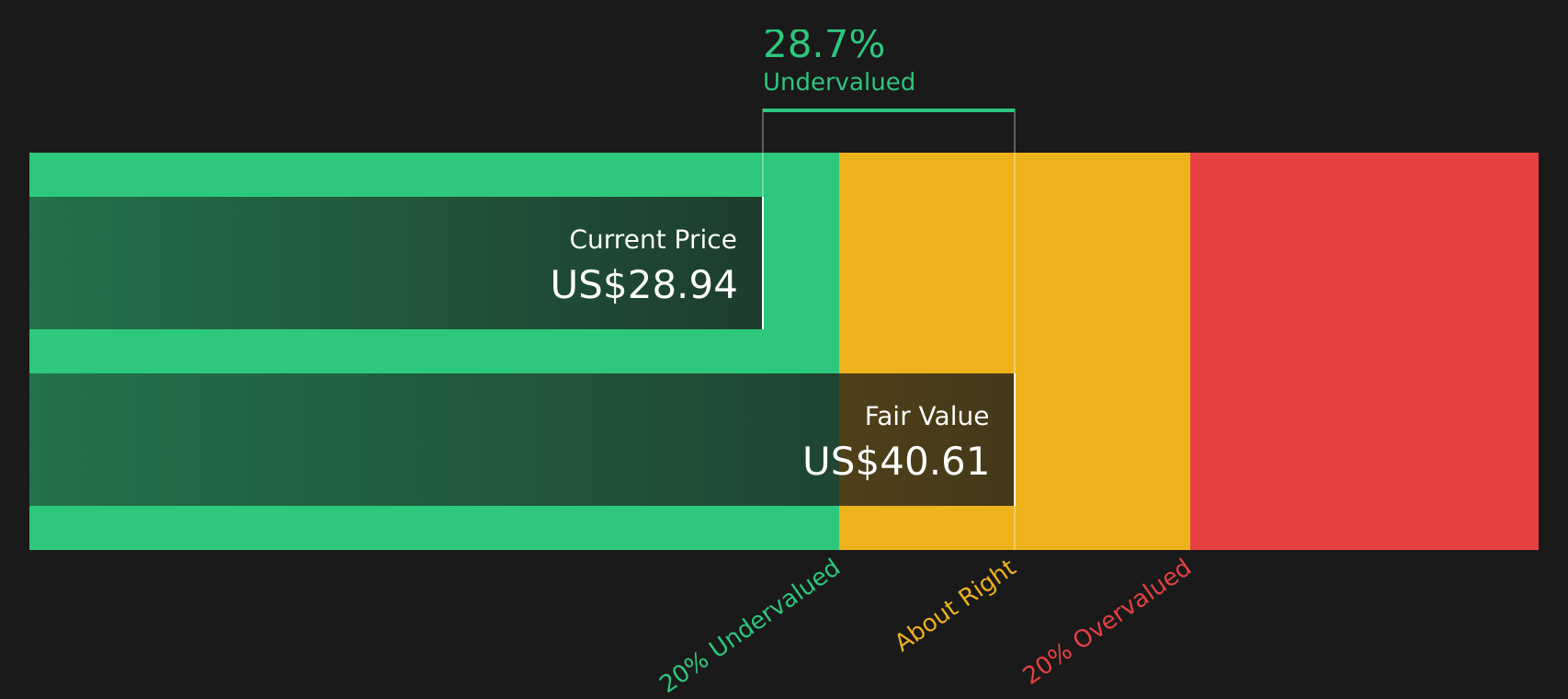
The model uses a Book Value of $16.69 per share and a Stable EPS of $3.14 per share, based on the median return on equity from the past 5 years, against a Cost of Equity of $2.00 per share. That leaves an Excess Return of $1.14 per share, supported by an average return on equity of 14.86% and a Stable Book Value of $21.12 per share, sourced from two analyst estimates. Together this produces an intrinsic value estimate of $40.94 per share. Compared with the current share price, the Excess Returns model implies eToro Group screens as about 30.5% undervalued. The sharp reaction to the planned TradeZero acquisition helps explain why the price trades below this model value despite the positive excess return profile.
On this Excess Returns view, eToro Group stock currently looks undervalued relative to what its projected profitability on equity would justify.
Our Excess Returns analysis suggests eToro Group is undervalued by 30.5%. Track this in your watchlist or portfolio, or discover 49 more high quality undervalued stocks.
Is eToro Group a Bargain on Earnings?
The P/E ratio fits eToro Group well because the company is currently profitable and analysts focus closely on earnings. Right now, eToro Group trades on a P/E of about 8.7x, which is well below the Capital Markets industry average of roughly 37.5x and also below the peer group average of about 16.8x.
The fair P/E ratio, which blends eToro Group’s earnings profile, sector, size and risk factors, is closer to 14.2x. That is noticeably higher than the current 8.7x level, which points to a sizeable gap between what the market is paying for each dollar of eToro Group earnings and what this framework suggests might be reasonable. Despite the recent share price reaction to the TradeZero acquisition announcement, the earnings multiple is still at a discount to both peers and this tailored fair value marker.
On the P/E yardstick, eToro Group stock currently appears undervalued compared with both its industry and the fair multiple implied by its earnings profile.

See what the numbers say about this price — find out in our valuation breakdown.
The eToro Group Narrative: What Would Justify Today's Price?
Simply Wall St Narratives for eToro Group pick up where the valuation puzzle leaves off. They lay out the specific growth, margin and earnings paths that would need to play out for eToro Group's stock to be worth materially more or less than its current price, and sit on the company's Community page. Where a single ratio or model gives one number, these narratives describe the future behind that number so you can watch whether it actually plays out.
You can add your voice to the Simply Wall St community by sharing a Narrative on eToro Group that sets out a clear, number driven view on whether the TradeZero acquisition and eToro Work offering justify where the stock trades today. It is a chance to spell out your thesis on eToro Group's earnings, capital allocation and US expansion, then track how it holds up as future results and news arrive.
Do you think there's more to the story for eToro Group? Head over to our Community to see what others are saying!
The Bottom Line
For eToro Group, both the Excess Returns intrinsic value estimate and the P/E based view currently point in the same direction and suggest the stock screens as undervalued. The high value score adds weight to that message, although it does not remove the need to think carefully about execution and capital allocation around TradeZero and eToro Work. The real dividing line between bulls and bears now is whether management can turn those initiatives into sustained, attractive returns on equity that justify a higher earnings multiple, rather than the market correctly treating the current discount as a sign of elevated risk.
This article by Simply Wall St is general in nature. We provide commentary based on historical data and analyst forecasts only using an unbiased methodology and our articles are not intended to be financial advice. It does not constitute a recommendation to buy or sell any stock, and does not take account of your objectives, or your financial situation. We aim to bring you long-term focused analysis driven by fundamental data. Note that our analysis may not factor in the latest price-sensitive company announcements or qualitative material. Simply Wall St has no position in any stocks mentioned.
Have feedback on this article? Concerned about the content? Get in touch with us directly. Alternatively, email editorial-team@simplywallst.com