
- PRICING
- LIVE QUOTES
- LEARN
- HELP


EN
Nvidia's Market Value Grew 24% Over the Past Year. Intel's Grew 474%.
Key Points
Intel's market value rose about 474% over the past year to roughly $510 billion, while Nvidia's grew about 24% to $5.4 trillion.
Roughly a sixth of Intel's market-value gain came from new shares rather than a higher stock price.
Nvidia earned $159.6 billion over the trailing year, while Intel reported an $11.3 billion loss dominated by a non-cash charge.
Over the past year, Nvidia (NASDAQ: NVDA) added about 24% to its market value, which now sits near $5.4 trillion as of this writing. Intel (NASDAQ: INTC) added about 474%, lifting its value to roughly $510 billion. On that measure, it isn't close.
But market value tracks two things at once: the share price and how many shares exist. These two gains are built differently.
Missed Nvidia in 2009? This Rare Signal Is Flashing Again. In 2009, a "Double Down" signal flashed for a little-known chipmaker called Nvidia. For the first time in years, that same "Total Conviction" signal is flashing for a company 1/100th the size of Nvidia. Continue »
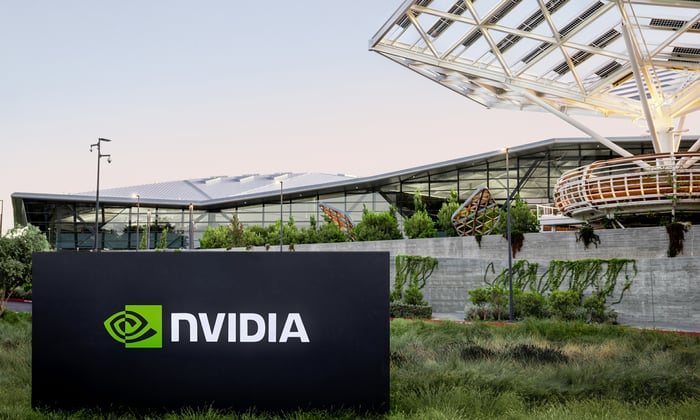
Image source: Nvidia.
Intel: a higher price and more shares
Intel's stock price is up roughly 400% over the past year, from around $20 to about $101 as of this writing. The rest of the market-value gain came from the share count, which grew by about a sixth (from about 4.4 billion shares to more than 5 billion). Much of the new stock was issued to the U.S. government under the company's CHIPS Act agreement, along with other new investors. And a shareholder who held Intel all year captured the price move, not the headline market-value move.
Of course, the higher price has substance behind it. Intel's revenue rose 25% year over year last quarter, its fastest growth in nearly 15 years. The run has not been smooth. Shares hit $142.35 at their peak over the past year and now trade about 29% lower.
The earnings, though, haven't arrived. Intel lost $11.3 billion over the trailing 12 months, and most of that reflects a $12.5 billion non-cash charge tied to shares held for the U.S. government. On an adjusted basis, the company earned $0.42 per share in the second quarter -- profitable, but arguably thin for a business now valued above $500 billion.
Nvidia: the earnings
Nvidia's 24% market-value gain looks modest next to that. But the chipmaker's trailing-12-month earnings came to $159.6 billion, more than double the year-earlier figure, on $253 billion of revenue. Trailing revenue rose about 71% as well.
Its market value grew slower than its profits did, which means the stock got cheaper over the stretch -- its price-to-earnings ratio now sits near 34.
Intel offers no such multiple. Its trailing earnings are negative, so the $510 billion valuation rests on what the foundry build-out and a supply constrained chip market could deliver in 2027 and beyond.
Nvidia earned about $160 billion over the year and ended the stretch cheaper against its profits than it began it. Intel delivered a return to fast revenue growth, a loss on paper, a sixth more shares outstanding, and a valuation that multiplied almost six-fold on the strength of what comes next.
Nvidia's gain came with the profits already in hand. Intel's still depends on them arriving.
Daniel Sparks and his clients do not have positions in any of the stocks mentioned. The Motley Fool has positions in and recommends Intel and Nvidia. The Motley Fool has a disclosure policy.