
- PRICING
- LIVE QUOTES
- LEARN
- HELP


EN
OPEC oil demand predicts four consecutive falls, difficult to pressure oil prices, and the double threat of Hormuz and the Red Sea supports energy risk premiums
The Zhitong Finance App learned that OPEC (OPEC)'s latest monthly report shows that OPEC lowered its forecast for global oil demand growth in 2026 to 580,000 barrels per day on Wednesday. This is the fourth time in a row that the organization has lowered this benchmark forecast at the global oil demand level.
Since the outbreak of the war in Iran, OPEC economists still believe that the extent of the geopolitical conflict's impact on oil consumption will not show a relatively pessimistic judgment from other forecasting agencies such as the International Energy Agency (IEA); the International Energy Agency predicts that oil demand will drop significantly in 2026.
According to a report published on the OPEC website, the Organization of Petroleum Exporting Countries (OPEC) also unexpectedly raised its forecast for oil demand growth in 2027.
The Organization of Petroleum Exporting Countries OPEC (“OPEC”) has 12 member countries: Algeria, the Republic of the Congo, Equatorial Guinea, Gabon, Iran, Iraq, Kuwait, Libya, Nigeria, Saudi Arabia, the United Arab Emirates, and Venezuela. The “OPEC+” organization is based on these 12 OPEC member states, plus 10 non-OPEC oil producers participating in the Declaration of Cooperation (DoC): Azerbaijan, Bahrain, Brunei, Kazakhstan, Malaysia, Mexico, Oman, Russia, Sudan, and South Sudan, so what people usually call OPEC+ has a total of 22 countries. But with the UAE's withdrawal from OPEC, the current number of OPEC+ countries is 21.
Currently, the core pricing contradiction in international oil prices is that “demand expectations continue to deteriorate” and “actual supply is still stuck in war,” yet the latter still has the upper hand. On August 12, the international oil price benchmark, the price of Brent crude oil was once reported at about 89.26 US dollars/barrel, rising for six consecutive trading days; WTI crude oil hovered around 83.77 US dollars/barrel and strengthened for 5 consecutive days. Previously, the two major benchmarks surged about 5% in a single day on August 10.
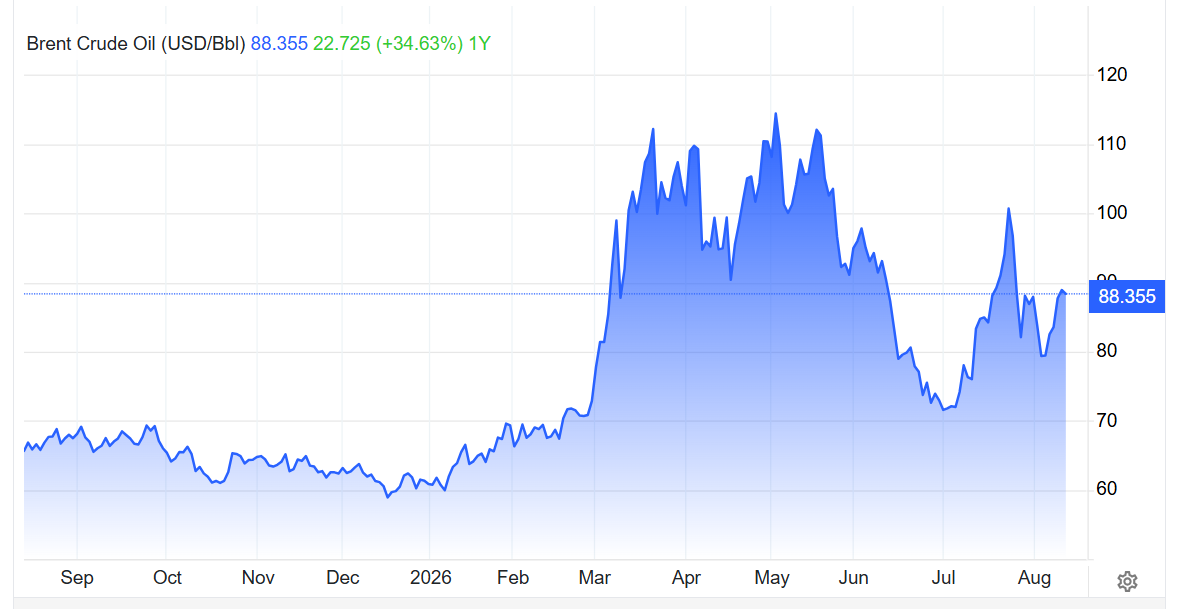
The latest worsening point of the Middle East situation has spread from a simple US-Iran war to two major global oil transportation arteries: the previous temporary cease-fire between the US and Iran has broken down, and Tehran said on August 12 that there are currently no so-called “extension of the cease-fire” negotiations; only 8 ships passed through the Strait of Hormuz on Tuesday, while about 125-140 ships per day before the war. The Houthis supported by the US and Iran also reported separate attacks on ships in the Strait of Hormuz and the Strait of Mander. Meanwhile, the Houthis announced a maritime blockade against Saudi Arabia on July 20, and attacked Saudi oil tankers, Yanbu facilities, and the Jazan refinery, forcing more and more Saudi Red Sea tankers to shut down AIS for “dark flights” or suspend their voyages; in other words, the market is now simultaneously facing the double logistics bottleneck of blocked exports to the east of Hormuz and rising risk of alternative routes to the west of the Red Sea.
OPEC lowered oil demand in 2026 from the previous 970,000 b/d and 780,000 b/d to 580,000 b/d, indicating that demand damage caused by high oil prices, war disrupts trade, and the global economy can no longer be ignored. However, the IEA is even more pessimistic. The latest direct forecast is that global oil demand will drop 1.6 million b/d year on year in 2026. There is an astonishing 2.18 million b/d demand judgment gap between the two. However, the IEA also lowered the 2026 global supply forecast to a reduction of 4.3 million b/d to 1020.2 million b/d. The annual supply is still about 1.27 million b/d less than demand; the gap in the third quarter reached 1.8 million b/d, the deepest quarterly gap since the fourth quarter of 2021. Middle East production in July was still 8.3 million b/d less than before the war.
As a result, the current oil market has a counterintuitive structure: demand damage itself is bad, but it is not enough to offset the larger supply damage caused by the war — this is why OPEC continues to lower demand, yet the price of Brent crude oil can still be supported at close to $90.
As far as the international oil price trajectory is concerned, it is still “dominated by geopolitical supply premiums” in the short term, and there is a very clear risk of a return to the mean in the medium term. As long as Hormuz cannot be steadily reopened, the Houthis continue to threaten Red Sea routes, and Middle Eastern crude oil production and shipping volumes cannot resume, the risk distribution of Brent crude oil prices remains skewed upward — any tanker attack, broken negotiations, or infrastructure damage could re-trigger the price impact of supply shortages, rising freight/insurance premiums, and expansion of refining profits.
But what we really need to be wary of is the risk of a reversal in 2027: the IEA assumes that after the geographical situation eases in the next few months, global supply in 2027 will in turn exceed demand by about 4.61 million b/d, enough to quickly rebuild the inventory that has accumulated during this year's war. In other words, the current crude oil is not a “bullish demand market” in the traditional sense, but a typical “supply-damaged bull market”; as long as the risk of war continues, it is difficult to knock down oil prices alone, but once there is a credible US-Iran cease-fire, the resumption of normal shipping in Hormuz, and a rapid return to production in the Gulf, the weak demand already revealed by OPEC and IEA will immediately become the biggest downside catalyst for oil prices.