
- PRICING
- LIVE QUOTES
- LEARN
- HELP


EN
Elon Musk Says Optimus Will Be a $10 Trillion Business. Here Are 2 Industrial Stocks That Could Actually Cash In
Key Points
Tesla isn't the only way to invest in humanoid robots.
Automation suppliers could benefit regardless of Tesla's success.
Pick-and-shovel stocks may offer steadier robotics exposure.
Elon Musk has never been shy about making bold predictions. But his latest may be one of the biggest yet.
Musk believes Tesla's (NASDAQ: TSLA) humanoid robot, Optimus, could eventually become a $10 trillion business, calling it potentially the company's most valuable product ever. The company is preparing to begin production of its first manufacturing-ready Optimus units this summer, while analysts expect robotics to dominate the company's long-term earnings discussion.
Missed Nvidia in 2009? This Rare Signal Is Flashing Again. In 2009, a "Double Down" signal flashed for a little-known chipmaker called Nvidia. For the first time in years, that same "Total Conviction" signal is flashing for a company 1/100th the size of Nvidia. Continue »
Whether Optimus ultimately reaches that valuation is impossible to predict. But you don't necessarily need to own Tesla to profit if humanoid robots become commonplace. Every robot deployed into a factory, warehouse, or distribution center will require automation software, motion controls, machine vision, sensors, and factory management systems.
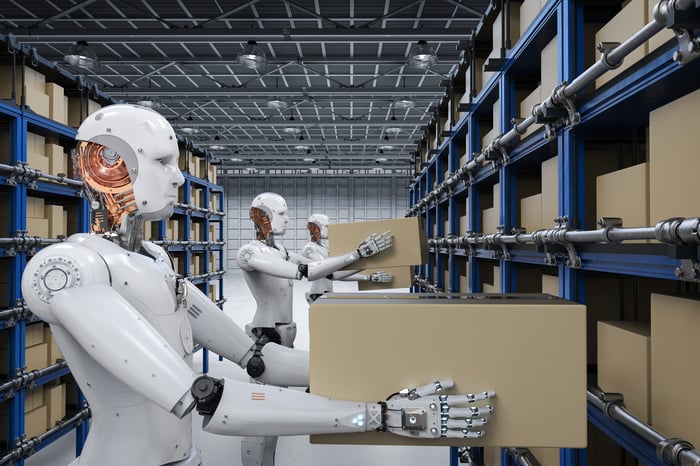
Image source: Getty Images.
That's where industrial automation companies come in. So here are two that could benefit regardless of which robot manufacturer ultimately wins.
1. Rockwell Automation
If factories become increasingly automated, someone has to connect everything. And that's what Rockwell Automation (NYSE: ROK) does. The company provides programmable logic controllers, industrial software, motion control, sensors, safety systems, and factory automation solutions used by manufacturers worldwide. Basically, Rockwell supplies much of the digital infrastructure that allows machines, robots, and production lines to communicate with one another.
To be sure, humanoid robots won't operate in isolation. They will need to interact with conveyor systems, packaging equipment, quality-control cameras, inventory software, and existing industrial machinery. Integrating all those systems is exactly the type of work Rockwell has been doing for decades.
The company is also leaning heavily into artificial intelligence (AI). Management has identified industrial AI as one of its primary acquisition priorities while expanding AI-enabled design, logistics, autonomous operations, and recurring software services, which have become an increasingly important part of Rockwell's business because they produce steadier revenue than one-time equipment sales.
Financially, Rockwell the company remains in excellent shape, too. Management continues targeting free cash flow conversion of roughly 100%, return on invested capital above 20%, and earnings growth that outpaces revenue growth over the long term. Those aren't the numbers of a speculative robotics start-up. They're the characteristics of a mature industrial company positioning itself for the next automation cycle.
2. Teradyne
Most investors know Teradyne (NASDAQ: TER) as a semiconductor testing company. But its robotics business could become increasingly important.
Through its Universal Robots and Mobile Industrial Robots (MiR) divisions, Teradyne already sells collaborative robotic arms and autonomous mobile robots used in manufacturing, logistics, and warehouse operations.
Unlike traditional industrial robots that typically work inside safety cages, collaborative robots are designed to work alongside people. The reason I mention this is because many companies are expected to adopt humanoid robots gradually, integrating them into existing workflows rather than replacing entire production lines overnight.
Indeed, Teradyne's experience in collaborative automation gives it a front-row seat to that transition. And demand already appears to be improving.
The company recently pointed to stronger automation spending and growing demand for robotics as manufacturers continue to upgrade facilities despite broader economic uncertainty. At the same time, AI-driven manufacturing is accelerating investment in robotics, machine vision, and intelligent factory software.
Teradyne also benefits from diversification. Its semiconductor testing business remains tied to long-term growth in AI chips and advanced electronics, while its robotics segment provides additional exposure to factory automation. To put it simply, you don't have to bet solely on humanoid robots for the Teradyne thesis to work.
Pick-and-shovel plays
Humanoid robots may eventually become a huge business -- or not. Either way, factories are becoming smarter, warehouses are becoming more automated, and manufacturers are increasingly using AI to improve productivity.
Those trends were already underway long before Tesla introduced Optimus, which is why I maintain that the companies supplying the picks and shovels of industrial automation may prove to be among the more reliable ways to invest in the robotics revolution.
Even if Musk is partially correct about the scale of humanoid robotics, companies providing factory software, motion controls, industrial sensors, collaborative robots, and automation infrastructure could see demand grow alongside every robot that enters the workforce.
Yes, Tesla may build the robots. But Rockwell Automation and Teradyne could end up supplying much of the technology that allows those robots to do useful work.
Jeff Siegel has no position in any of the stocks mentioned. The Motley Fool has positions in and recommends Teradyne and Tesla. The Motley Fool recommends Rockwell Automation. The Motley Fool has a disclosure policy.